Barnacle and mussel settlement in Sarasota County: what your hull is up against by location
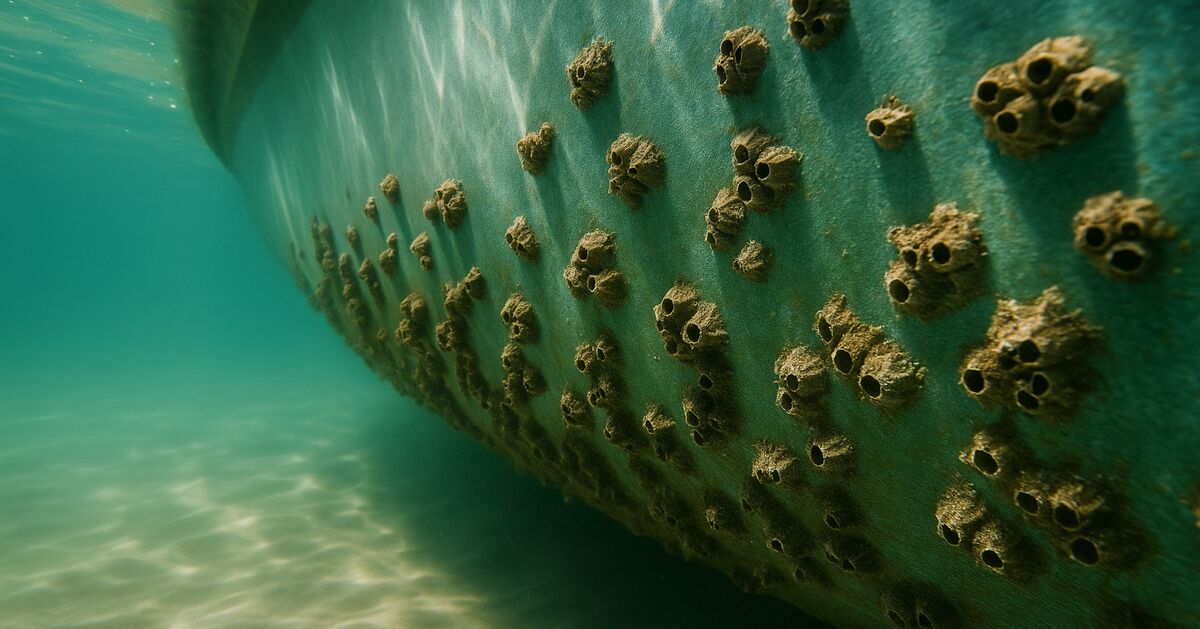
Barnacles don't care where you'd like to keep your boat. They care about salinity, water temperature, current speed, and how long your hull sits still - and in Sarasota County, those four variables change dramatically from one location to the next. A boat docked at a protected marina slip in Sarasota Bay can pick up a completely different biofouling community than a boat moored off Siesta Key or sitting on a lift at a Casey Key canal. Understanding those differences is how you stop guessing at a hull-cleaning schedule and start building one that actually matches where you keep your boat.
Why settlement biology matters before we talk about schedules
Biofouling is not a single event. It is a layered process. First, a thin biofilm of bacteria and diatoms coats your hull within hours of launch. That biofilm is invisible, but it is the welcome mat that makes everything else stick. Barnacle cyprids and zebra mussel veligers (their free-swimming larvae) actively sense chemical signals from that biofilm and preferentially settle on surfaces that already have one.
That means a hull that has been sitting in the water for even a few days is already more attractive to larvae than a freshly cleaned one. By day seven to fourteen in warm Gulf Coast water, you can start to see the early calcareous plates of young barnacles with the naked eye. At 30 days, a neglected hull in the wrong location can carry a colony dense enough to measurably increase drag.
The species you are most likely to encounter in Sarasota County waters are:
- Amphibalanus amphitrite (striped barnacle) - the dominant foul-weather generalist, tolerates a wide salinity range
- Amphibalanus eburneus (ivory barnacle) - prefers lower salinity, very common in upper-bay and canal environments
- Megabalanus coccopoma (titan barnacle) - a large, aggressive invasive species spreading up Florida's Gulf Coast; its settlement seasons are intense and brief
- Dreissena rostriformis bugensis (quagga mussel) and related dreissenids - far less common in true saltwater but a real concern in the freshwater-influenced reaches of some inland canals
None of these organisms are evenly distributed. They cluster where conditions favor them, and those conditions vary block by block across the county.
How salinity shapes who settles where
Sarasota County sits at an interesting hydrological point. The Gulf of Mexico directly offshore runs at roughly 36 parts per thousand (ppt) salinity. But the county's bays and waterways are not simple buckets of seawater. Big Sarasota Pass, New Pass, and Venice Inlet all act as exchange valves, and the bays behind them are diluted by freshwater from creeks, stormwater outflows, and rainfall.
Roberts Bay and Little Sarasota Bay (the stretch from Nokomis down through Osprey toward Venice) receive freshwater input from Shakett Creek and other tributaries. In a rainy summer, salinity in the upper reaches of these bays can drop to 15 to 20 ppt. That range is too low to support the titan barnacle comfortably but is nearly ideal for ivory barnacles and for dreissenid mussels if they ever establish a local breeding population. If you keep your boat in a canal off Nokomis or Osprey, you may see fewer barnacles overall but a harder, more cement-like crust of ivory barnacles that bonds tenaciously to fiberglass.
Sarasota Bay proper, the stretch between Sarasota and Longboat Key, maintains higher and more stable salinity because it exchanges freely with the Gulf through New Pass and Longboat Pass. Here you get the full roster: striped barnacles year-round and periodic intense settlement pulses of titan barnacles, especially after a warm winter. Boats docked in the marinas along the Sarasota city waterfront, or in slips off Bird Key and Lido Key, are in some of the highest-salinity, highest-productivity fouling zones in the county.
The back-bay areas of Siesta Key and Casey Key tell yet another story. The channels between the keys and the mainland are relatively shallow and experience strong tidal flushing twice a day. That flushing delivers a constant fresh supply of larvae from the open Gulf, which keeps settlement pressure high. The shallowness also means water temperature in summer can climb several degrees above open-Gulf temperatures, and barnacle larvae are extremely sensitive to temperature cues. Warmer water shortens the time between settlement pulses. A boat in a slip off Siesta Key in July and August can go from clean bottom to heavy fouling in three to four weeks without proper antifouling protection.
Marina slips versus open moorings versus lifts
Where you physically keep your boat matters as much as which bay it is in.
Enclosed marina slips create microenvironments that differ from the surrounding bay. Water circulation is reduced. Nutrient-rich water (think runoff, boat-wash residue, fish cleaning stations) gets trapped. Higher nutrients feed the phytoplankton that barnacle larvae and mussel veligers eat. The biofilm forms faster. Settlement follows faster. In our experience across Sarasota County marinas, boats in interior finger slips with limited through-flow foul significantly faster than boats on end-ties or on docks with strong tidal current.
Open mooring fields expose hulls to more current, which dilutes larvae and makes it harder for them to complete the settling process. The tradeoff is that your hull is always wet and always exposed. Boats on moorings in Sarasota Bay or off Lido Key generally have moderate settlement rates but very consistent ones. There is rarely a "slow season" the way there is for boats on lifts.
Boat lifts are the most effective biofouling management tool available to the average boat owner in Sarasota County, but they are not perfect. Hulls stored on lifts still get wet during launches and should still be cleaned on a schedule. More critically, the cradle pads and the portion of the hull near the waterline when the boat is lowered for use accumulate growth quickly. We frequently find that lift owners are shocked at how much growth has crept up to the waterline stripe even when the rest of the bottom looks clean.
Seasonal settlement pulses to mark on your calendar
Sarasota County sees two main barnacle settlement peaks annually, driven by water temperature and phytoplankton blooms:
- April through June - water warms from the winter lows, triggering a major spawning pulse for most barnacle species. This is often the heaviest settlement window of the year.
- September through October - a secondary pulse as summer heat breaks and nutrients from summer rain events create ideal conditions.
The titan barnacle (Megabalanus coccopoma) behaves somewhat differently. Its settlement is more episodic and tied to larval transport events from offshore. You can go a whole season with very few titan barnacles and then find a bloom of them covering your hull after a sustained onshore current event. When they do settle, they grow fast and their base plates can literally delaminate gelcoat and antifouling paint as they are removed. Catching them early, before they reach the size of a pencil eraser, saves you significant refinishing cost.
What this means for your hull-cleaning schedule by location
There is no one-size-fits-all number of days between cleanings. Here is a practical framework based on what we see across the county:
High-pressure zones (Sarasota city waterfront, Bird Key marinas, enclosed Longboat Key slips, back-channels of Siesta Key): Clean every 30 to 45 days in summer, 45 to 60 days in winter. If you see any visible growth at 30 days, tighten the interval. Do not wait.
Moderate-pressure zones (open mooring in Sarasota Bay, Lido Key docks with good tidal flow, outer Osprey and Nokomis docks on Roberts Bay): Every 45 to 60 days in summer, 60 to 75 days in winter is often workable, but you should do an inspection dive or visual check monthly.
Lower-pressure zones (inland canals with significant freshwater dilution, boats on lifts used regularly): Every 60 to 90 days for the bottom is reasonable, but prioritize the waterline band and check the hull every 45 days regardless.
If you are uncertain, err on the side of cleaning sooner. A hull cleaned before growth is fully established takes a fraction of the labor that a hull with hard, cemented barnacle colonies does. That matters for the condition of your antifouling paint, and it matters for your wallet.
You can read more about how antifouling paint choices interact with these growth patterns in our post on choosing the right bottom paint for Sarasota County waters, which covers how ablative versus hard paints perform differently depending on your vessel's activity level and home slip.
Common mistakes that make fouling worse
Letting the boat sit still for extended periods. Water movement over a hull is mildly deterrent to settlement. A boat that gets used regularly, even for a short run, disrupts early-stage larvae. Boats that sit unmoved for weeks invite heavier colonization.
Skipping cleaning because "the boat looks okay from the dock." Barnacle plates are often translucent when young and nearly invisible until they calcify. By the time you can clearly see them at arm's length, they have been attached for weeks and are beginning to harden. An inspection from in the water, or a quick dive, tells you far more than a glance over the rail.
Using the wrong tool for removal. Aggressive scraping on a hull that still has viable antifouling paint can abrade away the very layer that is supposed to deter future settlement. Soft barnacle growth should be removed with a plastic hull brush or a medium pad, not a metal scraper. Hard, cemented colonies need professional assessment before you attack them blindly.
Ignoring the running gear. Propellers, shafts, and trim tabs foul as fast or faster than the hull, and growth on a prop directly translates to vibration, cavitation, and fuel consumption. The fouling biology on running gear is the same as on the hull, but the consequences of ignoring it show up in your boat's performance immediately.
For a broader look at the full scope of what professional hull and bottom cleaning involves, our boat cleaning and detailing services page walks through what each service tier covers.
How to tell if your schedule is already off track
A few practical signs that fouling has gotten ahead of you:
- Your boat feels sluggish at cruise RPM and you have not changed fuel load or trim
- You notice a slight vibration at speed that was not there before (prop growth)
- You can feel texture on the hull below the waterline when you run a hand along it at the dock ladder
- Your fuel burn per hour has crept up without an obvious mechanical explanation
If any of these match what you are experiencing, it is worth getting a professional underwater inspection sooner rather than later. We serve boat owners across all of Sarasota County's waterways, from Venice and Nokomis up through Osprey, Casey Key, Siesta Key, Lido Key, Bird Key, Longboat Key, and Sarasota proper.
Building a smarter maintenance calendar
The best approach is to stop thinking about hull cleaning as a single annual or semi-annual event and start treating it like a seasonal maintenance check. Build your calendar around:
- A clean start at the beginning of the April settlement pulse (late March cleaning)
- A follow-up inspection or cleaning at six to eight weeks into the season
- A pre-fall-pulse cleaning in late August or early September
- A winter inspection cleaning after the worst of the fall pulse has passed
If you keep your boat in a high-pressure marina environment, add an extra interval in July. If you are on a lift and use the boat frequently, your schedule will lean toward the lighter end, but do not skip the waterline inspection.
Our FAQ page has answers to some of the most common questions we hear from boat owners about cleaning frequency, what growth removal does to paint, and how to plan around haul-out schedules.
The bottom line is straightforward: your hull cleaning schedule should be dictated by where your boat actually lives, not by a generic calendar someone handed you at the marina. Sarasota County's waterways are diverse, and the biofouling pressure they produce is equally diverse. Know your location, watch for the settlement pulses, and act before growth gets the chance to calcify. Your hull, your antifouling coat, and your fuel bill will all be better for it. If you have questions about what you are seeing on your specific hull or want to talk through a schedule that fits your slip location, get in touch with us and we are happy to take a look.