Why boat upholstery cracks and fades so fast on the Gulf Coast
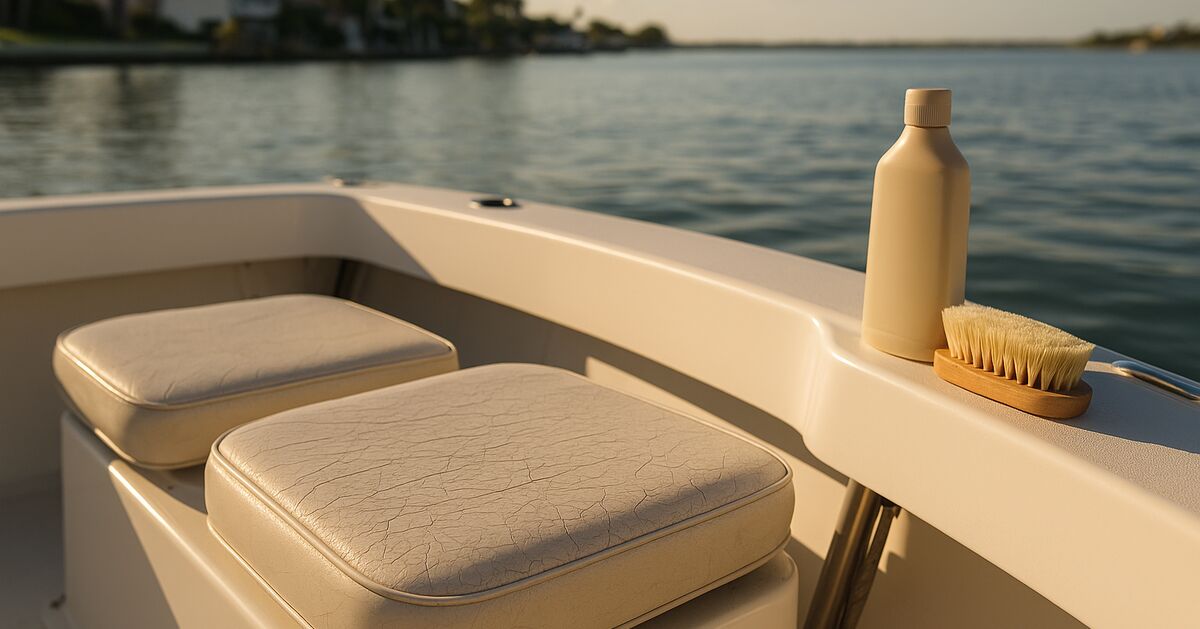
Salt spray, brutal UV, and back-to-back humid nights are a terrible combination for boat seats, and if you keep your boat anywhere from Longboat Key down to Venice, you already know this firsthand.
Most boat owners notice the damage in stages. First the color starts to look a little washed out. Then the surface develops a network of fine cracks, almost like dried mud. Then chunks of the vinyl start to peel away, and at that point the conversation shifts from "can we fix this?" to "how much does a full reupholster cost?" The good news is that there is a wide window between early fade and total failure, and professional reconditioning can bring seats back from surprisingly rough shape. The key is understanding what is actually happening to the material and acting before the damage becomes structural.
Why Gulf Coast conditions destroy upholstery faster than anywhere else
Marine vinyl is designed to handle sun and moisture, but there is a ceiling on what any synthetic material can absorb before it starts to break down. On the Gulf Coast, that ceiling gets hit fast for a few compounding reasons.
UV radiation is relentless. Sarasota averages around 250 sunny days a year, and the UV index during summer afternoons regularly hits the "very high" or "extreme" range. UV light attacks the plasticizers inside vinyl. Plasticizers are the chemical compounds that keep vinyl soft and pliable. As UV radiation breaks them down, the material loses flexibility. The vinyl cannot stretch when you sit on it, or when the seat heats up and cools down through daily temperature swings, and eventually it cracks.
Heat amplifies the damage. Dark-colored vinyl on a boat sitting in a Sarasota marina in July can reach surface temperatures well above 150 degrees Fahrenheit. At those temperatures, the degradation of plasticizers accelerates sharply. A seat that might last five or six years in a milder climate can show serious cracking in two to three years here.
Salt is a slow acid. Salt crystals deposit on every surface of a boat after every outing and even just sitting dockside in salty air. When those crystals dry, they are mildly abrasive and chemically active. Over time, repeated salt exposure and the moisture cycling that comes with it (wet, dry, wet, dry) breaks down surface coatings and stitching. Seams fail before the vinyl panels do in many cases, and once water gets into the foam underneath, you have a new set of problems including mold, mildew odor, and eventually structural softness in the seat base.
Mildew attacks from below. Boats kept in covered slips or under a bimini still experience high humidity. The underside of seat cushions and the foam cores stay damp between uses. Mildew colonies digest the backing material of vinyl, weakening it from the inside out. This is why you can sometimes pull a seat cushion up and find black mildew staining on the bottom of a seat that looks acceptable on top.
Sunscreen and insect repellent are surprisingly destructive. DEET-based repellents and some sunscreen formulas are genuinely corrosive to marine vinyl. Owners who sit down in the cockpit right after applying these products transfer them directly to the seating surface. Over a season, the chemical damage adds up in ways that look similar to UV cracking.
What "reconditioning" actually means, step by step
When a professional talks about reconditioning upholstery, they are describing a process, not just a product. Here is what that process involves when done correctly.
Deep cleaning the surface
You cannot condition or repair a dirty surface. The first step is a thorough cleaning with a pH-neutral marine vinyl cleaner, applied with a soft-bristle brush to work into the texture of the material. This removes salt residue, body oils, sunscreen residue, mildew staining on the surface, and the grime that accumulates in the stitching channels and seam lines.
Mildew staining on the surface is treated separately with a diluted cleaner appropriate for vinyl, applied with care to avoid bleaching the color. Pressure washing is not part of this process. High-pressure water forces moisture into seams and tears at stitching.
After cleaning, the surface is rinsed thoroughly and allowed to dry completely before anything else is applied. Conditioning a damp surface traps moisture underneath the treatment, which creates exactly the conditions mildew needs to thrive.
Assessing what you actually have
Once the vinyl is clean and dry, a proper inspection tells you what you are working with. A professional will check for:
- Surface cracking (fine networks of cracks versus deep cracks that go through to the backing)
- Peeling or delamination at seams and edges
- Seam integrity (stitching that has rotted or pulled through)
- Foam compression and moisture retention in the cushion beneath
- Discoloration that is reversible versus fading that has gone too deep to restore
- Any tears or punctures
This assessment determines whether reconditioning is the right call or whether replacement of specific panels is necessary. Sometimes one seat bottom is beyond saving while the rest of the upholstery has years of life left. A good technician is honest about the line between what conditioning can fix and what it cannot.
Plasticizer restoration and conditioning
This is the core of the reconditioning process and the step that most DIY efforts skip or do improperly. A quality vinyl conditioner does not just coat the surface with a shiny film. A good product penetrates the vinyl matrix and partially restores the plasticizer content that UV has depleted, which is what brings the flexibility back.
The conditioner is worked into the surface thoroughly, allowed to absorb for the recommended dwell time, and then buffed to remove any excess. Leaving too much product on the surface makes it slippery and actually attracts more dirt. A properly conditioned seat should feel soft and slightly matte, not greasy.
This step needs to be repeated regularly to maintain the benefit, because the product will continue to slowly offgas and deplete in the sun. Think of it like moisturizer for the vinyl.
Color restoration and UV-protective topcoat
When vinyl has faded significantly, a vinyl color restorer can bring back much of the original depth and evenness. These products are not paint. They are pigmented conditioners formulated to bond with the vinyl surface and restore color while maintaining flexibility. Applied correctly, they look natural and do not crack or peel the way paint would.
After color restoration, a UV-protective topcoat seals the work and dramatically slows future degradation. This is the layer that fights the next round of sun damage. Quality UV protectants used by professionals are quite different from the silicone-heavy spray products sold at gas stations, which can actually make vinyl more brittle over time by coating the surface without allowing it to breathe.
Seam and edge repairs
Stitching that has rotted or pulled free gets re-stitched using UV-resistant polyester thread. Marine upholstery thread is a small but important detail: cotton thread rots in months in this environment. Edges that have started to peel are re-bonded with a contact cement rated for vinyl. Small tears can often be repaired with a vinyl repair kit that includes a heat-activated patch and color-matched pigment.
None of these repairs are invisible under close inspection, but on a working boat in everyday light they are practically undetectable and they stop the damage from spreading.
What reconditioning cannot do
Honesty matters here. If the cracks have gone all the way through the vinyl and you can see the backing or foam beneath, no conditioner will bridge that gap permanently. If the foam core is saturated with mildew and has compressed flat, sitting on the cushion will feel like sitting on a board and the mildew smell will come back no matter what you put on the surface. If large sections have delaminated or stiffened so thoroughly that the vinyl no longer bends at all, replacement of those panels is the right answer.
The goal of reconditioning is to intervene before you reach those conditions. If you are looking at seats that are faded and showing surface cracks but still have intact seams and cushions that have some life left in them, you are in good territory for a professional recondition to add several years to their lifespan.
How often does this need to happen in Sarasota's climate?
Given the UV intensity and salt exposure that boats face from Siesta Key and Lido Key marinas to the quieter docks along Casey Key and the Osprey waterfront, once a year is a reasonable maintenance interval for vinyl conditioning on an actively used boat. Boats that sit under a bimini or in covered storage can stretch that interval somewhat, but they still benefit from at least an annual cleaning and condition treatment.
If your boat is kept on a lift exposed to full sun, twice a year is not excessive. Our boat cleaning and detailing services include upholstery care as part of comprehensive detail packages, and we can advise you on the right interval based on your specific storage situation and how hard you use the boat.
Owners across our service area, from Sarasota to Longboat Key to Nokomis, tend to underestimate how fast the UV damage accumulates simply because they are used to seeing their own boat every day. The change is gradual enough to miss until it is significant.
What you can do between professional treatments
Between professional visits, a few habits make a real difference:
- Rinse the seats with fresh water after every saltwater outing. Salt crystals left to dry and cycle through wet-dry cycles are the enemy.
- Avoid leaving wet towels or wetsuits on vinyl seats. Trapped moisture under fabric speeds up mildew growth underneath the vinyl surface.
- Apply a consumer-grade UV protectant (one specifically labeled safe for marine vinyl) every four to six weeks.
- Keep DEET-based bug spray away from the seating. Apply it before boarding and let it dry on skin before sitting down.
- Use a boat cover or bimini whenever the boat is not in use. Even partial shade makes a measurable difference in how fast plasticizers degrade.
These steps do not replace professional treatment, but they meaningfully slow the degradation between sessions.
How this fits into overall boat care
Upholstery is just one surface that takes a beating out here. If you are already thinking about vinyl, it is worth thinking about the other surfaces at the same time. Our posts on cleaning and protecting your boat's canvas and bimini top and on restoring your boat's windshield and isinglass cover adjacent surfaces that typically deteriorate on a similar timeline and for the same reasons. Taking a whole-boat approach to UV and salt protection tends to be more cost-effective than addressing each surface as it fails one at a time.
You can also find answers to common questions about timing and maintenance intervals on our FAQ page, or get in touch if you want an honest assessment of what your current upholstery actually needs.
The Gulf Coast is a wonderful place to own a boat. The conditions just require more intentional maintenance than most other parts of the country, and the owners who accept that early on tend to spend far less in the long run than those who wait until replacement is the only option left.