Ceramic coating on boats: wet slip vs. lift in Sarasota County
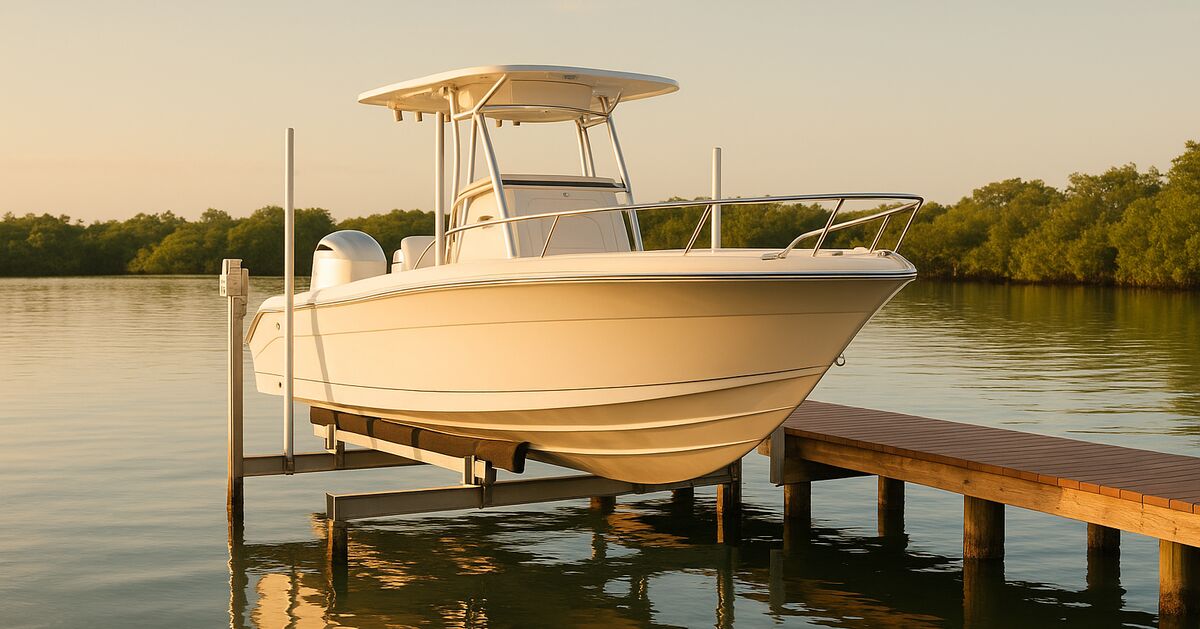
Ceramic coating is not magic, and where your boat lives matters just as much as the product being applied. Two boats moored a quarter-mile apart, one bobbing in a wet slip at Marina Jack and one sitting on a lift behind a home on Longboat Key, will put that coating through completely different stresses. Understanding why helps you decide whether a ceramic coating is the right call for your situation, and sets realistic expectations before you spend the money.
What ceramic coating actually does on a boat
Before comparing storage situations, it helps to be clear about what a marine ceramic coating is and is not. A ceramic coating is a liquid polymer, usually silica-based, that bonds chemically to the gelcoat or paint surface and cures into a hard, hydrophobic layer. It sheds water, resists UV oxidation, makes cleaning dramatically easier, and gives the hull a deep, glassy shine that wax simply cannot match in durability.
What it does not do is stop barnacles from colonizing a hull below the waterline. It is not bottom paint, and it is not a substitute for antifouling chemistry. That distinction is the first thing to understand when comparing wet-slip and lift scenarios, and it shapes almost everything that follows.
Our full boat cleaning and detailing services page covers the range of options available, including surface prep, polishing, and coating applications.
The wet-slip environment: what a coating is fighting
A wet-slip boat in Sarasota County is in the water around the clock. That means the waterline and everything below it is constantly exposed to warm, brackish or full-salt water, and Sarasota Bay and the surrounding Gulf waters run warm for the better part of nine months a year. Warm water is biologically aggressive. Algae, slime, barnacles, and mussels all colonize faster in water that stays above 70 degrees Fahrenheit than in cooler northern waters.
For the above-waterline surfaces, a ceramic coating on a wet-slip boat earns its keep every day. The topsides, freeboard, and deck are hit by:
- Constant splash and spray that leaves salt crystals behind as the water evaporates
- Bird droppings, which are highly acidic and attack unprotected gelcoat quickly
- UV radiation that in Southwest Florida is intense essentially year-round
- Dock lines and fender scuffs that become ingrained grime without a slick protective layer
- Humidity-driven mildew that colonizes any surface that stays damp and poorly protected
A well-applied ceramic coating on the above-waterline surfaces of a wet-slip boat creates a barrier that resists all of these. Salt rinses off more easily. Bird droppings can be wiped away before they etch. UV degradation slows noticeably. The boat stays cleaner between washes, and when it is washed, the effort required is a fraction of what bare or waxed gelcoat demands.
The problem is at and below the waterline. No ceramic coating should be applied below the waterline on a wet-slip boat without antifouling bottom paint already in place. Even then, ceramic coatings do not belong on top of ablative bottom paints (the soft kind that wears away to release biocides), because the coating would prevent the ablation. Ceramic coatings are sometimes applied on hard, non-ablative bottom paints with mixed results, but the coating itself provides zero antifouling protection. The biology does not care how hydrophobic your surface is.
The practical takeaway: on a wet-slip boat, ceramic coating is a powerful investment for everything above the waterline, and essentially irrelevant, or even counterproductive, below it.
If you want to understand what a hull is actually up against biologically in these waters, the post on barnacle and mussel settlement in Sarasota County is worth reading before making any coating decisions.
How a wet slip shortens coating lifespan above the waterline
Even above the waterline, a wet-slip environment is harsher than lift storage in some specific ways. Here is what shortens a coating's effective life on a boat that lives in the water:
Constant humidity. Gelcoat that never fully dries is a less stable substrate than one that dries out regularly. Moisture can work under the edges of any coating imperfection and accelerate delamination over time.
Dock contact. Boats in slips move with wakes and wind. Fenders compress and shift. Over months, the contact zones on the hull where fenders press repeatedly will wear through the coating faster than open surfaces.
Waterline chemistry. The zone right at the waterline is the harshest spot on any boat. Minerals precipitate, tannins stain, and biological slime establishes itself exactly at this line. The coating in this zone works extremely hard and wears faster than it does higher on the hull. On a wet-slip boat, that waterline never rests.
Less opportunity for maintenance. A boat in a slip is harder to pull out of the water and inspect than one on a lift. Small chips, stains, or spots where the coating has worn thin are easy to miss until they become big problems.
Despite these factors, a wet-slip boat still benefits substantially from a quality ceramic coating. It just benefits more from careful maintenance and more frequent inspections than a lift boat would.
The lift environment: why the case for ceramic coating is stronger here
A boat on a lift, whether a free-standing aluminum lift beside a dock in Osprey, a hydraulic floating lift in a canal off Casey Key, or a suspended cradle behind a home on Bird Key, spends the great majority of its time out of the water. It only gets wet when it is running. That single fact changes the coating calculus dramatically.
On a lift boat, a ceramic coating is protecting against:
- UV radiation on every surface, every day the sun is shining
- Salt air, which is relentless and corrosive even without direct water contact
- Occasional rain and morning dew, which bring dissolved salts back to the surface as they dry
- Bird activity (lifts are popular perches)
- Dry oxidation, the chalky surface degradation that starts on gelcoat the moment UV protection is lost
These are exactly the conditions a ceramic coating handles best. The coating's hydrophobic properties mean that rain sheeting off the hull carries salt and dust with it, leaving the surface cleaner after each rain than it was before. UV resistance is the coating's other major strength, and a lift boat gets UV on every surface, all day, all year.
There is no waterline biology to fight. There is no barnacle concern (with the caveat that the hull sections that dip below water briefly on launch and retrieval can pick up slime, but the exposure time is minimal). The coating is not being asked to work in an environment that it was never designed for.
Longevity on a lift boat is noticeably better. A properly applied, high-quality marine ceramic coating on a lift-stored boat in Sarasota County can realistically be expected to perform well for two to five years with proper wash maintenance, whereas a wet-slip boat's coating on the topsides may show meaningful wear closer to the one-to-three-year mark, depending on conditions and maintenance frequency.
That gap matters for return on investment. The coating costs the same to apply regardless of where the boat lives, but it lasts longer and requires fewer reapplications on a lift boat. Over a five-year window, that is real money.
For boats on lifts near Siesta Key, Lido Key, Nokomis, or anywhere else along the Sarasota County coastline, our locations page can point you to the service area closest to your marina or home dock.
Surface prep: the part that determines everything
Whether the boat lives in a wet slip or on a lift, the preparation work before the coating is applied is the most important variable in how long that coating lasts. A coating applied over oxidized gelcoat, surface contamination, or fine scratches will not bond properly and will fail sooner than the same product applied to a properly prepared surface.
Proper prep typically involves:
- A thorough wash and decontamination to remove salt, grease, and loose contamination
- Machine polishing or compounding to remove oxidation and level the surface
- Paint correction to address swirl marks, fine scratches, and water spots
- A final IPA (isopropyl alcohol) wipe-down to remove polish oils before the coating is applied
Skipping or rushing any of these steps is the most common reason a boat owner is disappointed with a ceramic coating's performance. The coating amplifies whatever surface is underneath it. A glossy, corrected surface looks stunning and bonds well. A surface with residual oxidation will look slightly better than it did, but the coating will not adhere evenly and will wear unevenly too.
This is also why do-it-yourself consumer-grade ceramic sprays, while useful for light maintenance top-coats, are not a substitute for a professional multi-stage application on a boat that needs real correction work first.
Maintenance after coating: what changes and what does not
One of the most common misunderstandings about ceramic coatings is that they eliminate maintenance. They do not. They change the nature and frequency of maintenance in ways that are genuinely favorable, but a boat with a ceramic coating still needs to be washed regularly, especially in a salt environment.
What changes after coating:
- Wash time is shorter because contaminants release more easily from the hydrophobic surface
- Salt and grime rinse away with less scrubbing
- Bird droppings and fish residue are less likely to etch if addressed reasonably promptly
- Oxidation is suppressed, so you spend less time polishing
- The boat holds its shine far longer between details
What does not change:
- You still need to rinse after every outing, or at least weekly, in salt air
- Waterline staining on a wet-slip boat still needs attention
- Bird activity still requires prompt cleanup, because even a coating has limits on how long acidic droppings can sit without doing damage
- Bottom cleaning on a wet-slip boat is still required on its regular schedule
Our FAQ page covers some of the most common questions about what ceramic coating maintenance involves and how it compares to traditional wax.
Which setup makes the stronger case for the investment
The honest answer is that both wet-slip and lift boats benefit from a ceramic coating applied above the waterline, but the lift boat makes a stronger case for the investment for two clear reasons: the coating lasts longer, and the environment plays to the coating's strengths rather than its limitations.
A lift-stored boat in Venice, Nokomis, or Osprey that sees hard sun all year, sits in salty air between runs, and gets the occasional afternoon thundershower is living in exactly the environment a ceramic coating was designed to defend against. The return on that investment, measured in reduced oxidation, fewer polishing cycles, easier washing, and a hull that looks sharp for years, is straightforward to calculate.
A wet-slip boat still benefits meaningfully, particularly on the topsides and deck surfaces. The coating works hard and earns its keep. But the owner should go in with realistic expectations about the waterline zone, the need for more frequent inspections, and the likelihood that reapplication will come sooner than it would on a lift boat.
If you want to dig into the black streaking and waterline staining that wet-slip boats in particular struggle with, the post on black streaks on a boat hull: causes, removal, and prevention in Sarasota covers the causes and solutions in detail.
And before any ceramic coating application, if the gelcoat has already started to go chalky or hazy from sun exposure, that oxidation needs to be addressed first. Our boat cleaning and detailing services include the full correction process that prepares the surface properly before any coating goes down.
Where to start if you are thinking about ceramic coating
The first step is an honest assessment of your boat's current surface condition and how it is stored. A boat that has been well maintained, with no heavy oxidation, few deep scratches, and a stable gelcoat, is a strong candidate for coating. A boat that has significant oxidation or surface damage will need correction work first, which adds time and cost but is not optional if you want the coating to perform.
The second step is deciding whether you want a full application on topsides and deck, or whether to also include surfaces like the hull sides and transom. On a lift boat, a full topsides-and-hull application makes a lot of sense. On a wet-slip boat, the conversation about the waterline zone and below needs to happen before work starts.
If you have questions about whether your boat is a good candidate for ceramic coating, or you want to understand what the prep and application process would look like for your specific setup, the contact page is the easiest way to start that conversation. We work throughout Sarasota, Siesta Key, Longboat Key, Lido Key, Bird Key, Casey Key, Osprey, Nokomis, and Venice, so no matter where your boat is docked or lifted, we can take a look and give you a straight answer about what makes sense.