How to choose the right bottom paint for Sarasota County waters
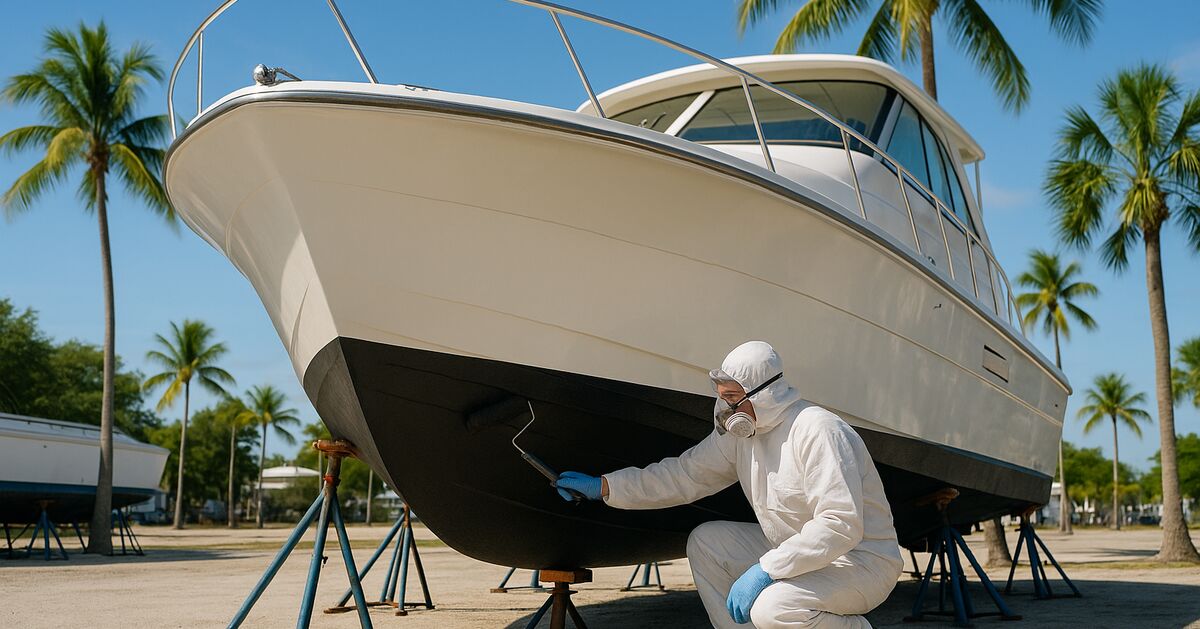
Bottom paint is not a set-it-and-forget-it decision, and in Sarasota County's warm, nutrient-rich water it matters more than almost anywhere else in Florida. Choose the wrong formula and you will spend the season fighting barnacles, slime, and fuel bills that climb for no obvious reason. Choose the right one, and your boat spends more time moving efficiently and less time being scrubbed between haul-outs.
This post is about making that choice intelligently, and it is also for anyone who is about to schedule a hull cleaning. Your detailer genuinely needs to know what is on your bottom before they touch it. Here is why - and everything else that goes into getting this right.
Why Sarasota County water is particularly hard on hulls
The Gulf and the inland bays around Sarasota, Siesta Key, Longboat Key, Lido Key, Bird Key, Casey Key, Nokomis, and Venice are shallow, warm, and loaded with biological activity. Water temperatures here rarely drop cold enough to slow marine growth the way they do farther north, even in January. That means fouling pressure is essentially year-round.
Sarasota Bay and Little Sarasota Bay are also nutrient-rich environments. Runoff from upland areas feeds algae and plankton blooms that attract the organisms that attach to hulls: barnacles, tubeworms, bryozoans, and biofilm-forming bacteria. Roberts Bay near Osprey and Nokomis is similarly productive, which is beautiful for fishing and miserable for an unprotected hull.
Salt content varies, too. The passes at Midnight Pass, Big Sarasota Pass, and Venice Inlet allow Gulf exchange, keeping salinity relatively high. Farther up into tidal creeks and marinas, salinity drops. Organisms that thrive in brackish water are different from those that thrive at full ocean salinity, and some antifouling formulas work better in one environment than the other.
The practical upshot: a boat that sits on a lift in a brackish canal in Nokomis needs a different strategy than a boat kept in a slip at the Sarasota Yacht Club where full-salinity Gulf water washes through every tide cycle.
The main types of bottom paint - plain language
Walk into a marine store and the shelf is overwhelming. Let's simplify the categories.
Ablative (self-polishing) paints These are the most popular choice for boats in active use. As water flows over the hull, the outer layer of paint slowly wears away, continuously exposing fresh biocide. The faster you go, the faster it ablates. Benefits include even biocide distribution, the ability to repaint over existing ablative paint without full strip-downs in most cases, and the fact that they don't build up thickness the way hard paints do. Downsides: if your boat sits for long stretches without moving, the ablation slows and a slime layer can establish itself before the biocide gets to work.
Hard (modified epoxy) paints Hard paints don't wear away. They release biocide from a fixed matrix until it is exhausted, then provide no antifouling benefit. They polish up slick, which is why racing sailors and performance-oriented powerboat owners like them. They are also the choice for trailer boats because they tolerate drying out between uses. The big drawback: layers build up over time, and eventually you have to strip back to bare fiberglass, which is expensive and disruptive. Hard paints also cannot be applied over most ablatives.
Hybrid and multi-season paints Several manufacturers now offer paints that try to capture the slick surface of a hard paint with some self-polishing behavior. These can work well, but they tend to sit in a middle ground that is best explained by your boat yard's paint rep, who can look at your hull history and actual use pattern.
Biocide-free and low-copper options Regulations around copper-based antifouling paints are tightening in some states, and even in Florida some marinas restrict certain formulas. If your home slip or storage area has restrictions, check before you buy. Non-copper alternatives use alternatives like zinc pyrithione, econea (tralopyril), or silicone-based foul-release coatings. Foul-release coatings work differently: instead of killing organisms with biocide, they create a surface so slick that barnacles can't grip. They work best on boats that regularly run at planing speeds because water flow physically shears the growth off. A boat that idles in and out of a marina slip at low speeds and then sits for days won't generate enough friction to keep a foul-release hull clean.
What actually drives the choice for a Sarasota County boat owner
Here are the questions you should honestly answer before choosing a paint:
- How often does the boat move? A boat used three or four times a week is a completely different candidate than a boat that goes out on weekends and sits the rest of the time. High-use boats benefit from ablatives because the movement helps the product work. Low-use boats may need a hard paint or a formula specifically designed for low-activity situations.
- Where is the boat stored? Full Gulf salinity at a Longboat Key marina, brackish canal in Nokomis, dry rack at a Sarasota facility - each changes which organisms you're fighting and how wet the hull stays.
- Is the boat on a lift or in the water? A boat on a lift spends time in the air. Most hard paints tolerate that fine. Some ablatives need to stay wet to remain effective, though modern formulas have improved significantly. Confirm with the manufacturer's spec sheet, not the sales brochure.
- What is already on the hull? This is crucial. Applying an incompatible paint over an existing system can cause delamination, peeling, or chemical reactions that ruin both layers. Before you paint anything, you need to know what's under there.
- Are you trailering? Trailer boats need a paint that can dry out completely between uses. Most ablatives are not designed for this. Hard paint or a trailer-specific formula is the right call.
Paint compatibility: the detail your hull cleaner needs to know
Here is the part that directly affects your working relationship with whoever cleans your hull. Not all hull cleaning methods are compatible with all bottom paint types.
Ablative paints are soft by design. Aggressive scrubbing with hard brushes or abrasive pads removes the outer layer of paint intentionally, but it can also remove it unevenly or excessively, shortening the effective life of the coating. A good hull cleaner working on an ablative bottom will use softer brushes and less mechanical pressure than they would on a hard paint.
Hard paints can tolerate more aggressive cleaning because the biocide isn't in a surface layer that wears off. But even here, excess abrasion can cut through to bare glass faster than you'd expect if the paint is getting thin.
Foul-release coatings (silicone-based) are especially sensitive. Solvents, strong acid-based hull cleaners, and abrasive tools can destroy the slick topcoat that makes them work. If your boat has a foul-release bottom, your cleaning crew needs to know it, full stop.
Copper-based antifouling paints require care around certain metals. The runoff from copper paint on aluminum components like outdrives or aluminum-hulled boats can accelerate galvanic corrosion. Your detailer should know if there are any bare aluminum surfaces below the waterline.
When you book a hull cleaning, tell the service company the paint brand and type if you know it. If you don't know, tell them what the hull looks like and whether it feels rough or smooth when you run your hand over a dry section on the trailer or lift. That tactile detail helps a professional make an educated call about what tools and products to use. You can browse our boat cleaning and detailing services to get a sense of what's involved in a full hull service, and our FAQ page covers several common questions about the hull cleaning process.
How to read a paint can (the parts that actually matter)
The back of a bottom paint label has information most buyers skip. A few things worth reading:
Coverage rate. This tells you how many square feet a gallon covers. Undercoating your hull to save money means thin coverage, which means the biocide layer runs out faster. Calculate your hull surface area honestly and buy enough paint.
Recoat window. Most paints have a minimum and maximum time between coats and between the final coat and launching. Miss the window and the adhesion suffers or the surface skins over in a way that traps solvent. In Sarasota County's heat and humidity, the recoat window can close faster than the instructions suggest, which were often written for temperate climates.
Launch window. This is the time by which the boat should be in the water after the final coat is applied. Ablative paints especially need to be launched within a certain time frame to maintain effectiveness.
Compatibility notes. Most labels list which existing systems the paint can go over and which it cannot. Read this before you commit to a product if you have any existing paint on the hull.
The haul-out schedule question
Bottom paint does not last forever, and in Sarasota County's climate it often doesn't last as long as the can suggests for northern boat owners. A formula rated for 12 months in Maine may give you 8 to 10 months of reliable protection here, where the water is warm year-round and biological pressure never fully eases.
Most boat owners in this area who keep their boats in the water full-time schedule a haul-out and fresh coat roughly once a year. Boats that see heavy use in fouling-intensive areas like the ICW between Venice and Nokomis may need that more frequently. Boats on lifts that get pulled regularly may stretch longer.
Between haul-outs, periodic underwater hull cleaning removes the soft slime and early-stage growth before it hardens into barnacles. A soft growth layer, caught early, comes off with light brushing and doesn't damage the paint. Barnacles that have been left to calcify are another story: removing them takes more force, which removes paint, which shortens the effective life of your antifouling system. Regular cleaning protects your paint investment just as much as the paint itself. If you are located anywhere from Longboat Key to Siesta Key or down through Casey Key, the biofouling pressure is real and consistent enough that skipping cleanings has a measurable cost.
What to tell your detailer before they touch your hull
Even if you can't remember the brand of paint you had applied two years ago, the following information helps significantly:
- Whether the paint is hard or soft (run your fingernail lightly over a dry area above the waterline; ablative paint tends to leave a slight chalky residue)
- Any areas where the paint has delaminated, blistered, or peeled
- Whether there is any bare fiberglass visible at the waterline or on the keel
- What's on your running gear (painted, bare metal, zinc anodes, outdrive finish)
- Whether you have had any blistering issues in the past
- The boat's normal mooring location (marina, lift, ICW, Gulf-front)
A detailer who is working on the boat hull in the water for a routine cleaning needs slightly different information than one doing a full out-of-water detail, but in both cases, the more you share, the better the result. Our locations page shows all the areas we serve throughout Sarasota County, and you can always get in touch if you want to talk through what your hull specifically needs before booking.
Pairing bottom paint decisions with overall hull care
Bottom paint is just one part of hull care. The waterline area, which is exposed to air, UV, salt, and alternating wet-dry cycles, often develops staining and oxidation independent of the antifouling zone below. Keeping that band clean and protected requires a different approach than antifouling paint.
Above the waterline, the hull needs waxing or a protective coating to resist oxidation and UV degradation. The non-skid deck areas have their own cleaning requirements. And if you have teak, canvas, or isinglass, those surfaces each need products and techniques suited to their materials. Our post on cleaning and protecting teak decking in Sarasota's climate goes into the specifics of that particular challenge.
The bottom line here is that a well-maintained boat is a system, not a collection of independent surfaces. The right bottom paint, cleaned on the right schedule by someone who knows what is on your hull, is the foundation of that system. In Sarasota County's water, cutting corners on any part of it shows up faster than it would almost anywhere else. The environment here is productive and beautiful precisely because it supports so much life. Unfortunately, some of that life wants to live on your hull.
Get the paint choice right, communicate it to the people who work on your boat, and you will spend your time actually enjoying the water around Siesta Key, Lido Key, and Bird Key instead of troubleshooting a hull that has turned into a reef.