How Often Should You Wash and Detail Your Boat in Southwest Florida?
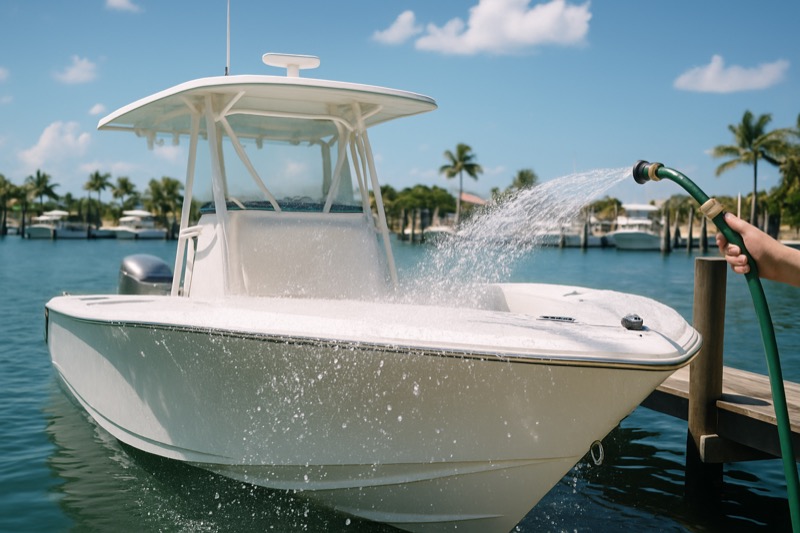
If you keep a boat anywhere on the Suncoast, you have probably noticed that it gets dirty faster here than almost anywhere else you have owned one. That is not your imagination. The combination of salt air, hard Florida sun, brackish canal water, and near constant humidity works on a boat around the clock. A vessel that might go a month between washes up north can look neglected in a week and a half here. So how often should you actually wash and detail your boat in Southwest Florida? The honest answer depends on where you keep it and how you use it, but there are clear rules of thumb we can walk through.
The short answer
For most boats kept in or near the water in Sarasota County, a proper rinse and wash every one to two weeks keeps the finish healthy, and a full detail two to four times a year keeps the gelcoat from going backward. Boats that live on a lift and stay covered can stretch those intervals a little. Boats that sit in the water at a marina or on a canal dock need attention more often, both above and below the waterline. If you only remember one thing, remember this: the salt is what does the damage, and salt is easy to remove when it is fresh and very hard to undo once it has baked in.
Why Southwest Florida is harder on boats
Three things stack up against your finish down here. First is salt. Every time you run in Sarasota Bay, the Intracoastal, or out through Big Pass or New Pass into the Gulf, you throw a fine mist of saltwater over every surface. When that spray dries, the water leaves but the salt crystals stay behind. Those crystals are mildly abrasive and they attract moisture, so they sit on your gelcoat and stainless and slowly etch and corrode.
Second is the sun. Florida sits far enough south that the ultraviolet load is intense most of the year. UV breaks down the resin at the surface of your gelcoat, which is what leads to the chalky, faded look so many older local boats have. A layer of wax or coating is what stands between that UV and your finish, and the sun burns through wax faster here than in cooler climates.
Third is biology. Warm brackish water is a soup of algae, slime, and barnacle larvae. Anything sitting in the water grows a beard within days. That is a bottom and waterline problem, and it is the reason in-water hull service is its own category of work rather than something you fold into a wash.
Put those three together and you have an environment that is beautiful to boat in and brutal on the boat itself. The owners whose boats still shine after ten years are not lucky. They are consistent.
How your storage situation changes the schedule
Where your boat sleeps matters more than almost anything else when it comes to cleaning frequency.
Boats on a covered lift have the easiest life. The cover blocks a lot of the UV and the daily dew, and being out of the water means no bottom growth between uses. A lift boat that gets rinsed after every saltwater trip and washed every couple of weeks can hold a great finish with a full detail two or three times a year. If you are on a lift on a canal in places like Siesta Key or Bird Key, you are in the best position to keep costs down, as long as you stay ahead of it.
Boats on an open lift or a canal dock without cover get more sun and more airborne salt, so the wash interval tightens to about weekly, especially in summer. The bottom still stays clean because it is out of the water, but the topsides, glass, and metal need more frequent attention.
Boats kept in the water full time, whether at a marina slip or tied to a dock, are the highest maintenance. They need everything the lift boats need above the waterline plus regular in-water hull and running gear cleaning below it. In our water, a bottom can foul enough to matter within two to four weeks. We cover why that matters for speed and fuel in a separate article, but for scheduling purposes just know that an in-water boat needs a diver or in-water service on a recurring cycle, typically monthly, on top of its topside washing.
Trailer boats are a mixed bag. They avoid bottom growth entirely, which is a big advantage, but they often sit in a driveway baking in full sun between trips. A trailer boat that gets a thorough freshwater flush and wipe down after each saltwater launch, plus a wax every few months, will outlast one that gets hosed off carelessly and left to dry in the sun.
Rinse, wash, and detail are three different things
People often lump all boat cleaning together, but the three levels of care do different jobs and happen on different schedules.
A rinse is a freshwater flush after a saltwater trip. It takes a few minutes and it is the single most valuable habit a boat owner can build. Rinsing knocks the fresh salt off before it dries and bonds. You should rinse after essentially every saltwater outing.
A wash is soap, a mitt, and a real effort to lift salt, dirt, bird mess, and light grime off every surface, then dry it so you do not leave water spots. This is your weekly to biweekly job. A good wash also includes the glass, the non skid, the rails, and the cushions if they are out. Our exterior wash and detail service is built around this cycle, and many owners have us handle it on a schedule so it simply happens without them thinking about it.
A detail is the deep work. It means decontaminating the surface, correcting oxidation and light scratches, and laying down fresh protection. A detail is where chalky gelcoat gets brought back and where a new coat of wax or sealant goes on. This is a two to four times a year job for most local boats, more often for neglected finishes that need to be caught up.
A realistic yearly rhythm for a Sarasota boat
Here is what a sensible year looks like for a typical center console or bay boat kept on a lift on the Suncoast.
After every saltwater trip you rinse the boat with fresh water, paying attention to the engine, the trim, and any stainless. Every one to two weeks you or a service washes and dries the whole boat. Every three to four months you get a full detail with fresh wax, timed loosely to the seasons. And if the boat lives in the water, you layer a monthly in water hull cleaning on top of all of that.
Snowbird owners need a slightly different plan. A boat left sitting from April to November while you are up north is not resting, it is weathering. Salt still settles, sun still bakes, and if it is in the water, the bottom still grows. The worst gelcoat we see belongs to boats that sat untouched through a Florida summer under a poorly fitting cover. If you head north, arrange for the boat to be washed and checked on a regular cycle while you are gone, or plan for a serious catch up detail when you return. We handle a lot of both.
What happens when you fall behind
Skipping washes does not just make the boat look tired. It costs you money in ways that show up later.
Salt left on stainless leads to rust staining and pitting that no wash will remove once it sets in. Salt and UV left on gelcoat lead to oxidation, that chalky white haze that means the top layer of resin has degraded. Light oxidation can be polished out, but heavy oxidation requires aggressive oxidation removal and wax or full gelcoat restoration, which costs far more than the washes you skipped would have. Mildew left in damp seats and carpet stains the vinyl and works into the foam, which is a whole interior detailing project to reverse. And a fouled bottom left too long can force a haul out and a much bigger cleaning bill.
The theme is simple. Regular light maintenance is cheap. Catching up from neglect is expensive. That is why we push owners toward a steady rhythm rather than occasional heroic cleanups.
Protection changes the math
How often you need to detail depends heavily on what is protecting the surface. Bare gelcoat with no wax oxidizes fast and needs frequent correction. A good carnauba or synthetic wax buys you a few months of protection but burns off in our sun and needs reapplying several times a year. A ceramic coating changes the equation entirely, shrugging off salt and UV for a year or more and making every wash easier and faster in between. We break down whether that upgrade pays off in our article on ceramic coating for Gulf Coast boats, and you can see the service on our ceramic coating page. The better your protection, the less often you need heavy detailing, though you still rinse and wash on the same rhythm.
Let us build a schedule around your boat
Every boat is a little different. A trailered flats skiff in Nokomis has different needs than a fifty foot cruiser in a Venice marina slip or a wake boat on a lift in Osprey. The right interval depends on your storage, your usage, your finish, and how you want the boat to look. Our recurring maintenance wash program exists so you never have to track any of this yourself. We show up on a set cadence, keep the finish healthy, and flag problems while they are still small and cheap to fix.
If you are not sure where your boat stands, the easiest first step is to have us look at it. You can browse everything we do on our services page, check straightforward numbers on our pricing page, or get a free quote and we will recommend a realistic wash and detail schedule for your exact situation. Whether you keep your boat in Siesta Key, on a canal in Bird Key, or down in Venice, staying consistent is what keeps it looking new, and it is a lot easier when someone else keeps track of the calendar for you.