How to tell if your boat's oxidation is surface or too deep for wax
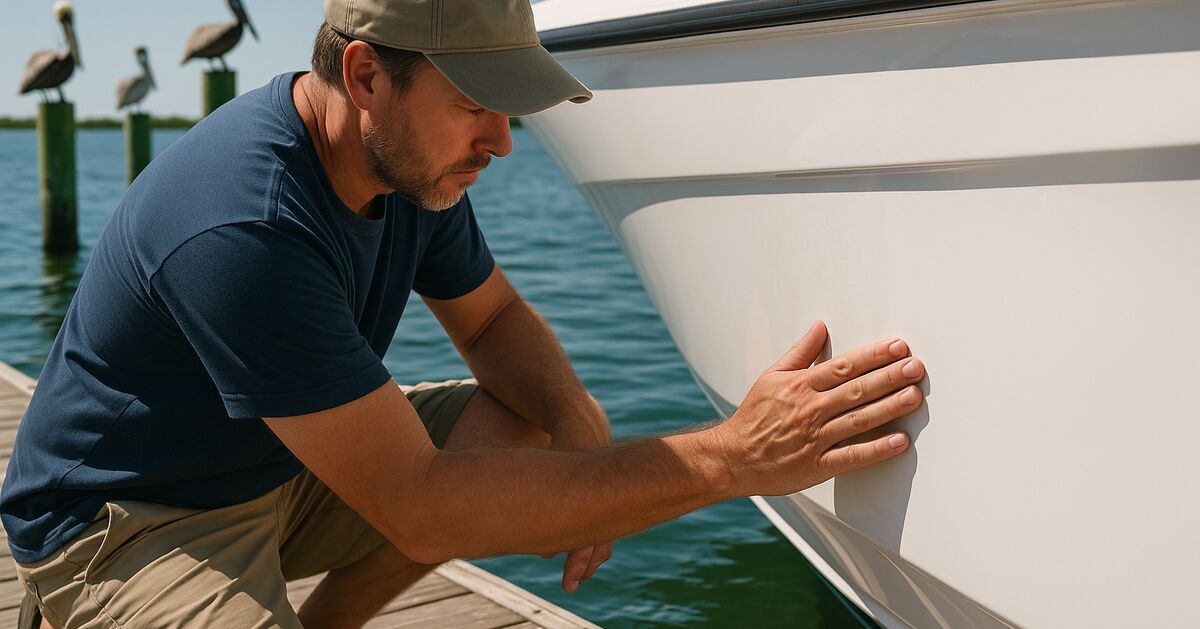
Run your palm across the hull of a neglected boat and you will feel it instantly: a dry, powdery chalk that transfers onto your hand like old paint. That is oxidation, and it is one of the most common problems facing boats kept anywhere on the Gulf Coast. But not all oxidation is the same, and the difference between "fix it with a good wax" and "this needs professional compounding or gelcoat work" can save you hundreds of dollars if you read the signs correctly before reaching for a bottle of polish.
This guide walks you through exactly how to assess the severity of oxidation on your own boat, explains the chemistry behind why it happens, and tells you honestly what each stage requires to put right.
Why gelcoat oxidizes in the first place
Gelcoat is essentially a pigmented polyester resin that manufacturers apply as the outermost protective layer of a fiberglass hull. When it is new, it is dense, smooth, and sealed. Ultraviolet radiation is its primary enemy. UV energy breaks down the polymer chains in the resin over time, and as those chains degrade, the surface becomes increasingly porous and rough. Oils and plasticizers that gave the gelcoat its flexibility and gloss literally gas off into the atmosphere, leaving behind a dry, microscopically fractured surface.
Saltwater spray accelerates this process by depositing mineral salts into those micro-pores, and heat makes it worse still. Southwest Florida sits in one of the highest-UV-index regions in the continental United States, per data from the National Weather Service, and boats stored in the open at docks from Sarasota Bay to the marinas off Venice Avenue take that punishment daily. Even boats kept on lifts receive reflected UV from the water below and direct sun from above for the majority of the day.
The end result is the chalky, faded, dull surface that owners describe as oxidized. Understanding how far that process has gone is the key to choosing the right remedy.
The four-stage oxidation scale
Detailers and fiberglass specialists generally describe oxidation in four broad stages. These are not hard scientific categories but are widely used as a practical communication tool in the marine care industry.
Stage 1 - Light oxidation: The gelcoat looks slightly dull or hazy compared to when it was new. Gloss is reduced but color depth is still visible. The chalky transfer onto your hand is faint or barely present.
Stage 2 - Moderate oxidation: The surface is visibly chalky, color has faded noticeably, and gloss is largely gone. There is a clear powdery transfer when you rub the hull. This is the most common presentation for boats that have gone a year or two without proper protection in climates like Sarasota's.
Stage 3 - Heavy oxidation: The chalking is heavy, the color is washed out or grey-toned, and the texture may feel rough or gritty to the touch. There may be patches where the oxidation looks uneven or blotchy.
Stage 4 - Failed or delaminating gelcoat: The surface is not just dull but visibly crazed, checked, or cracking. Areas of gelcoat may be flaking or completely absent. This is structural degradation, not surface chemistry.
Wax alone is a meaningful solution only for Stage 1. A light polish or all-in-one product can address Stage 1 and early Stage 2. Professional machine compounding is typically required for moderate to heavy Stage 2 and all of Stage 3. Stage 4 is beyond detailing and enters the realm of gelcoat repair, which is a separate craft altogether.
The quick field tests you can do right now
You do not need any tools beyond what is already on your boat to get a useful initial read on oxidation depth. Here are three practical tests.
The swipe test: Drag two fingers firmly across the hull in a six-inch line. Then look at your fingers. Light whitish powder is normal oxidation in the mild-to-moderate range. A heavy chalk coating, especially if it comes away easily with almost no pressure, suggests moderate to heavy oxidation. No transfer at all, or a barely visible smear, points toward light surface oxidation.
The water-drop test: Pour a small cup of fresh water on a section of the hull (not the bottom paint area). On a healthy or lightly oxidized surface, the water beads up into discrete droplets and sheets off. On moderately oxidized gelcoat, the water spreads into a thin sheet rather than beading. On heavily oxidized gelcoat, the water soaks into the surface noticeably and may take a moment to run off at all. This happens because heavy oxidation creates macro-porosity in the surface, the same reason heavily oxidized hulls absorb staining so readily.
The machine-polish test panel: If you are unsure where your boat falls, pick a hidden area such as under the rub rail or near the transom, and apply a quality marine compound with a hand applicator or a random orbital polisher at low speed. Work it into a one-square-foot area and wipe it off. If color and gloss return dramatically in that spot, the gelcoat beneath the oxidation is still sound and viable. That is good news. If you work through the compound and the result is still dull, or if you start to see bare fiberglass weave through the gelcoat, the gelcoat itself has been compromised.
What wax actually does (and what it cannot do)
Wax does not remove oxidation. This is worth saying clearly because a mistake that comes up again and again in owner forums is applying a coat of paste wax over chalky gelcoat and wondering why it does not look better. Wax is a sacrificial barrier that sits on top of the gelcoat and protects it from UV and moisture. It is maintenance, not restoration.
To address oxidation you need an abrasive, and the word that covers abrasive marine products is "compound" or "polish." These products contain diminishing abrasive particles that physically abrade away the damaged outer layer of gelcoat to reveal the less-damaged material beneath. After compounding, the surface is sealed with polish and then protected with wax or a longer-lasting coating.
For light oxidation, a mild all-in-one product that combines light abrasives with a protective sealant can handle the job in a single step. For moderate oxidation, a dedicated compound step followed by a polish and then a wax is the standard approach. For heavy oxidation, multiple compounding passes with a heavier-cut compound and a machine polisher are typically required, and the process is time-consuming and physically demanding. This is why heavy oxidation restoration is best done by professionals with dual-action or rotary polishing equipment.
Our boat cleaning and detailing services include oxidation assessment as part of every full detail, so you know exactly which stage you are dealing with before any work begins.
What you can and cannot save: being honest about the limits
If the gelcoat has been worn through by previous compounding or by severe oxidation, no amount of polishing will restore it because there is no longer any gelcoat left to reveal. Gelcoat is applied at a limited thickness on most production boats, and repeated heavy compounding over the years removes material permanently.
Signs that you may be approaching or past the point of no return for detailing include:
- A fibrous or cloth-like texture appearing in polished areas (fiberglass mat or woven roving showing through)
- Spider-cracking or checking that goes below the surface layer
- Sections where the surface cannot be polished to any gloss regardless of product or effort
- A translucent or glass-like appearance in areas that should be solid white or colored
At this stage, the options are gelcoat respray (a job for a boatyard or marine painter), topside paint over the existing surface, or in some cases a vinyl wrap. These are all legitimate approaches with their own trade-offs in cost, durability, and appearance.
How Southwest Florida conditions compress the timeline
Boats on the Gulf Coast move through the oxidation stages faster than boats in cooler, cloudier climates. The combination of year-round UV exposure, high humidity, salt air, and warm water temperatures creates conditions that stress gelcoat continuously. There is no real winter reprieve for a boat kept on the water in Sarasota, Siesta Key, or Longboat Key the way there would be for a boat stored in a garage in, say, Ohio from November through April.
Our post on why Siesta Key boats oxidize faster than Longboat Key boats explores how even relatively short distances across the bay can mean meaningfully different exposure conditions. Boats moored in open Gulf-facing water with no afternoon shade tend to reach Stage 2 oxidation faster, sometimes within a season, without protective maintenance. Boats kept in covered slips or on lifts in shaded canals typically take longer, often a couple of years, before showing the same level of damage.
This is one of the core reasons that consistent protective waxing is not optional on the Gulf Coast. It is the single most cost-effective thing an owner can do to slow the progression from one stage to the next. If you want to understand how the math works out across different service approaches, our comparison of one-time detailing versus a maintenance wash program breaks it down in practical terms.
A note on what skipping maintenance actually costs
A common pattern we see across our service locations from Osprey to Lido Key is boats brought in for detailing after two or three years of minimal maintenance. At that point, work that would have taken one moderate-compound session has become a multi-pass heavy-cut job, and sometimes that job still cannot fully restore the surface to what regular care would have preserved.
The neglect cost is real and it compounds over time, much like the oxidation itself. Our blog post on what skipping post-outing cleaning does to your gelcoat covers the shorter-term version of this problem, but oxidation is the long-term version. Every month without protection is material removed from the finite thickness of your gelcoat, never to be returned.
Assessing your boat: a practical checklist
Before you call a detailer or reach for a compound, work through this quick checklist on a sunny day when you can see the hull clearly.
- Stand back ten feet and look at the hull broadside in direct sun. Is there any gloss remaining, or does the surface look uniformly flat and chalky?
- Run the swipe test across different parts of the hull. Note whether the upper topsides, the area just above the waterline, and the transom all behave the same. Oxidation is often uneven, with sun-facing sides worse than shaded ones.
- Do the water-drop test on the bow, midship, and transom separately. Different areas may be at different stages.
- Look closely at any stress crack areas, around cleats, stanchion bases, or hardware cutouts. Crazing in those areas that extends more than skin-deep is a gelcoat integrity concern separate from oxidation.
- Check the color on the deepest, least-sun-exposed part of the hull, such as under the gunwale overhang. If that sheltered area still shows good color and some sheen, the pigment in the gelcoat is intact and restoration is likely viable.
Bring those observations to any detailing conversation you have. A professional who does boat detailing in Sarasota or any of the surrounding keys should be able to confirm or adjust your staging assessment within a few minutes of inspecting the boat in person.
When to call a professional versus doing it yourself
Light surface oxidation on a small boat is a reasonable DIY project if you own a random orbital polisher and have a few hours to spend. Moderate to heavy oxidation on any boat larger than about 22 feet is a significant undertaking that is easy to do unevenly or to make worse by using too aggressive a cut compound, burning through a thin spot, or creating holograms in the gelcoat with an improperly used rotary polisher.
The risk with DIY heavy compounding is that you can go too far in one spot and not far enough in the adjacent spot, leaving a patchy result and removing gelcoat you cannot replace. Professional detailers work with the full range of compound grades, have experience reading when to drop to a lighter cut, and have machine control from repetition that is genuinely hard to replicate on a first or second attempt.
If you are on Longboat Key, Bird Key, Casey Key, or anywhere along the barrier islands and you are not certain which stage you are dealing with, an in-person assessment is the most reliable starting point. You can reach us through our contact page or read through our frequently asked questions to get a better sense of what to expect from the process.
The bottom line
Oxidation is a spectrum, not a single condition. A quick swipe test, a cup of water, and a test-panel polish are enough to give you a working read on whether your hull needs a wax, a compound and wax, a professional multi-stage restoration, or a conversation with a gelcoat repair specialist. The earlier you catch it, the more options you have and the less it costs to fix. In Southwest Florida's climate, catching it early is not luck. It is a direct result of regular inspection and consistent protective maintenance.
Sources & further reading
- UV Index data and regional sun exposure resources (National Weather Service (NOAA))
- UV radiation and its effects on outdoor materials (U.S. Environmental Protection Agency)
- Gelcoat and fiberglass boat hull care guidance (National Marine Manufacturers Association (NMMA))
- Boating maintenance and hull care resources (U.S. Coast Guard Office of Boating Safety)
- Florida UV and climate data for boater safety planning (Florida Department of Environmental Protection)
Claim-by-claim audit (5 checked)
- “Southwest Florida sits in one of the highest-UV-index regions in the continental United States, per data from the National Weather Service, and boats stored in the open at docks fr…” (cited → weather.gov)
- “Gelcoat is applied at a limited thickness on most production boats, and repeated heavy compounding over the years removes material permanently.” (rewritten to what the article can stand behind)
- “Boats moored in open Gulf-facing water with no afternoon shade tend to reach Stage 2 oxidation faster, sometimes within a season, without protective maintenance.” (rewritten to what the article can stand behind)
- “Boats kept in covered slips or on lifts in shaded canals typically take longer, often a couple of years, before showing the same level of damage.” (rewritten to what the article can stand behind)
- “This happens because heavy oxidation creates macro-porosity in the surface, the same reason heavily oxidized hulls absorb staining so readily.” (reasoning shown in the article)