What skipping post-outing cleaning does to your gelcoat
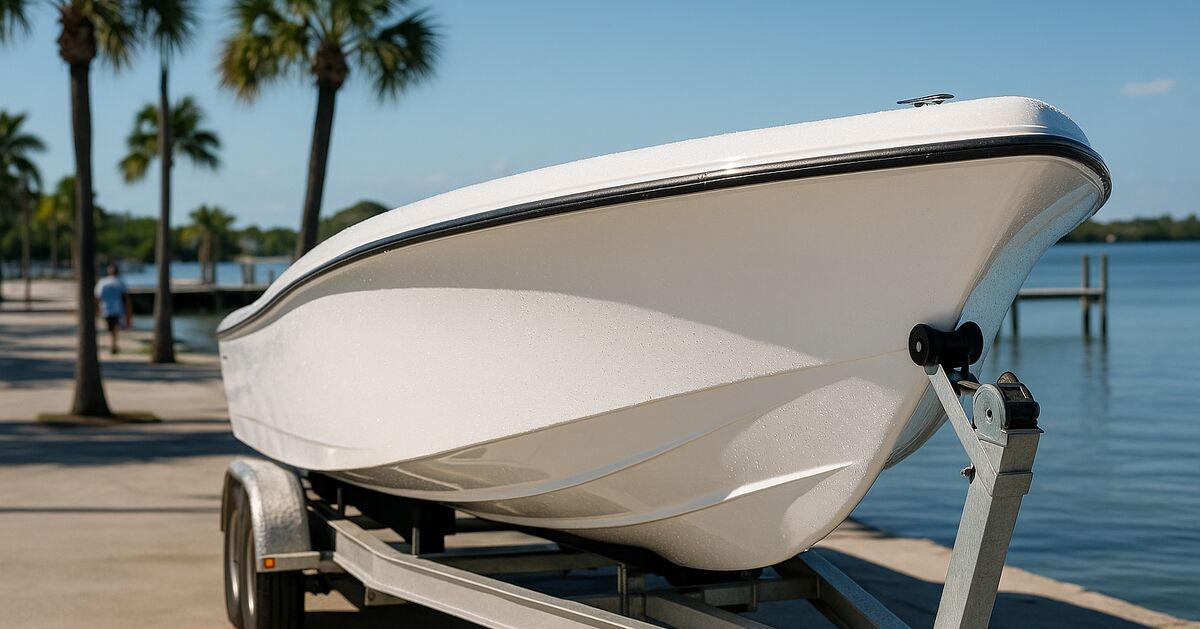
Salt water is not just wet. Every time you bring your boat back from Sarasota Bay, Roberts Bay, Little Sarasota Bay, or the passes between the keys, you're returning with a hull and deck coated in a cocktail of dissolved salts, microscopic marine organisms, tannins from the estuaries, and whatever fuel or oil sheen the water carried that day. That coating is invisible to most eyes. It does not feel urgent. But gelcoat is a porous, semi-permeable surface, and every hour that cocktail sits on it, something is happening underneath.
This post is about what, specifically, is happening, why it matters for the long-term value and appearance of your boat, and what a realistic cleaning routine looks like for boats kept on the water from Longboat Key down to Venice.
What gelcoat actually is, and why it's vulnerable
Gelcoat is not paint. It is a resin-based outer layer, typically polyester, that is applied to the mold when a fiberglass hull is manufactured. It is hard, glossy, and UV-resistant when new. But it has no additional protective topcoat baked into it the way automotive clear coat does. The gloss you see on a fresh hull is the gelcoat itself.
Over time, that surface develops microscopic pores and hairline surface stress from UV exposure, flexing, and general use. Those pores are exactly the entry point that salt, acids, and biological matter need. Once inside the surface layer, contaminants can cause staining, chemical etching, and accelerated oxidation that goes well below what light polishing can reach.
Understanding this helps explain why frequency of cleaning matters so much more than intensity. Removing contaminants before they penetrate is far easier than trying to remove them after they have had time to work their way in.
The specific damage that builds up after a Sarasota Bay outing
Salt crystal formation
When saltwater evaporates from a gelcoat surface in the Florida sun, it does not disappear. The water evaporates; the salt stays. Salt crystals are abrasive, and if you run your hand across a hull that has dried after a bay outing without being rinsed, you can sometimes feel the faint texture of them. When spray, wakes, or gear rubs across that surface before rinsing, those crystals act like fine sandpaper, creating microscopic scratches in the gelcoat. Over hundreds of outings, that surface becomes progressively duller, and no amount of wax or polish will fully restore a surface that has been scratched at the micro level repeatedly.
Salt is also hygroscopic, meaning it draws moisture from the air. That retained moisture keeps the surface chemically active even when the boat is sitting in a slip or on a lift. Osmotic pressure from salt concentrations beneath the surface layer can, reasoning suggests, contribute over time to small blisters in the laminate, though deeper moisture intrusion over years is generally needed for full blister formation.
Tannin and organic staining
Sarasota County's inshore waters carry organic load from mangrove systems, seagrass beds, and the Myakka and Peace River watersheds that drain into Charlotte Harbor and move northward. The result is tannin-rich water in many of our back bays and estuaries. Tannin stains are brown or yellow-brown, and they bond tenaciously to gelcoat pores. A single outing through stained back-bay water around Nokomis or the estuaries near Casey Key, left unwashed for a few days in summer heat, can leave a visible brownish cast in a gelcoat surface that previously looked white.
Tannins are polyphenolic compounds that tend to bond strongly with polymer surfaces when heat and time are present. The longer they sit, the deeper the bond. What a thorough wash would have removed in five minutes on the day of the outing may require an acid-based cleaner and significant mechanical effort a week later.
Biological settlement
Sarasota Bay water is biologically rich. That is good news for fishing; it is bad news for surfaces left wet. Even a boat kept on a lift gets splash and spray, and any surface that stays damp long enough after an outing can see the early stages of biofilm formation: a thin, slippery layer of bacteria and microscopic algae that is the precursor to more substantial growth. On hulls that stay in the water, this accelerates dramatically, but even topsides and deck surfaces are not immune if they are regularly wet and never cleaned.
Biofilm itself is not structurally damaging to gelcoat in the short term, but it creates a surface that traps other contaminants more effectively, and it is the biological substrate that larger organisms, including algae and eventually barnacle larvae, use to locate a settlement surface. Our separate post on barnacle and mussel settlement in Sarasota County covers that progression in detail for different parts of the county.
Fuel and exhaust residue
If you run an outboard or sterndrive, the exhaust and any fuel that drips or is carried in the water leaves petroleum-based residue on the transom and hull sides. These residues are not just aesthetic problems. Petroleum residues are generally considered chemically harsh on polyester resin over time. A transom that is regularly coated in exhaust soot and never cleaned will show yellowing and surface degradation faster than one that is washed after each outing.
What happens over weeks and months of skipped cleanings
The damage from a single skipped cleaning is real but minor. The problem is that it compounds. Here is a realistic progression for a boat used two or three times a week in the summer and left uncleaned:
- Weeks 1-2: Salt residue builds on deck and hull sides. Tannin staining begins in any areas that stay wet longest, typically near the waterline and the scuppers. Exhaust soot accumulates on the transom. The gelcoat still looks acceptable.
- Weeks 3-4: The salt residue has now been baked and rebaked by the Florida sun through multiple humidity cycles. It is no longer a surface deposit but a more bonded layer. Tannin staining is now visible. The gelcoat begins to lose its reflective depth and looks "flat" or slightly chalky in strong sunlight.
- Months 2-3: UV oxidation, which is always occurring, is now accelerated because the surface contaminants have compromised the gelcoat's ability to shed UV energy uniformly. Oxidation appears first as a whitish or chalky film that does not wash off with water. Any wax layer that was present has been chemically degraded and is no longer protecting the surface.
- Beyond 3 months: Without intervention, the oxidation penetrates deeper into the gelcoat. The surface becomes porous enough that staining is nearly permanent without compounding. At this stage, restoration requires a multi-step cutting, compounding, and polishing process, and depending on the severity, the gelcoat may be measurably thinner after restoration than it would have been with routine maintenance.
Our boat cleaning and detailing services page explains what each stage of restoration involves when cleaning alone is no longer enough.
The Gulf Coast sun multiplies all of this
Sarasota County sees many sunny days per year, and Gulf Coast UV index levels often reach the EPA's "very high" to "extreme" range from April through September. UV radiation breaks down the chemical bonds in polyester resin, causing the surface to become chalky and microscopically fractured. This is oxidation, and it is accelerating every single day a boat is used on the water here.
The interaction between UV and surface contamination is important: a clean, waxed gelcoat surface reflects UV more efficiently and resists oxidation better. A surface coated in salt, biological residue, and tannins absorbs and traps heat and UV energy more effectively, which accelerates the degradation cycle. Per general UV exposure guidance, higher UV index values are associated with faster photochemical damage to exposed polymer surfaces.
If you are curious about how location affects the rate of oxidation specifically, our blog post on why Siesta Key boats oxidize faster than Longboat Key boats gets into the local microclimate factors that many owners don't think about.
What a proper post-outing routine looks like
You do not need to do a full detail after every outing. What you need is a consistent, quick routine that removes the active contaminants before they have time to bond.
After every outing, while the hull is still wet or immediately after hauling out:
- Rinse the entire boat with fresh water, including the hull sides, transom, deck, and any hardware. A thorough rinse takes five to ten minutes with a good hose and pressure. This alone removes the majority of soluble salt and a significant portion of loose biological matter.
- Pay particular attention to the waterline, the transom, the scuppers, and any horizontal surfaces where water pools, because these areas retain contaminants the longest.
- Wipe down the deck with a clean chamois or microfiber towel to speed drying. A surface that dries quickly has far less time for biofilm initiation.
Every two to four outings, or weekly for heavy users:
- Wash the hull sides and topsides with a marine-specific soap. Dish soap and household cleaners strip wax and can leave residues that are themselves harmful to gelcoat over time. A pH-neutral marine wash preserves whatever wax layer is present while lifting salt, organics, and exhaust residue.
- Inspect the waterline for early tannin or rust staining. Catching this early means a targeted cleaner and light agitation rather than an acid treatment.
Monthly or as needed:
- Apply a marine wax or sealant to hull sides and topsides. This is not just cosmetic. Wax fills the micro-pores in the gelcoat surface, creating a sacrificial barrier between the gelcoat and the environment. The wax degrades so the gelcoat does not have to.
If your boat lives at a wet slip from Bird Key Marina to Osprey, or anywhere along the ICW, you are dealing with a more aggressive biological environment than a lift-kept boat, and that monthly wax interval may need to be tightened. Our FAQ page covers some of the questions we hear regularly about how storage type affects cleaning frequency.
What professional cleaning adds that a DIY rinse does not
A fresh-water rinse after every outing is genuinely important and something every owner should do themselves. But periodic professional cleaning reaches things a routine rinse does not.
Clay bar treatment, for example, removes bonded contamination from the gelcoat surface that water and soap cannot touch. It is a physical decontamination process that leaves the surface genuinely clean at the molecular level rather than just visually clean. A professional detailer can also identify early-stage oxidation, waterline staining, or stress cracks before they become expensive restoration projects.
Owners across our service area, from Longboat Key to Siesta Key and south through Nokomis and Osprey, tend to find the most value in a professional clean every one to three months depending on use and storage type, with their own rinse routine in between.
The cost of skipping versus the cost of restoration
A boat that is rinsed consistently and professionally cleaned periodically will hold its gelcoat integrity and gloss for a very long time. With consistent maintenance, gelcoat on a fiberglass hull can often stay in good condition for many years.
A boat that goes seasons without cleaning typically requires compound polishing and sometimes wet-sanding to restore the surface. Those processes remove gelcoat. Gelcoat has a finite thickness, typically somewhere between 0.5 and 0.8 millimeters on most production fiberglass hulls. Each compounding session removes a measurable fraction of that thickness. After enough restoration cycles, the gelcoat becomes too thin to polish without risking cut-through, at which point the repair options become significantly more expensive and invasive.
Framed that way, the five-minute post-outing rinse is not a chore. It is a maintenance investment with a direct payoff in the long-term value and integrity of the boat.
For a full picture of what we do and the areas we cover from Sarasota down to Venice, visit our service locations page or get in touch to talk through a cleaning schedule that fits how you use your boat.
Sources & further reading
- UV Index and Photochemical Degradation of Materials (U.S. Environmental Protection Agency)
- Sarasota Bay Estuary Program - Water Quality and Ecosystem Overview (Sarasota Bay Estuary Program)
- Fiberglass Boat Construction and Repair Standards (American Boat and Yacht Council (ABYC))
Claim-by-claim audit (8 checked)
- “Osmotic pressure from salt concentrations beneath the surface layer can, reasoning suggests, contribute over time to small blisters in the laminate, though deeper moisture intrusio…” (rewritten to what the article can stand behind)
- “Tannins are polyphenolic compounds that tend to bond strongly with polymer surfaces when heat and time are present.” (rewritten to what the article can stand behind)
- “Petroleum residues are generally considered chemically harsh on polyester resin over time.” (rewritten to what the article can stand behind)
- “Sarasota County sees many sunny days per year, and Gulf Coast UV index levels often reach the EPA's "very high" to "extreme" range from April through September.” (rewritten to what the article can stand behind)
- “UV radiation breaks down the chemical bonds in polyester resin, causing the surface to become chalky and microscopically fractured.” (reasoning shown in the article)
- “Per general UV exposure guidance, higher UV index values are associated with faster photochemical damage to exposed polymer surfaces.” (rewritten to what the article can stand behind)
- “With consistent maintenance, gelcoat on a fiberglass hull can often stay in good condition for many years.” (rewritten to what the article can stand behind)
- “Gelcoat has a finite thickness, typically somewhere between 0.5 and 0.8 millimeters on most production fiberglass hulls.” (cited → abyc.com)