How red tide residue affects your boat's surfaces after a bloom
Red tide does its worst damage to your boat while you're busy worrying about the smell. The rusty-brown water and the dead fish get the headlines, but the microscopic organism behind it all, Karenia brevis, leaves a physical residue on every surface your boat touches during a bloom, and that residue keeps working long after the water clears.
This post covers exactly what that residue does to fiberglass, metal, upholstery, and canvas, why some surfaces are more vulnerable than others, and how to clean up safely without exposing yourself to the neurotoxins K. brevis produces.
What Karenia brevis actually leaves behind
Karenia brevis is a single-celled dinoflagellate native to the Gulf of Mexico. Florida's Fish and Wildlife Research Institute (FWRI) documents its bloom concentrations in Gulf waters regularly, and Sarasota County sits squarely in one of the state's most frequently affected stretches of coastline.
When the organism dies or is physically disturbed (by wave action, propellers, or boat wakes), it releases brevetoxins into the water and the air. Those toxins are the reason beachgoers get respiratory irritation during blooms. What gets less attention is what stays on your boat's surfaces.
The residue left on a boat after running through bloom-affected water is a mix of:
- Decomposed and partially decomposed algal cells, which are slightly acidic and contain organic oils
- Brevetoxins, which are lipophilic (fat-soluble) and bind readily to waxes, vinyl, and porous surfaces
- Particulate matter from the water column, stirred up along with the bloom
- Concentrated salt, since bloom water is still Gulf water
The acidic organic material is what starts breaking down your surfaces. The lipophilic toxins are what make cleanup a personal safety concern, not just a cosmetic one.
Surface-by-surface: what the residue does
Gelcoat and fiberglass
Fiberglass gel coat is more porous than it looks. A well-maintained, freshly waxed surface has a protective layer that slows penetration, but any surface with existing oxidation, micro-scratches, or an aging wax coat gives the organic acids in algal residue a pathway in.
The early sign is a dull, slightly brownish haze across the hull, especially at the waterline and on horizontal surfaces that collected spray. Left for several days, the organic oils in the residue begin breaking down the surface wax and, in worse cases, staining the gelcoat itself with a yellowish-orange tint that is difficult to polish out.
This connects directly to something we've written about before: what skipping post-outing cleaning does to your gelcoat. The mechanism is the same, organic contamination accelerating oxidation, but red tide residue is a more concentrated version of the problem.
Boats kept on wet slips in areas like the canals off Longboat Key or the marina docks around Bird Key face extended contact time with bloom water, making them more vulnerable than boats on lifts that can be raised out of the water quickly.
Metal hardware and fittings
Stainless steel, aluminum, and chrome fittings are not immune. The organic acids in the algal residue, combined with the salt already present, create a mildly corrosive environment that attacks any existing scratches or worn protective coatings on metal. Aluminum may be more susceptible than stainless steel to pitting from prolonged exposure to acidic organic residue, based on how corrosion generally affects softer metals.
Cleats, rod holders, grab rails, and engine trim components are the usual first victims. You'll see a chalky or slightly discolored film that doesn't wipe off with a dry cloth, a sign the surface has already begun to react.
Upholstery and vinyl
Brevetoxins are fat-soluble, meaning they bind readily to the plasticizers that keep marine vinyl soft and flexible. This is not purely a staining problem. The toxins and the organic residue can accelerate plasticizer migration, which is the process by which vinyl loses the chemical compounds that keep it pliable. The result, over repeated exposures without cleaning, shows up as cracking and stiffening, the same kind of damage described in our guide to why boat upholstery cracks and fades so fast on the Gulf Coast.
Seating surfaces that faced the water during a transit through bloom areas, cockpit cushions, helm seats, and bolsters, are where you'll notice residue most clearly. It often appears as a faint brown film that smells faintly of sulfur or low-tide.
Canvas and bimini tops
Canvas is porous. Marine-grade Sunbrella and similar materials have coatings that resist water, but an organic residue with surface-tension-lowering properties, like decomposed algal cells, can work past that coating and stain the fibers. Once the residue penetrates the weave, it's significantly harder to remove than it would be from a smooth surface.
Bimini tops that were left up during a bloom, or that collected spray on an outing near bloom-affected water between Nokomis and Venice (an area that sees frequent late-summer blooms), should be treated as a priority in any post-bloom cleaning routine.
The personal safety side of cleanup
This is not optional information. Brevetoxins are neurotoxins. Brevetoxin exposure can occur through skin contact and inhalation, not just ingestion, so treat contaminated surfaces with caution. Handling surfaces heavily contaminated with algal residue without protection is a real exposure risk, particularly for people with asthma or respiratory sensitivities.
Safe cleanup practices include:
- Gloves: Nitrile gloves, not latex (latex provides minimal chemical protection), should be worn for any direct scrubbing of residue-heavy surfaces.
- Eye protection: Splash goggles or safety glasses are appropriate if you're pressure washing or working in a way that creates spray.
- Respiratory protection: If you're cleaning in an enclosed area or working on a boat with heavy surface contamination, an N95 or better mask is worth using.
- Ventilation: Work with hatches and compartments open. Work with hatches and compartments open, since fumes and residue particles may build up in enclosed, poorly ventilated spaces.
- Disposal: Rinse water and any absorbent materials (rags, sponges) used during cleanup should be disposed of appropriately, not left in or near the water.
It's generally advised to avoid water activities in red-tide-affected areas during active blooms for these same safety reasons. The same logic applies to handling the residue afterward.
How to actually clean it up
Step one: freshwater rinse first
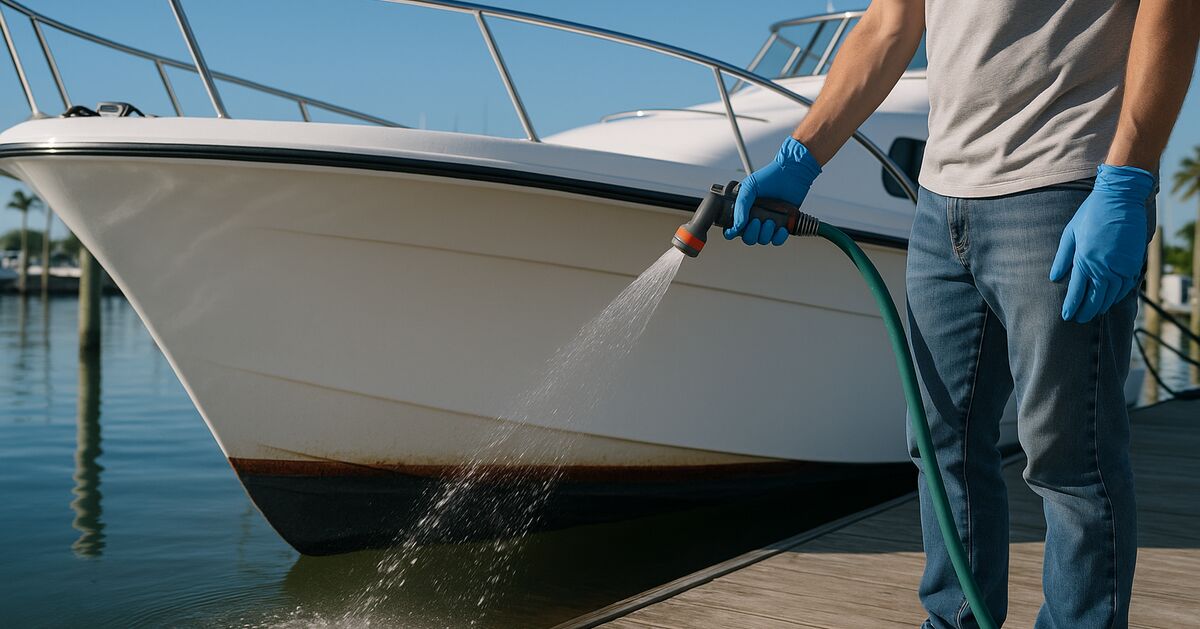
Before you apply any product, rinse every exterior surface thoroughly with fresh water. This removes loose particulate matter, dilutes the surface concentration of toxins, and gives you a clearer picture of what actually needs scrubbing versus what will simply wash off.
Use a hose with good pressure but not a pressure washer at this stage. A pressure washer applied directly to contaminated surfaces can aerosolize the residue and increase your inhalation exposure.
Step two: hull and gelcoat
A pH-neutral boat soap is the right choice here. Avoid acidic hull cleaners as a first pass on red-tide residue because the surface has already been exposed to organic acids; you don't want to compound that. Work the soap into the gelcoat with a soft brush or wash mitt, paying extra attention to the waterline.
If there's visible staining after the wash (a brownish or orange-yellow tint in the gelcoat), a dedicated gelcoat polish with mild abrasive action is the next step. This is also the point at which re-waxing becomes important. A clean surface with no protective wax layer is already vulnerable to the next set of problems. Our boat cleaning and detailing services include this full sequence for post-bloom situations.
For boats with ceramic coatings, the coating itself provides meaningful protection against residue penetration, though the surface still needs to be cleaned thoroughly after bloom exposure.
Step three: metal hardware
A dedicated marine metal polish or a mild non-abrasive cleaner (like a diluted white vinegar solution for light surface deposits on stainless) handles most of the film you'll find on hardware. For aluminum components, avoid anything acidic. Use a product labeled safe for aluminum, rinse well, and apply a protective wax or metal sealant afterward to close off any micro-etch the residue may have started.
Step four: upholstery and vinyl
Warm water and a marine-grade vinyl cleaner work well here. The key is not to use a solvent-based cleaner, which can strip plasticizers further. After cleaning, apply a UV-protective vinyl conditioner. This restores some of the plasticizer protection and helps close any surface microporosity that could trap future contamination.
Step five: canvas
Canvas requires a gentle approach. Use a soft brush, not a stiff deck brush, and a cleaner specifically formulated for marine canvas. After cleaning, let the canvas dry completely in open air before rolling or folding it. Damp canvas stored folded is a mildew problem within days in Sarasota's humidity.
Reapply a fabric waterproofing spray once the canvas is clean and dry. Blooms erode that protective coating faster than normal use.
Step six: non-skid deck
Non-skid texture traps organic residue in its recesses in the same way it traps salt and grime under normal conditions. A stiff but not metal-bristled brush and a good marine deck cleaner are the tools here. This is one of the more labor-intensive parts of post-bloom cleanup, and it's easy to underestimate how much residue has settled into the texture. Our detailed guide on why non-skid deck is harder to clean than gelcoat covers the technique in full.
Timing matters: don't wait for the smell to fade
A mistake that comes up repeatedly among boat owners in our area is waiting until the bloom has visibly cleared before cleaning. By that point, the residue has had days or weeks of contact time with your surfaces. The longer organic acids and lipophilic toxins sit on gelcoat, vinyl, and canvas, the more work it takes to restore those surfaces fully.
If you've been out on the water in bloom-affected conditions anywhere between Casey Key and Longboat Key, the practical rule is to rinse your boat the same day and do a proper wash within 24 to 48 hours. The difference in effort between cleaning after 24 hours versus after a week is significant.
What professional detailing looks like after a bloom
Post-bloom detailing is more involved than a standard wash. It typically includes the full exterior wash sequence, inspection and treatment of any surface staining, hardware polishing, vinyl cleaning and conditioning, canvas treatment, and re-application of protective wax or sealant to all exterior fiberglass.
If you're in Sarasota, Siesta Key, Lido Key, or anywhere else along our service area and you've come through a bloom, a professional detail at this point is not just cosmetic maintenance. It's protecting against the kind of cumulative damage that eventually requires more intensive and expensive restoration work. You can see our full list of locations we serve or reach out directly through our contact page to arrange a post-bloom clean.
A quick note on bloom tracking
Florida Fish and Wildlife's red tide status page (via FWRI) provides current bloom location and intensity data updated regularly. Checking it before outings is worthwhile not just for your health, but so you know how much decontamination your boat may need afterward. Blooms tend to concentrate in inshore areas during the late summer and fall, which is exactly when the waters around Osprey, Nokomis, and Venice see some of their highest recreational boat traffic.
For broader context on protecting your boat's surfaces in Sarasota County conditions year-round, our FAQ page covers the questions owners ask us most often about maintenance schedules and what different bloom seasons mean for a regular cleaning routine.
Red tide is part of boating life on the Gulf Coast. Knowing what it actually does to your surfaces, and how to respond quickly and safely, keeps your boat in far better shape through bloom season and beyond.
Sources & further reading
- Karenia brevis and red tide bloom monitoring in Florida waters (Florida Fish and Wildlife Conservation Commission (FWC))
- Brevetoxins and Karenia brevis biology overview (NOAA National Ocean Service)
Claim-by-claim audit (6 checked)
- “Aluminum may be more susceptible than stainless steel to pitting from prolonged exposure to acidic organic residue, based on how corrosion generally affects softer metals.” (rewritten to what the article can stand behind)
- “Brevetoxin exposure can occur through skin contact and inhalation, not just ingestion, so treat contaminated surfaces with caution.” (rewritten to what the article can stand behind)
- “It's generally advised to avoid water activities in red-tide-affected areas during active blooms for these same safety reasons.” (rewritten to what the article can stand behind)
- “A pressure washer applied directly to contaminated surfaces can aerosolize the residue and increase your inhalation exposure.” (reasoning shown in the article)
- “Brevetoxins are fat-soluble, meaning they bind readily to the plasticizers that keep marine vinyl soft and flexible.” (cited → oceanservice.noaa.gov)
- “Work with hatches and compartments open, since fumes and residue particles may build up in enclosed, poorly ventilated spaces.” (rewritten to what the article can stand behind)