One-time detail vs. maintenance wash program: which saves you more money in Sarasota?
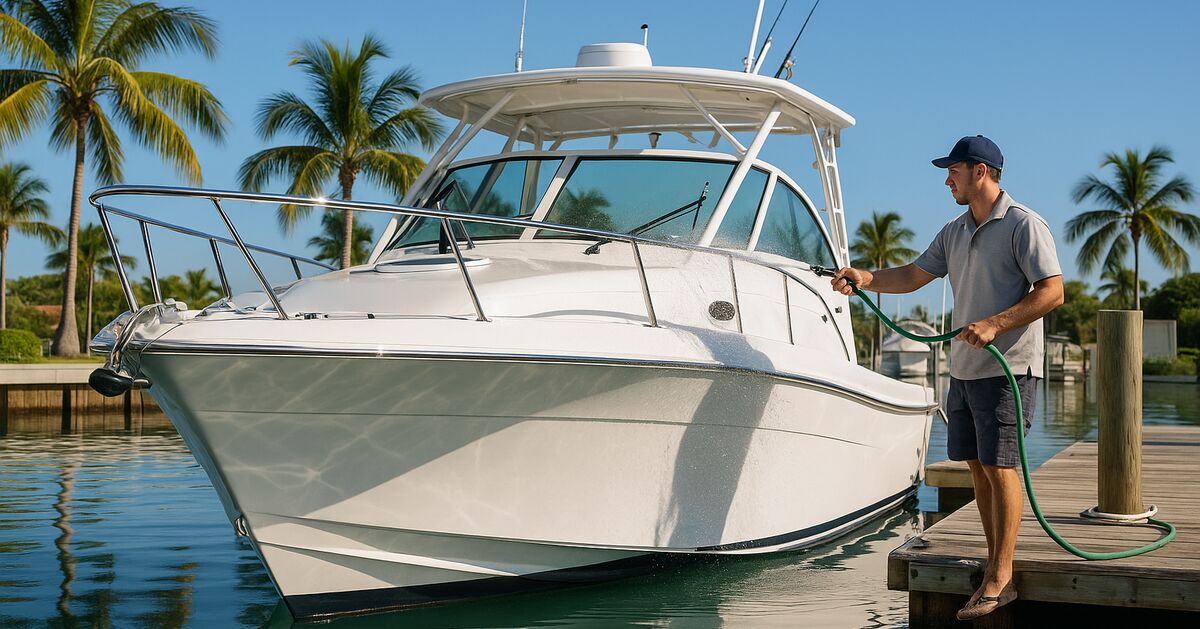
Salt spray hits your hull the moment you leave the dock, and in Sarasota County that process never really stops - the air near Sarasota Bay, Roberts Bay, and the Gulf passes salt particles over your gelcoat, canvas, and upholstery even on days you never leave the marina. The question many boat owners eventually ask is a practical one: should I book a thorough one-time detail when things look rough, or commit to a recurring maintenance wash program from the start? The answer involves real money, real chemistry, and a honest look at what Sarasota's marine environment actually does to a boat between cleanings.
What a one-time detail actually is (and what it costs you)
A one-time detail is a deep-cleaning event. Technicians address accumulated contamination - oxidation, waterline staining, salt scale, mildew, faded upholstery, corroded fittings - that has built up over weeks or months. Depending on the boat's condition, this can involve compound polishing to cut through chalky gelcoat, heavy-duty vinyl cleaners, stainless brightening, and multiple rounds of wax or sealant. The work is labor-intensive.
What drives the price of a one-time detail upward is the same thing that makes it necessary: time. Oxidation that has had three months to bond to fiberglass requires more abrasive cutting than oxidation that is three weeks old. Mildew that has worked into the texture of vinyl seams takes longer to treat than surface mildew caught early. A waterline ring that has mineralized over an entire season may need a chemical soak before it responds to mechanical scrubbing. You can see the full range of services we offer to understand how much each layer of work adds to a single visit.
None of that is a criticism of the one-time detail as a service. Sometimes it is exactly what a boat needs, particularly after a long haul-out, a summer unattended in a dry rack, or the aftermath of a red tide event (you can read more about surface damage from blooms in our post on how red tide residue affects your boat's surfaces after a bloom). The point is that the more neglect has accumulated, the more the one-time detail costs, and the more aggressively it has to treat your boat's surfaces.
What a maintenance wash program actually is
A maintenance program is a scheduled, recurring visit, typically every two, four, or six weeks depending on how often you use the boat and where it lives. The scope is lighter than a full detail: rinse and hand-wash the hull and topsides, clean and treat vinyl, wipe down stainless and aluminum fittings, clean glass and isinglass, inspect the bilge and livewell, and apply a quick-detail spray or protectant as needed.
The logic is preventive rather than corrective. Each visit removes the salt, organic material, bird droppings, fuel residue, and airborne contamination that have accumulated since the last one, before any of those things have enough time or concentration to etch, stain, or oxidize the surface beneath them. The technician also catches emerging problems early, a hairline crack in a canvas seam, early bronze-green staining on a cleat base, a spot of gelcoat oxidation starting on the bow - before they become expensive repairs.
The cost math: why maintenance is cheaper over time
Here is where the economics get concrete. The relationship between cleaning frequency and restoration cost is not linear - it compounds. A surface that goes unprotected for six months does not simply need six times the cleaning effort of a surface maintained monthly. Oxidation, in particular, penetrates deeper into the gelcoat over time, meaning that correction at month six may require a heavier compound cut than correction at month one, which removes more material from a layer that cannot be replenished. Do this enough cycles and the gelcoat becomes thin enough that polishing stops being an option and repainting or re-gelcoating becomes necessary.
Vinyl upholstery follows the same curve. UV-induced cracking starts on the surface and works inward. A vinyl conditioner applied every few weeks keeps the plasticizers that give vinyl its flexibility topped up. Skip conditioning for a season in Sarasota's sun and the cracks begin, then deepen, then reach the foam backing. At that point the seat cover needs replacement, not cleaning. Our post on why boat upholstery cracks and fades so fast on the Gulf Coast explains the UV and heat physics in detail.
The honest comparison for most boats used regularly in Sarasota County looks something like this:
- Maintenance wash program: Consistent, predictable cost every month or every other month. Gelcoat, vinyl, and canvas stay in service longer. Major detailing events (compound polish, full wax, deep fabric treatment) are needed less often and take less time when they do happen.
- One-time detail only: Lower cost in any individual month where nothing is booked. Higher cost when things finally deteriorate and a full restoration detail is needed. Additional cost if deterioration passes the point of cleaning into the territory of repairs or replacements.
In our experience, owners on a regular maintenance program tend to spend less overall than those who wait and book rescue details.
How Sarasota's specific environment accelerates the math
Sarasota County is not a forgiving marine environment. The combination of year-round sun intensity, high humidity, salt air that moves inland from the Gulf and the Bay, and warm water temperatures that accelerate biological growth means that contamination builds faster here than in many Northern or inland boating markets.
Boats kept in wet slips in Sarasota Marina, Marina Jack, or the marinas along Longboat Key are exposed to brackish or salt water around the clock. Boats kept at dry stack facilities in Osprey or Nokomis get rinsed between outings, but still accumulate salt in canvas folds, upholstery seams, and hardware crevices. Boats on private lifts on Bird Key or Lido Key canals see strong tidal movement and afternoon thunderstorms that rewet salt deposits and push them into gelcoat pores before they can be rinsed away.
The practical effect is that the interval between "clean" and "needs significant restoration work" is compressed relative to many other markets. What might be a reasonable six-month detail interval in a northern freshwater lake environment can easily become a damaging neglect cycle in Sarasota. Our locations page covers all the areas we serve, and the conditions genuinely differ from Casey Key's open Gulf exposure to the more sheltered canals of Nokomis, but all of them accelerate surface degradation faster than many owners expect when they first buy a boat here.
Where a one-time detail genuinely makes sense
There are scenarios where the one-time detail is the right call, not a compromise.
Buying or selling: A thorough detail before a sale or survey inspection is a straightforward ROI calculation. A well-presented boat commands a better price and inspires more buyer confidence.
Post-storage or post-haul-out: If the boat has sat in a rack or on the hard for several months, it needs a restoration baseline before a maintenance schedule can realistically begin.
Seasonal resets: Snowbirds returning to Siesta Key or Longboat Key after a summer away often find their boat in condition that requires a deep clean before regular maintenance can take over. Our blog post on what skipping post-outing cleaning does to your gelcoat gives context on exactly how fast damage accumulates during storage periods.
After a specific event: A red tide bloom, a fuel spill, a bird roost taking over the cockpit - these are events that call for targeted intensive cleaning regardless of what the regular schedule says.
In each of these cases, the smart move is a one-time detail to restore condition, followed by enrollment in a maintenance program to protect the work that was just done.
What to look for in a maintenance program
Not all maintenance wash programs are structured the same way. When you are comparing options, the questions worth asking include:
- What is the exact scope of each visit? Is vinyl conditioning included, or is it an add-on?
- How are between-visit issues handled? If a technician notices a problem, does someone contact you?
- Is the schedule fixed, or does it flex with your usage? A boat used every weekend needs more frequent attention than one used twice a month.
- What products are used on upholstery and non-skid surfaces? Harsh all-purpose cleaners do short-term cosmetic work and long-term damage.
- Does the program include periodic deeper work (a compound polish round, a full wax application) at defined intervals, or is it wash-only forever?
Our FAQ page addresses a number of common questions about what is and is not included in our programs.
The psychological accounting trap most boat owners fall into
A pattern that comes up again and again in conversations with boat owners is what you might call the "it still looks okay" justification. The boat gets used on a Saturday, there is some salt haze and a few bird droppings on the bow, but it does not look seriously dirty, so the cleaning gets postponed. Two weeks later the same thing happens. By week eight, the salt haze has become a haze-and-waterline combination, the bird droppings have etched into the gelcoat, and the vinyl has gone a shade duller. Now the cleaning that would have taken an hour in week two takes three hours in week eight and requires more product.
The insidious part is that the damage looks gradual from the inside. You are never choosing between a clean boat and a dirty one - you are choosing between a boat that got cleaned this week and a boat that did not, and those do not look dramatically different day to day. The divergence is only obvious at the end of a season, or when you put it next to a boat that has been properly maintained all year.
Putting both options together as a long-term strategy
Based on what we've seen, owners who combine a baseline detail, a regular maintenance program, and periodic deeper details tend to spend less and preserve resale value better over five to ten years. That combination keeps the boat in a condition where each service is affordable because nothing has been allowed to compound into a restoration project.
If your boat is already on a lift or in a slip in the Sarasota area and you are not sure which approach fits your situation, a honest assessment of current condition is the place to start. Reach out to us and we can give you a straight read on whether your boat needs a restoration detail first or can move directly into a maintenance program.
If you want to explore all the areas we cover, from Sarasota to Siesta Key to Longboat Key, our locations page has the full picture. The economics of good boat care are the same across all of them: consistent, timely cleaning costs less than corrective restoration, and both cost less than premature replacement.
Sources & further reading
- Corrosion in marine environments: metals and protective coatings (NACE International (now AMPP))
- Vinyl and polymer degradation from UV and heat exposure (National Institute of Standards and Technology (NIST))
- Florida coastal water quality and salinity data (Florida Fish and Wildlife Conservation Commission)
- Saltwater corrosion and marine surface protection guidance (BoatUS Foundation for Boating Safety and Clean Water)
Claim-by-claim audit (4 checked)
- “Oxidation, in particular, penetrates deeper into the gelcoat over time, meaning that correction at month six may require a heavier compound cut than correction at month one, which …” (reasoning shown in the article)
- “In our experience, owners on a regular maintenance program tend to spend less overall than those who wait and book rescue details.” (rewritten to what the article can stand behind)
- “Based on what we've seen, owners who combine a baseline detail, a regular maintenance program, and periodic deeper details tend to spend less and preserve resale value better over …” (rewritten to what the article can stand behind)
- “A well-presented boat commands a better price and inspires more buyer confidence.” (reasoning shown in the article)