Oxidized, Chalky Gelcoat: What Causes It and How It Gets Fixed
Run your hand across the side of an older boat around Sarasota and you will often come away with a faint white powder on your palm, and the hull that used to shine now looks flat, dull, and chalky. That is oxidation, and it is one of the most common problems we fix on the Suncoast. The good news is that oxidized gelcoat is usually very fixable, and once you understand what causes it you can keep it from coming back. Here is the honest, plain spoken version of what oxidation really is and how the repair actually works.
What gelcoat actually is
Most fiberglass boats are not painted. The outer shell is gelcoat, a thick pigmented resin sprayed into the mold before the fiberglass is laid up. When the boat comes out of the mold, that gelcoat is the smooth, glossy, colored surface you see. It is durable and it is designed to be the sacrificial outer layer that takes the abuse so the structural glass underneath stays protected.
The important thing to understand is that gelcoat is a resin, and resins break down when exposed to ultraviolet light and the elements over time. Gelcoat is fairly thick compared to paint, which is why it can be sanded and polished and brought back to life for years. But it is not infinite. Every correction removes a little material, so the goal is always to fix what is there and then protect it so you are not correcting it again next year.
What oxidation is, in plain terms
When the sun and salt attack the surface of your gelcoat, they degrade the very top layer of resin. The smooth, tightly bound surface starts to break down into a rough, porous, microscopically pitted layer. Instead of reflecting light like a mirror, that damaged surface scatters light in every direction. Your eye reads that scattered light as dullness, haze, and that chalky white or faded look.
The chalk you can rub off is literally dead resin and released pigment. That is why a badly oxidized red or blue hull will leave color on a white rag, and why a white hull goes flat and lifeless. The color is not gone, it is buried under a layer of degraded, light scattering surface. Polish that damaged layer away and the healthy, glossy gelcoat is usually still sitting right underneath.
What causes it here on the Suncoast
Oxidation is a wear problem, and three local forces drive it hard.
The sun is the biggest one. Southwest Florida gets intense ultraviolet exposure most of the year. UV is what actually breaks the chemical bonds in the resin. A boat stored in full sun with no cover and no wax will oxidize far faster than the same boat kept shaded or coated. The horizontal surfaces that face straight up at the sky, like the gunwales, the hardtop, and the bow, almost always oxidize first and worst.
Salt is the accelerator. Salt crystals are mildly abrasive and they hold moisture against the surface, which keeps a corrosive film working on the gelcoat between washes. Boats that run the Gulf passes and Sarasota Bay and never get rinsed collect a heavy salt load that speeds the whole process.
Neglect is the multiplier. Wax and coatings are what stand between UV and your gelcoat. When that protection burns off and is not replaced, the sun goes straight to work on bare resin. Most of the severe oxidation we see is not because the owner did anything wrong on the water, it is because months or years went by with no protection on the finish. Snowbird boats that sit through a Florida summer uncovered are the classic case.
How bad is it? The three rough levels
Not all oxidation is equal, and the severity decides how much work the fix takes.
Light oxidation looks like a slight loss of gloss and maybe a faint haze. The color is still mostly there, it just is not popping. This usually comes back with a one step polish and fresh protection.
Moderate oxidation is a clear chalky film, noticeable fading, and color that transfers to a rag. This is the most common condition we see on older local boats. It typically needs a compounding step to cut through the dead layer, followed by a polish to refine the gloss, then protection.
Heavy oxidation is deep chalkiness, a surface that looks almost matte, and sometimes color that has faded unevenly. This takes aggressive compounding, sometimes wet sanding, and multiple passes to restore. There is a point where the gelcoat is simply too thin or too far gone to correct fully, and at that stage the honest answer is paint or a gelcoat overhaul rather than polishing. We will always tell you if you are at that point rather than sell you a correction that will not hold.
How the fix actually works
Restoring oxidized gelcoat is a process of removing the damaged surface layer to reveal the healthy resin underneath, then protecting what is exposed. Here is how a proper job goes, step by step.
First comes a thorough wash and decontamination. There is no point polishing salt and grime into the surface, so the boat gets a real wash and the gelcoat is cleaned of contaminants first. This is also when we assess how deep the oxidation goes and set expectations honestly.
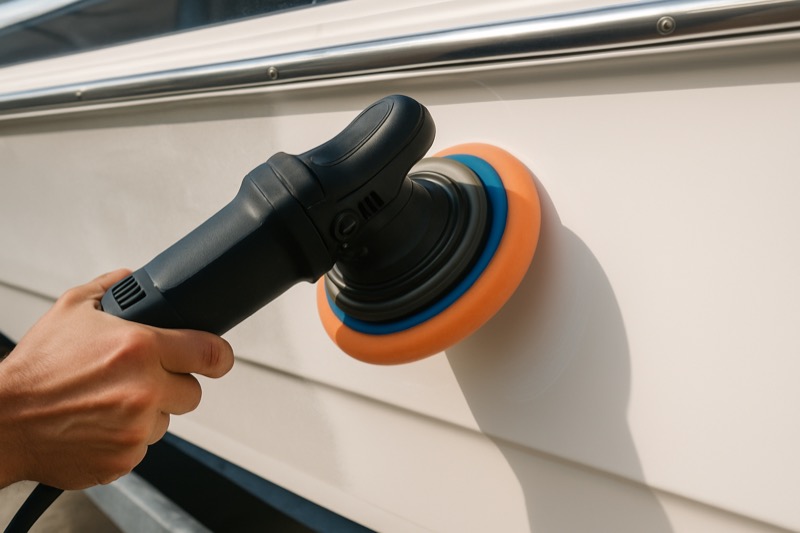
Next is compounding, which is the cutting step. Using a machine polisher and an abrasive compound, we remove the thin degraded top layer of resin. This is the step that does the heavy lifting on moderate and heavy oxidation. It requires control, because you are removing material and you only have so much gelcoat to work with. This is exactly why machine correction on a boat is not the same as waxing a car, and why it is easy to do damage with the wrong technique or too aggressive a pad.
After compounding comes polishing, the refining step. Compounding leaves very fine haze and swirl in the surface. Polishing with a finer product and pad refines that away and brings the gloss up to a deep, wet shine. On a good gelcoat this is where the color really comes alive again.
Finally, and this is the part people skip, comes protection. Freshly corrected gelcoat is clean, exposed resin with no defense against the sun. If you leave it bare, it will start oxidizing again almost immediately. So the last step is always to seal the surface, either with a quality marine wax or sealant or, better, with a longer lasting coating. Our oxidation removal and wax service always finishes with fresh protection for exactly this reason. Correction without protection is money thrown away.
Why protection is the whole game
Here is the part that saves you money over the years. Every correction removes a little gelcoat. If you oxidize, correct, oxidize, correct in an endless loop, you slowly sand your way through the finish until there is nothing left to save. The way you break that cycle is protection.
A traditional wax gives you a few months of UV defense before it burns off in our sun, which is why waxed boats need re protecting several times a year. A ceramic coating gives you a much tougher, longer lasting barrier that can hold for a year or more, dramatically slowing how fast oxidation comes back. For a freshly corrected hull, laying down a ceramic coating is the single best way to make that expensive correction last. We get into whether that upgrade pays off in our article on ceramic coating for Gulf Coast boats.
Either way, the routine after correction matters. Regular rinsing and washing keeps salt from re establishing its grip, and staying on a schedule means the protection gets refreshed before it fails. Our recurring maintenance program is built to keep a restored finish from ever sliding back into the chalky state you paid to fix.
Can you do it yourself?
You can, and plenty of owners tackle light oxidation with a machine polisher and patience. If your gelcoat has only lost a little gloss, a careful one step polish and a good wax can bring it back and it is honest work. Where people get into trouble is on moderate and heavy oxidation, where the temptation is to reach for the most aggressive compound and pad and just grind. That is how you burn through an edge, leave holograms and swirl marks, or create uneven patches that look worse than the oxidation did.
The two things that separate a professional correction are judgment and finish. Judgment about how much to cut, where the gelcoat is thin, and when to stop. And the final polishing step that most DIY jobs skip, which is the difference between a hull that looks acceptable from ten feet and one that looks genuinely deep and wet up close. If your boat is past light oxidation, it is usually worth having it corrected properly once and then protected well so you are maintaining it rather than rescuing it.
Get an honest assessment
The hardest part of oxidation for an owner is judging how bad it really is and whether it can come back. That is where a look in person is worth more than any article. We will tell you honestly whether your gelcoat is a light polish, a full correction, or genuinely past the point where polishing makes sense.
You can see the full range of what we do on our services page, get straightforward numbers on our pricing page, or request a free quote and we will assess your finish and lay out realistic options. We restore chalky, sun beaten gelcoat on boats all over the county, from Siesta Key to Longboat Key to Osprey. Most owners are surprised by how much color is still hiding under that haze, waiting to come back.