Leaving Your Boat for the Summer? A Snowbird's Guide to Coming Back to a Clean Boat
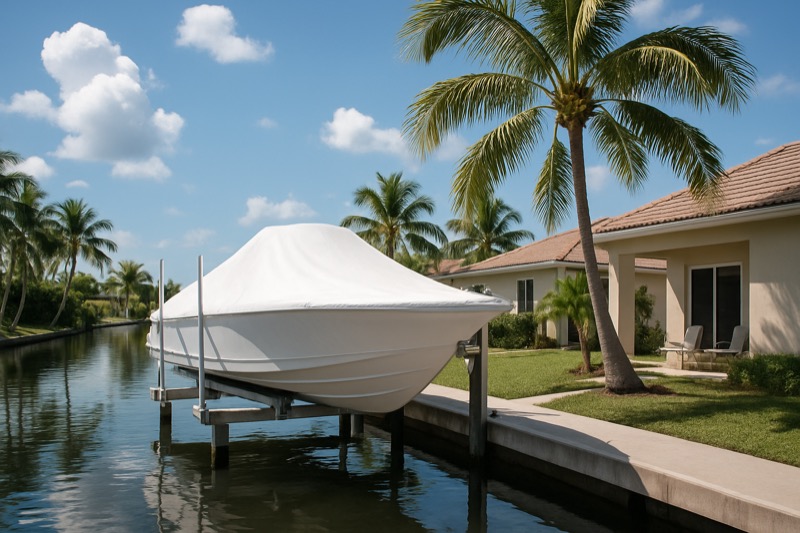
Every year, a big share of the boats we clean around Sarasota belong to owners who are only here for part of the year. They come down in the fall, run the boat all winter and spring, and then head back north for the summer, leaving the boat behind on a lift, at a dock, or in a slip. It is one of the most common situations on this coast, and it is also the one where a little planning makes the biggest difference. A boat left sitting through a Gulf-coast summer is exposed to the two hardest months of sun, heat, and humidity of the whole year, with nobody around to rinse the salt off or wipe down a seat. Come back in the fall to a boat that was not prepped, and you are often looking at chalked gelcoat, a fouled bottom, and a cabin that smells like a locker room. Prep it right, and you step back aboard a boat that looks almost the way you left it.
This is a guide to doing that the easy way. Some of it you can handle yourself before you leave. The rest is exactly what our clients hand to us so they can fly home without worrying about it.
Why summer is the hard season for an idle boat
It is tempting to think a boat that is not being used is a boat that is not wearing out. On the Gulf coast, the opposite is closer to the truth. The Florida summer sun is relentless, and ultraviolet light is what breaks down gelcoat and fades it to a dull, chalky white. A boat that sits uncovered in that sun for four or five months ages faster than one that is run and cared for. Heat and humidity do their own damage below deck, where a closed-up cabin becomes a warm, damp box that mildew loves. And under the waterline, marine growth does not take the summer off. Slime and barnacles build steadily on a hull that never moves, and by fall the bottom can be badly fouled.
Salt ties all of it together. Every bit of salt spray and salt air that settles on the boat stays there, drawing moisture and working on metal and finishes, unless something washes it off. When you are here, you rinse the boat after a run without even thinking about it. When you are gone, nothing does, and the salt just accumulates week after week.
What you can do before you leave
A few simple steps before you head north go a long way. Give the boat a thorough final wash so it goes into storage clean rather than covered in a season's salt. Pull anything organic out of the cabin and cooler, because food, drinks, and damp towels are what turn a musty smell into a real mildew problem. Leave the refrigerator propped open so it does not grow mold inside. Crack a couple of interior compartments so air can move a little. If the boat has a canvas cover or a full enclosure, make sure it is clean, dry, and secured, because a cover that traps moisture against the boat can do more harm than no cover at all.
None of this is complicated, but it is easy to run out of time in the last few days before a flight. That is exactly why so many owners have us handle the send-off wash and the return detail, so the boat is looked after on both ends without it eating into their last week on the water.
The real answer: a maintenance plan while you are gone
The single best thing you can do for a boat that sits all summer is not to leave it sitting untouched at all. A scheduled wash on a regular interval keeps the whole problem from ever building up. When we come by on a wash and maintenance program, we rinse and wash off the accumulated salt, knock down any early mildew before it sets into the vinyl, keep the deck and non-skid clean, and give the boat a set of eyes on a regular basis so nothing gets out of hand. It is a fraction of the cost and effort of a full rescue detail in the fall, and it means the boat is never more than a couple of weeks away from its last cleaning.
Owners on the islands and in the canal neighborhoods, from Bird Key to Longboat Key, tend to set this up before they leave and forget about it. We handle the access, do the work, and they get a clean boat waiting for them when they return. For a boat kept in a slip down in Venice or anywhere along the coast, the story is the same: the boat that gets touched every few weeks comes through the summer in far better shape than the one nobody sees until October.
Do not forget the bottom
Everything above deck is only half the picture. The hull and bottom are where an idle boat quietly loses its condition, because a boat that never moves is a perfect surface for growth. Slime forms within days, and barnacles follow, and by the end of a summer an unattended bottom can be genuinely fouled. That matters even if you are not running the boat, because heavy growth can work on running gear and make the first trip of the fall slow and sluggish until the bottom is cleaned. Keeping the bottom on a regular in-water cleaning schedule through the summer keeps it from ever getting to that point. If the boat sat all season with no bottom attention, a good in-water cleaning is usually the first thing it needs when you get back.
Boats on trailers and in dry storage need it too
Not every summer boat sits in the water. Plenty of owners pull the boat and leave it on a trailer at the house or in a dry-stack rack for the season, and it is easy to assume a boat out of the water is a boat out of trouble. It is better off below the waterline, since there is no growth to worry about, but the sun and salt air are still working on everything above deck, and a trailered boat left uncovered in a Florida side yard bakes just as hard as one on a lift. A boat under a cover that traps humidity can actually fare worse, growing mildew in the trapped damp air. The same basic plan applies: get it clean before it sits, keep the cover clean and dry, and give it attention through the season rather than letting five months of sun, pollen, and salt build up untouched. We are just as happy to service a boat on a trailer in the driveway as one on a lift behind the house.
Coming back: the return detail
For a lot of owners, the return is where we do the most. A boat that sat through the summer usually wants a full going-over: a thorough wash to strip off months of salt and grime, a look at the gelcoat to see whether the sun has started to chalk it, and real attention to the interior and upholstery where mildew and stale air tend to settle in over a closed-up summer. Vinyl seats that have gone spotty with mildew can almost always be brought back if they are cleaned and conditioned properly, and getting the musty smell out of a cabin is mostly a matter of cleaning the surfaces where it lives and getting air moving again.
If the gelcoat has dulled over the summer, this is also the natural time to bring the shine back with an oxidation removal and wax before the season starts. Handling it in the fall means the boat looks its best for the winter you actually came down to enjoy, rather than you spending the first month back scrubbing. A straightforward wash and full detail is often all a well-prepped boat needs to be ready to run again.
What we actually watch for on each visit
When we keep a boat on a summer schedule, each visit is more than a rinse. We are watching for the small things that turn into big ones: the first spotting of mildew on a seat before it sets into the vinyl for good, salt building up in the corners and around hardware, a cover that has shifted or started to pool water, early growth creeping up the waterline, and any standing water finding its way somewhere it should not be. Catching those early is the whole point. A seat wiped down before mildew takes hold stays perfect; a seat left three months turns into a real cleaning job. That steady set of eyes on the boat is often worth as much as the cleaning itself, because it means nothing gets a five-month head start while you are a thousand miles away.
Ceramic coating: the low-maintenance option for absentee owners
If leaving the boat for months at a time is your normal pattern, it is worth thinking about longer-term protection. A ceramic coating gives the gelcoat a hard, slick layer that sheds water and dirt and, importantly, shrugs off a lot of what the summer sun and salt would otherwise do to an unprotected finish. It does not make a boat maintenance-free, but it does mean the finish is genuinely protected while you are away, and that the washes it does get go faster and leave a cleaner result. For an owner who is only here half the year, that trade can be well worth it.
What it costs, and how to set it up
The honest answer on cost is that it depends on the boat and what you want done, which is why we look at the actual boat and put a real number in writing rather than guessing over the phone. A summer maintenance schedule is priced per visit and is far cheaper than a fall rescue; a full return detail is priced on the size and condition of the boat. Our pricing page walks through what actually drives the number, and there is no charge and no pressure to get a free quote.
Setting it up is simple. Before you leave, tell us the boat, where it is kept, and how to get access to the dock, lift, or slip. We take it from there, keep the boat clean through the summer, and have it ready for you in the fall. You get to spend your last week on the water instead of prepping the boat, and your first week back on the water instead of cleaning it.
If you are heading north soon and want the boat looked after while you are gone, or you are coming back to a boat that has been sitting and needs to be brought back to life, reach out for a free quote and we will put together a plan that fits how you use the boat. A boat that gets a little steady attention through the summer is a boat that is ready to go the day you come home.