How to clean and protect teak decking on a saltwater boat in Sarasota's climate
Teak decking is one of the most satisfying things a boat can wear - warm underfoot, grippy when wet, and genuinely beautiful against blue Gulf water. It is also one of the quickest things to go wrong when you keep a boat in a place like Sarasota, where intense UV, salt air, and near-daily humidity create conditions that punish neglected wood faster than almost anywhere in the country.
The good news is that teak is a naturally durable, oily hardwood that responds very well to consistent, correct care. The bad news is that a lot of well-meaning boat owners accidentally accelerate the damage by using the wrong products, scrubbing too hard, or skipping steps. This guide covers everything you need to know: why teak grays and dries out here, how to clean it properly, which treatments actually work in Southwest Florida's climate, and how to stay ahead of the maintenance cycle so the wood never reaches the point where it needs aggressive restoration.
Why teak on Sarasota boats takes such a beating
Sarasota sits on the Gulf of Mexico, which means your boat is exposed to intense summer UV radiation, airborne salt from Sarasota Bay and the open Gulf, and a humidity cycle that swings from soaking wet to baking dry within a single afternoon. That combination hits teak in three ways simultaneously.
Salt infiltration. Salt crystals work their way into the open grain of the wood and, as the wood expands and contracts through heating and cooling, those crystals act like tiny wedges. Over time this opens the grain further, allows more salt in, and starts to break down the wood's surface fibers.
UV oxidation. The natural oils in teak are degraded by ultraviolet light. As those oils break down, the wood loses its warm golden-brown color and the surface fibers lose their cohesion. This is what produces the familiar silvery-gray patina. A little gray can look intentional on a classic vessel, but unchecked graying means the wood is actively drying out and becoming brittle.
Mildew growth. The humidity here, especially from May through October, gives mildew spores exactly what they need. Teak that is not kept reasonably clean will develop dark streaking, particularly in the caulking seams between planks. Mildew on the wood surface is mostly cosmetic at first, but it holds moisture in an uneven way and contributes to the expansion-contraction stress mentioned above.
Boats docked along the marinas in Sarasota, out on Longboat Key, or moored near the channels around Siesta Key are all facing the same conditions. The difference in how their teak looks after two seasons usually comes down entirely to the maintenance routine.
The two things most boat owners get wrong
Before getting into the correct process, it is worth naming the two most common mistakes, because they are both done with good intentions.
Mistake one: using a pressure washer or stiff bristle brush. Teak grain runs in alternating soft and hard bands. A pressure washer or a stiff brush hits the soft bands harder than the hard bands, raising the grain unevenly and creating a fuzzy, rough texture that is much harder to protect afterward. It also physically removes wood material every time you do it, shortening the life of the decking noticeably over years.
Mistake two: applying a penetrating oil on top of dirty or salt-contaminated wood. Teak oil or teak sealer is meant to replenish and protect the wood's natural oils. If you apply it over salt residue, mildew, or old oxidized surface fibers, you seal all of that in. The treatment cannot penetrate properly, it looks blotchy within weeks, and the underlying contamination continues to damage the wood from underneath.
Step 1: Rinse first, always
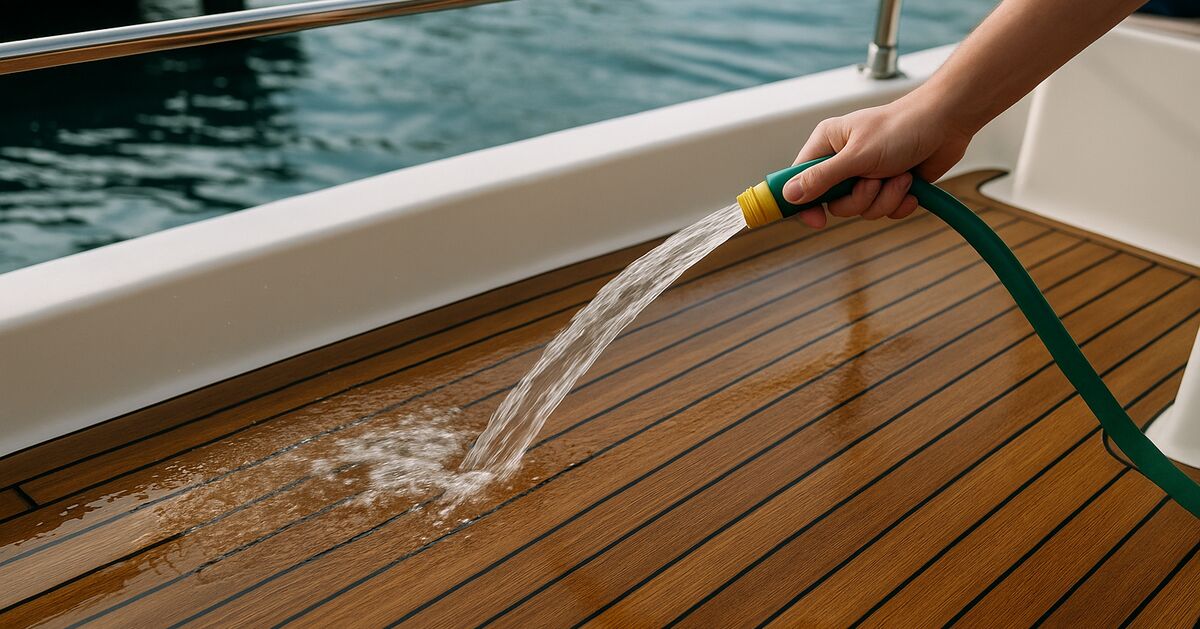
Before you apply any cleaner, rinse the teak thoroughly with fresh water. This dissolves and flushes surface salt, removes loose debris from the seams, and lets you see the true condition of the wood before you commit to a cleaning approach. Use a gentle flow from a standard garden hose, not a pressure nozzle.
If your teak is only lightly soiled, meaning it has not been left untreated for more than a month or so and shows no significant graying, this rinse plus a mild soap scrub (described below) may be all you need.
Step 2: Choose the right cleaner for the condition
There is a meaningful difference between routine cleaning and restoration cleaning. Using a strong two-part teak cleaner on wood that only needed a gentle wash is overkill and strips natural oils unnecessarily.
For routine maintenance (monthly or after heavy use): Use a purpose-made teak soap or a very dilute solution of dish soap in fresh water. Apply with a soft natural-bristle brush or a non-scratch scrub pad. Always scrub with the grain, never across it. Rinse completely and let the wood dry.
For moderate graying and surface mildew: A single-part teak cleaner containing oxalic acid is appropriate. Oxalic acid brightens the wood, lifts iron stains (common near stainless hardware), and kills surface mildew without the harshness of a two-part system. Apply, scrub gently with the grain, let it dwell for a minute or two, and rinse very thoroughly. Oxalic acid residue left in the grain will interfere with any sealer you apply.
For significant graying, deep mildew, or wood that has not been treated in a long time: A two-part teak cleaner (Part A is a mild acid, Part B is a mild bleach/brightener) is the appropriate tool. Follow the product directions carefully. Never let Part A dry on the wood before applying Part B. Rinse extremely well between each part and after the final step. Two-part cleaners are effective but they do strip oils aggressively, which makes the follow-up treatment step non-negotiable.
Step 3: Let it dry completely before treating
This is the step people rush and regret. Teak needs to be bone dry before you apply any sealer, oil, or protectant. In Sarasota's humidity, "dry" does not mean dry to the touch. Give it at least 24 to 48 hours of dry weather after cleaning. If you apply a sealer to wood that still has moisture trapped in the grain, the treatment will not bond correctly, it will peel or blister, and you will have to strip it and start over.
Step 4: Choose between teak oil and teak sealer
This is where a lot of people get confused, and the distinction genuinely matters.
Teak oil is a penetrating finish that soaks into the wood and replenishes the natural oil content. It gives a beautiful warm glow and feels very natural. The downside in a climate like Sarasota's is that it needs to be reapplied frequently, often every four to eight weeks in the harsh sun and salt air, because it breaks down quickly when exposed to UV. Each reapplication also brings a small risk of the oil going rancid in the grain in humid conditions, which can contribute to mildew.
Teak sealer (sometimes called teak protector) forms a slightly harder surface layer that is more UV-resistant than straight oil. A good sealer applied to clean, dry teak can last three to six months here before needing a refresh, which makes it a much more practical choice for boats that are in the water regularly.
For most Sarasota boaters, a quality teak sealer applied two to three times per year is the right answer. It keeps the wood from graying, repels salt water, and takes far less ongoing effort than frequent oil applications.
Apply the sealer with a foam brush or a dedicated teak sealer applicator pad. Work with the grain. Apply in thin, even coats rather than one heavy coat. Two thin coats with an hour of dry time between them give better penetration and adhesion than one thick application. Mask off any adjacent fiberglass or gelcoat before you start, because teak sealer that gets onto white surfaces is genuinely difficult to remove.
Step 5: Protect the caulking seams
The black or dark brown caulking between teak planks is usually a polysulfide or polyurethane compound. It is flexible and waterproof, but it is also vulnerable to UV degradation and to cleaning products. When using any acid-based cleaner, try to minimize contact time on the seams and rinse them promptly. Hardened or cracked caulking should be professionally recaulked before it allows water to penetrate under the planks, which causes delamination problems that are far more expensive to fix than the caulking itself.
Between treatments: the simple things that make the biggest difference
Consistent light maintenance between deep cleaning and sealing cycles is what separates teak that looks great for years from teak that needs aggressive (and expensive) restoration every season.
- Rinse with fresh water after every outing on salt water. This is the single highest-return habit you can build.
- If the boat sits in the rain, wipe standing water off the teak when you can. Prolonged water contact softens the surface fibers.
- Avoid leaving wet lines, fenders, or gear sitting on the teak in the same position for days at a time. The contact pattern traps moisture and creates dark staining.
- Keep the teak seams clear of debris. Leaves, pine needles, and dirt packing into the seams hold moisture against the wood and the caulking.
If you are also dealing with related maintenance tasks, our post on how to clean and protect your boat's canvas and bimini top in Sarasota's sun and salt air covers the same UV and humidity challenges on a different material, and many of the scheduling principles apply across the whole boat.
When to call a professional
There are situations where DIY teak maintenance reaches its limits.
If the wood has gone genuinely silver and dry across large sections, if the grain is raised and fuzzy from previous pressure washing, or if the caulking seams are cracked or lifting, you are looking at a restoration rather than a maintenance job. Restoration typically involves machine sanding (always with the grain, and with great care not to sand through thin veneer decking), thorough cleaning, and multiple applications of sealer over several days. It is the kind of work that is easy to make worse with the wrong tools or rushed timing.
Boats all along the coast, from Bird Key and Lido Key down through Casey Key, Osprey, and Nokomis, tend to come in for professional teak attention after a summer of heavy use or after a season of being left to sit without treatment. If you are not sure whether your teak needs maintenance or restoration, an honest assessment from someone who works with this wood regularly is worth the conversation before you commit time and product to an approach that may not be right for the condition.
Our full list of boat cleaning and detailing services includes teak work, and you are welcome to visit the FAQ page for common questions about scheduling, what to expect, and how we approach different surface conditions. If you would rather just describe what you are seeing and get a straight answer, the contact page is the easiest place to start.
How often should you do this in Sarasota?
In a climate this demanding, a realistic teak care calendar looks roughly like this:
- Fresh water rinse after every salt water use. No exceptions.
- Mild soap wash: monthly, or after any trip that involved heavy spray, fish cleaning, or guests tracking debris across the deck.
- Oxalic acid brightening: two to three times per year, or whenever you notice early graying or light mildew.
- Teak sealer reapplication: two to three times per year, following a brightening wash. Spring (before the summer rainy season) and fall (after it) are natural anchor points.
- Professional inspection and restoration as needed: every two to four years for regularly maintained teak, sooner if the routine slips.
If that schedule sounds like more than you want to manage alongside everything else that goes into owning a boat in Southwest Florida, you are not alone. A lot of owners find it makes more sense to hand teak care off to someone who is already handling the rest of the boat on a regular schedule. You can see everything we cover across our complete service area and get a sense of how we typically structure ongoing maintenance programs.
The bottom line
Teak decking in Sarasota is not maintenance-free, but it is absolutely maintainable. The wood wants to look good. It has natural properties that make it resilient in marine environments. What it cannot do is take care of itself through a Florida summer while being rinsed with salt water day after day and baked under Gulf Coast sun.
The key habits are simple: rinse with fresh water religiously, clean gently and with the grain, let the wood dry completely before sealing, and choose a quality sealer over frequent oil applications. Do those things consistently and the teak on your boat will stay warm, golden, and solid for many years.
Neglect any one of those steps for a full season and you will spend a weekend sanding and starting over. The maintenance is genuinely much easier than the restoration.