How to clean and protect your boat's canvas and bimini top in Sarasota's sun and salt air
Your bimini top will fail faster here than almost anywhere else in the country, and the reason is sitting right above you every single day.
Sarasota sits at roughly 27 degrees north latitude, which puts it squarely in one of the highest UV zones in the continental United States. Combine that with the salt air rolling in off Sarasota Bay, Little Sarasota Bay, and the Gulf itself, and you have a combination that is genuinely punishing on fabric, stitching, zippers, and coatings. Canvas that might last eight years on a boat in Michigan can look faded and stitched-apart in three years here if it is not maintained correctly.
The good news is that the process is not complicated. It is mostly about consistency and using the right products in the right order. This post walks you through everything: how to clean canvas safely, how to treat mildew (which is almost inevitable in Southwest Florida), how to re-apply water repellency, and what to do between washes to slow down UV degradation.
Why Sarasota is So Hard on Boat Canvas
Before getting into the how, it helps to understand the why, because it changes the way you approach the whole job.
UV radiation is the primary enemy. The sun breaks down the synthetic fibers in Sunbrella and similar acrylic fabrics at a molecular level over time. It also degrades the thread, which is often the first thing to go visually: you will notice stitching pulling apart at seams before the fabric itself looks destroyed. UV also bleaches color out of darker fabrics, turning navy blue into a washed-out gray and forest green into something closer to khaki.
Salt is the second enemy. Salt crystals are abrasive, and when they deposit on canvas and dry out, they work their way into the fibers with every bit of movement and flexing the top goes through. Salt also holds moisture against the fabric, which creates the warm, wet, slightly shaded environment that mildew absolutely loves.
Heat is the third factor. Canvas that bakes in the Florida sun gets extremely hot, and that heat accelerates every other form of degradation. It dries out the fabric's natural flexibility, makes coatings brittle, and causes zippers and snaps to expand and contract repeatedly until they crack or seize.
Boats docked on Longboat Key, Siesta Key, or out on Casey Key get the full Gulf-facing exposure, which is often more intense than inland bay locations. Even boats stored at marinas closer to the intercoastal on the Nokomis or Osprey side of the county are not spared, because salt air travels well inland, especially during afternoon sea breezes.
Step One: Rinse First, Every Single Time
This sounds obvious, but it is skipped more than you would think. Before any cleaning product touches your canvas, rinse it thoroughly with fresh water from a garden hose.
Why does this matter so much? Because salt crystals and loose grit are abrasive. If you apply a brush or a sponge to dry or salty canvas, you are essentially scrubbing those particles across the fibers. Over time, that mechanical abrasion opens up the weave, destroys the water-repellent finish faster, and creates small surface breaks where mildew can take hold.
A good rinse loosens most of the loose debris, dissolves surface salt, and softens any dried bird droppings or organic material before you ever make contact with the fabric. Use a gentle flow, not a pressure washer. Pressure washers force water through the weave in ways that damage the DWR (durable water repellent) finish and can literally blow stitching apart at seams. A standard garden hose with a spray nozzle set to a fan pattern is exactly what you need.
Step Two: Choose the Right Cleaner
Not all canvas cleaners are equal, and several common household products will actively damage your fabric.
What to avoid:
- Bleach or bleach-based cleaners: Bleach degrades the acrylic fibers in Sunbrella and similar fabrics and destroys the UV-inhibiting finish. A little mildew might disappear, but you are trading a cosmetic problem for structural damage.
- Dish soap or laundry detergent: These are designed to strip oils and coatings. On canvas, they strip the DWR finish along with the dirt, leaving the fabric soaking water like a sponge.
- Harsh solvents or acetone: These will discolor fabric and destroy any protective treatment already in the weave.
What to use instead:
- A purpose-formulated canvas cleaner, such as 303 Fabric and Vinyl Cleaner, Iosso Mold and Mildew Stain Remover, or the Sunbrella-branded cleaner (if your fabric is Sunbrella). These are pH-balanced for synthetic acrylic fabrics and will not strip your water repellency any more than necessary.
- For light general cleaning, a very small amount of mild soap (think Woolite or a dedicated canvas soap) diluted heavily in water can work for routine washes.
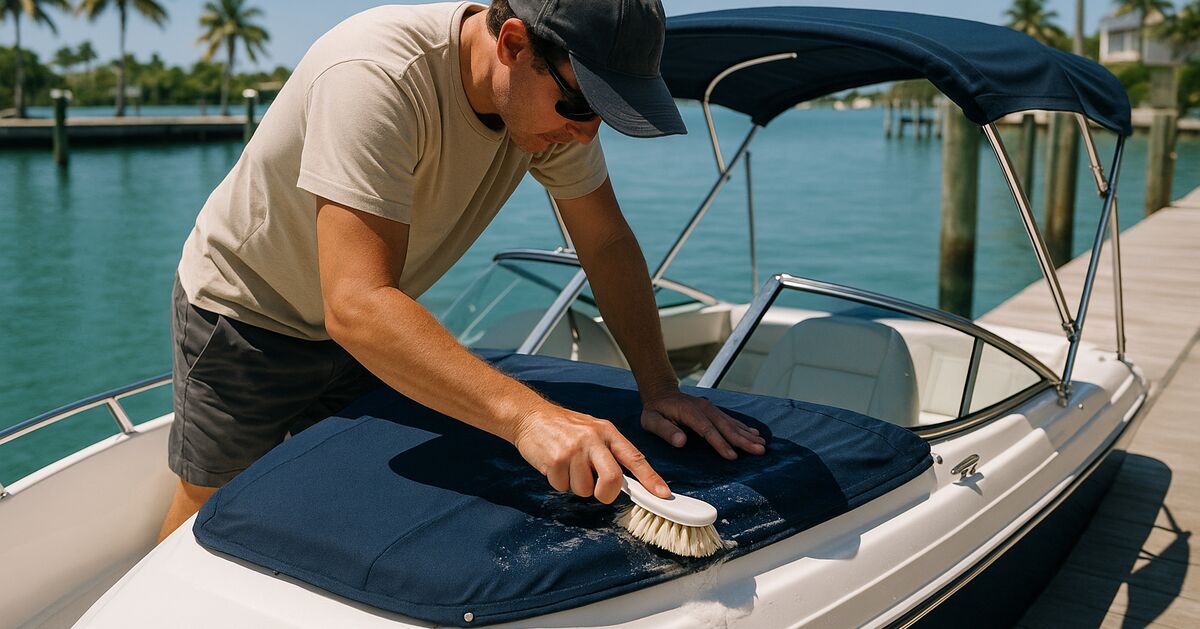
Apply your cleaner to the wet fabric, work it in gently with a soft-bristle brush (a car wash brush or a soft deck brush works well), and let it dwell for a few minutes on any stained areas. Then rinse thoroughly. Any cleaner left in the fabric will continue working long after you are done, which is not something you want.
Step Three: Treating Mildew the Right Way
Mildew on canvas is nearly unavoidable in Southwest Florida, especially on boats that are covered or kept in slips where air circulation is limited. It shows up as dark gray or black spots, often concentrated at seams or in low areas where water pools.
The important distinction is between mildew stains and active mildew growth. Active growth is fuzzy, slightly raised, and smells musty. Stains are flat discolorations left behind after the mildew itself is gone. Treating active growth requires a biocidal cleaner. Treating stains is more of a cosmetic effort.
For active mildew, a diluted solution of a mildew-specific canvas cleaner (many contain oxygen bleach or quaternary ammonium compounds rather than chlorine bleach) is your best option. Apply it, work it in gently, let it dwell for five to ten minutes, then rinse completely. In stubborn cases you may need a second application. Do not scrub aggressively, because that pushes mildew deeper into the weave.
For staining left after treatment, some discoloration is permanent, particularly on lighter fabrics. Accepting a faint ghost stain is better than over-treating with bleach and destroying the fabric itself.
After mildew treatment, let the canvas dry completely in open air before folding or storing. Folding damp canvas is how you guarantee the mildew comes back within a week.
Step Four: Re-applying Water Repellency
This is the step most boat owners skip, and it is probably the most important one for long-term fabric health.
Sunbrella and most marine canvas fabrics are solution-dyed acrylic, meaning they are inherently resistant to UV and mildew to a degree. But the thing that makes water bead off and roll away is a separate DWR coating applied at the factory. Every time you clean the canvas, some of that coating is removed. Every time the canvas bakes in Sarasota's summer sun, a little more degrades.
Once the DWR is gone, water soaks into the fabric instead of beading off. A soaked bimini top is heavier, stays wet longer, dries more slowly, and creates the perfect incubator for mildew between uses.
Re-applying a fabric water repellent is straightforward:
- Make sure the canvas is completely clean and completely dry. Applying a repellent over dirt or damp fabric traps contaminants in the weave.
- Use a spray-on fabric guard designed for marine canvas. 303 Fabric Guard is the most widely recommended by canvas shops and marine detailers. Star Brite Waterproofing Spray and similar products also perform well.
- Apply an even coat, working in sections. Let it soak in for the dwell time listed on the product label, then wipe off any excess.
- Allow it to cure fully before the canvas gets wet, typically 24 to 48 hours.
In Sarasota's climate, plan on re-treating canvas roughly every six to twelve months, or after any deep cleaning. If you notice water no longer beading and instead soaking in immediately, that is your sign that it is time.
Step Five: UV Protectant for the Long Haul
Fabric guard handles water repellency. UV protectant is a separate product that slows down the photodegradation of the fibers themselves.
303 Aerospace Protectant is the go-to recommendation in the marine world for vinyl and canvas surfaces. It is not a silicone-based product, so it does not leave a greasy residue that attracts dirt. It applies like a spray detailer, you wipe it on and buff it lightly, and it leaves a mild UV-blocking layer on the fabric surface.
On a boat spending weekends anchored off Siesta Key or running out through Venice Inlet, where you have full open-sky exposure for hours at a stretch, applying a UV protectant every few months is a genuinely useful habit. It will not make the fabric invincible, but it slows the fading and fiber breakdown that eventually makes replacement unavoidable.
What About Zippers, Snaps, and Frames?
Canvas care is not just about the fabric. The hardware attached to it matters just as much, and often fails first.
Zippers on enclosures and covers should be lubricated regularly with a dedicated zipper lubricant (beeswax-based or a product like McLube Sailkote). Salt causes zipper teeth to seize, and forcing a seized zipper tears the fabric at the pull. A thirty-second wipe-down of the zipper teeth after every rinse makes a significant difference.
Snaps and fasteners corrode quickly in salt air. After rinsing, a light wipe with a water-displacing lubricant keeps them moving freely. If snaps start to resist or feel gritty, do not force them. Work in some lubricant and let it dwell before trying again.
Aluminum and stainless frames under bimini tops benefit from the same rinsing attention as the fabric itself. For more on why metal corrodes so aggressively in our local waters, the post on why boat metal fittings corrode so fast in Sarasota's waters goes into detail on the chemistry involved.
How Often Should You Be Doing This?
At a minimum, rinse your canvas with fresh water every time the boat is used or after any significant salt spray or rain. A full cleaning with a canvas-specific cleaner should happen every one to two months for boats in regular use. Re-application of fabric guard and UV protectant should follow every deep clean, or at least every season.
If you are running your boat on weekends out of a slip in Sarasota or Osprey, you are looking at more frequent attention than someone who trailors and stores dry. The combination of constant ambient salt air and condensation cycles makes fabric maintenance more important for liveaboard or slip-kept boats.
For a broader look at how often different parts of your boat need attention in this climate, the guide on how often to wash and detail your boat in Southwest Florida is worth reading alongside this one.
Signs It Is Too Late for Cleaning and You Need Replacement
Not every canvas issue is fixable with cleaning and retreatment. Here are the honest signs that fabric has reached end of life:
- Stitching is pulling apart at multiple seams and the thread itself is brittle or powdery
- The fabric tears easily when flexed, or you can see daylight through worn areas
- Water no longer beads at all even after re-treatment, because the fiber structure itself is compromised
- Mildew has penetrated so deeply that it remains after multiple treatments and the smell does not go away
Canvas replacement is a significant expense, but continuing to use structurally compromised canvas creates its own problems: UV exposure gets through to upholstery and electronics, and a failed top during an afternoon Gulf squall is a real inconvenience. Good maintenance extends life, but at some point, replacement is the better call.
When It Makes Sense to Hand It Off to a Pro
Some boat owners enjoy the hands-on maintenance side of ownership. Others would rather be on the water than working on the boat. Both are reasonable positions.
Professional canvas cleaning as part of a full boat detail service ensures the job is done with the right products and without the risk of accidentally using something that damages the fabric or voids any canvas warranty. It also pairs well with the rest of a detail: hull, gelcoat, upholstery, and canvas all cleaned and treated at once rather than piecemeal.
If you are curious about what a full detail covers and what it typically involves, our boat cleaning and detailing services page has a full breakdown. We cover boats throughout the Sarasota area, from Longboat Key and Lido Key down through Siesta Key, Casey Key, and all the way to Venice and Nokomis. You can see the full list of areas we serve on our service locations page.
If you have questions about your specific canvas situation or want to get a cleaning scheduled, the easiest next step is to get in touch with us directly. We are happy to take a look and give you an honest assessment of what your canvas needs and what it does not.
Good canvas that is cleaned, retreated, and respected lasts a long time even in a climate as demanding as Sarasota's. The key is not waiting until the mildew is obvious or the water is pouring through. A little consistent attention between uses adds years to a fabric that is genuinely expensive to replace.