Soft-washing vs. pressure washing: what each does to gelcoat
Grab the pressure washer from the garage, point it at the hull, and pull the trigger - it feels productive, and the dirt disappears fast. But the thin layer of gelcoat between the outside world and your fiberglass laminate does not care how productive you feel. Choosing the wrong method, or even the right method at the wrong settings, quietly damages that layer a little more each time, until one season you notice the finish looks chalky, rough, and dull no matter how many coats of wax you apply.
This post breaks down exactly what soft-washing and pressure washing do to fiberglass gelcoat, why the physics of each method matters, what can go wrong, and how to make the right call for your boat at every stage of a wash.
What gelcoat actually is, and why it matters so much
Gelcoat is a pigmented polyester or vinyl ester resin applied as the outermost layer of a fiberglass hull during manufacturing. It is not paint. Gelcoat is generally a thin layer, and once it wears away, it does not grow back. You can compound and polish it to refresh its surface, but you are removing a small amount of material each time you do. The gelcoat is doing several jobs at once: it gives the hull its color and gloss, it provides a chemical barrier against water intrusion into the laminate beneath, and it resists UV degradation - up to a point.
Salt, sun, biological growth, and mechanical abrasion all attack gelcoat. Washing methods fall squarely in the mechanical abrasion category, and the difference between a careful soft-wash and an aggressive pressure wash is not subtle.
What pressure washing does to fiberglass gelcoat
Pressure washers work by forcing water through a narrow nozzle at high velocity. The impact force at the surface is what removes dirt. The key variables are pressure (measured in PSI), flow rate (measured in GPM), and nozzle angle.
Using lower pressure with a wide fan tip held well back from the surface is generally considered gentler on a single wash, though repeated use can still cause wear. That is roughly the pressure many homeowners think of as "light" use. The problem is that repeated sessions at even moderate pressure gradually erode the microscopic surface texture of the gelcoat, making it slightly more porous with every wash. A more porous surface picks up staining compounds, oxidizes faster, and loses gloss more quickly.
The problems compound at higher pressures. A 2,500 to 4,000 PSI gas pressure washer - the type sold at every big-box hardware store and common in garages around Sarasota County - can visibly etch gelcoat, especially when a narrow-angle nozzle (0-degree or 15-degree) is used or the wand is held close. This type of surface etching shows up as a slight matte haziness that looks like oxidation but is actually physical roughening of the gelcoat surface. No amount of polishing fully corrects it once it is deep enough.
Specific high-risk situations with pressure washing on fiberglass:
- Zero-degree (red) nozzles focused on any part of the hull, even briefly, can cut through gelcoat entirely in a single pass.
- Holding the wand closer than 12 inches multiplies impact force dramatically, even at lower machine pressures.
- Directing the spray at a sharp angle into seams, vents, or around fittings can force water into the laminate and behind hardware.
- Pressure washing over existing gelcoat cracks or crazing opens those cracks wider and allows water intrusion into the fiberglass below.
- Using pressure to "blast off" barnacle scars on the waterline. The barnacle is already gone after haul-out; what remains is the adhesion scar, and high pressure will not remove it cleanly - it will only roughen the surrounding gelcoat further. That kind of staining calls for chemistry, not force.
One mistake that comes up again and again in owner forums is pressure washing a boat shortly after it has been sitting in the hot Florida sun. Gelcoat that has heated up in the sun may be softer and more susceptible to impact erosion. Rinsing the hull first with cool water to bring the temperature down before applying any significant pressure is a small habit that makes a real difference over a boat's lifetime.
What soft-washing does to fiberglass gelcoat
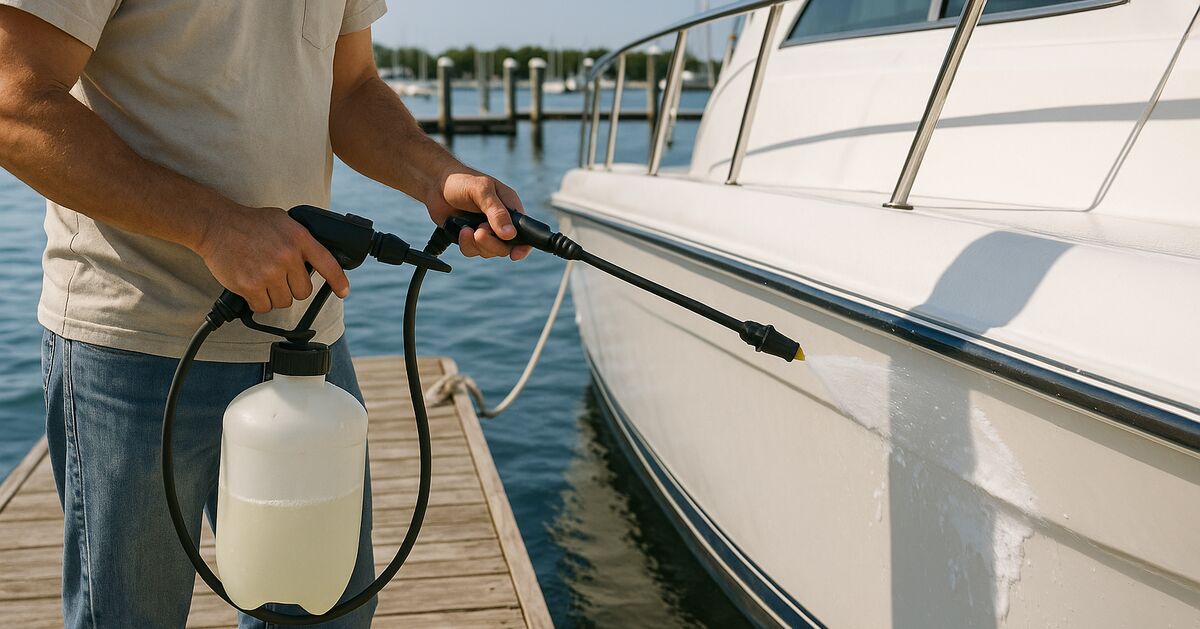
Soft-washing uses very low pressure - typically under 100 PSI at the surface, sometimes as low as 40-60 PSI - and relies on the chemistry of the cleaning solution to do the actual work rather than mechanical force. The solution dwells on the surface, breaks the bond between contaminants and the gelcoat, and is then rinsed away with a gentle flow.
Done correctly, soft-washing is close to chemically neutral in terms of gelcoat thickness removal. You are not abrading the surface. You are dissolving or lifting the contaminant layer.
The trade-off is that the chemistry has to be appropriate for fiberglass. A common mistake is using household cleaning products - bleach-heavy mold removers, alkaline degreasers, acidic rust treatments - without checking whether they are safe for gelcoat. Per OSHA's Hazard Communication Standard guidance, all concentrated cleaning chemicals require review of their Safety Data Sheets before use, and that is practical advice, not just regulatory formality: some common household acids will etch gelcoat chemically just as effectively as a pressure washer etches it physically.
Marine-formulated, pH-neutral or mildly alkaline soft-wash products are the standard for professional boat washing. They remove salt residue, oxidation byproducts, light biological film (algae, mildew), fish residue, and atmospheric fallout without attacking the gelcoat chemistry.
For the Sarasota area specifically, there is an additional consideration. Red tide can leave residue on hull surfaces that should be removed carefully. Our post on how red tide residue affects your boat's surfaces after a bloom goes into detail on that, but the short version is that a proper soft-wash with a marine surfactant solution is far better than blasting the residue off with high pressure, which can aerosolize particles you do not want near your eyes and lungs.
Soft-washing limitations worth knowing:
- It will not mechanically dislodge heavy biological fouling - thick algae mats, barnacle bases, or mussel shells need a scraper or brush first, then soft-washing to clean the residue.
- Dwell time matters. Spraying soft-wash solution and immediately rinsing it gives the chemistry very little time to work. Most professional formulations need two to five minutes of dwell time on a shaded, cool surface.
- Rinsing still requires adequate flow rate. Low pressure does not mean a trickle. You need enough volume of clean water to carry the loosened contamination away without it re-depositing.
How the Sarasota environment changes the calculus
Boats on the water anywhere from Longboat Key and Lido Key down through Siesta Key, Casey Key, Nokomis, and Venice face a specific combination of stressors. UV index in Southwest Florida runs among the highest in the continental United States for much of the year, per the EPA's UV Index data. Boats kept in wet slips tend to collect biological growth faster than boats on lifts, and that growth can create conditions that soften gelcoat over time.
What this means practically: boats in this area need more frequent washing than boats kept in northern climates, but they also need gentler washing because the gelcoat is already under elevated UV and chemical stress between sessions. The combination of aggressive sun and aggressive washing accelerates the timeline to visible oxidation and chalking substantially.
Our team covers boat cleaning and detailing in Sarasota and throughout the surrounding keys and communities, and one of the most common things we see on boats that owners have been washing themselves for years is premature surface roughening - not from UV alone, but from the mechanical toll of high-pressure washing compounding on a gelcoat that is already UV-stressed.
Choosing the right method for the job
Here is a practical framework:
Use soft-washing for:
- Routine maintenance washes (every two to four weeks in summer, monthly in winter)
- Topsides, decks, and any painted surfaces
- Canvas, bimini tops, and upholstery surrounds
- Any area where you see existing crazing, stress cracks, or thin/faded gelcoat
- Removing salt film, light biological film, fish residue, and general grime
- Post-red-tide or post-storm cleaning
Use low-to-moderate pressure washing (under 1,500 PSI, 40-degree tip, 18+ inches away) for:
- Initial rinse of heavy bottom growth after a haul-out, before bottom paint inspection
- Heavy mud or silt accumulation on the bottom (not the sides or deck)
- Pre-rinse to knock loose debris before soft-wash application
- Anchor chains, bilge areas, raw aluminum trailer frames, and other non-gelcoat surfaces
Avoid high pressure on:
- Topsides and deck gelcoat in any routine maintenance scenario
- Anywhere the gelcoat is already dull, rough, or chalky (you will accelerate degradation)
- Any surface with visible cracks, crazing, or areas where gelcoat is thin or missing
- Upholstery, canvas, isinglass, teak, and instrument bezels
One variable that people underestimate is nozzle condition. A worn or damaged nozzle concentrates the spray unevenly and can create high-pressure hot spots you do not see coming. If you do use a pressure washer on your boat, inspect the nozzle before each use.
What professional detailers actually do differently
When a professional boat washing service arrives at your dock or lift - whether that is at the Sarasota Marina, Cannons Marina on Longboat Key, or a private lift in Osprey or Nokomis - the first thing an experienced technician does is assess the gelcoat condition before choosing products and methods.
Soft-wash chemistry is matched to what is on the surface. Heavy biological contamination calls for a mildly alkaline product with surfactants and a longer dwell. Light salt and dust calls for a pH-neutral boat soap. Waterline staining from tannins or minerals calls for a mild acid wash applied carefully and rinsed immediately. The method and the chemistry are chosen for the surface condition, not out of habit.
Proper technique also means working in sections, keeping the surface wet during dwell time (which matters on hot days when solutions can dry on the gelcoat and leave residue), rinsing thoroughly from top to bottom, and following up with a protectant - wax, sealant, or ceramic coating - to close the gelcoat pores back up before the next UV exposure cycle.
For a broader look at the full range of boat cleaning and detailing services that go into a proper maintenance program, that page covers what each step accomplishes and why it is sequenced the way it is.
How this fits into a longer-term gelcoat protection plan
A single wash method question sits inside a bigger picture: how do you protect a fiberglass hull's surface over the 10, 15, or 20-plus years you own the boat?
The short answer is that soft-washing regularly enough to prevent heavy buildup, combined with periodic professional compounding and polishing to address oxidation before it goes deep, combined with a wax or coating schedule to keep UV from attacking the raw gelcoat surface, adds up to a hull that looks dramatically better and is worth more at resale.
Oxidation that goes too deep for polishing is a real risk in Southwest Florida's UV environment - our post on how to tell if your boat's oxidation is surface or too deep for wax walks through how to assess that before you invest in a detail or a compound job.
And if you have been skipping post-outing rinses because a full wash feels like too much work every time you go out, the post on what skipping post-outing cleaning does to your gelcoat makes a compelling case for why a five-minute freshwater rinse after every outing is one of the highest-return habits a boat owner can build.
Whether your boat lives at a wet slip on Siesta Key or on a lift behind a home on Bird Key, the right washing method is the one that removes contamination while taking as little gelcoat with it as possible. That is the whole game.
If you want to talk through what your specific hull needs, our frequently asked questions page covers a lot of the most common scenarios, and you are always welcome to get in touch for a no-pressure conversation about what we would recommend for your boat.
Sources & further reading
- UV Index and Sun Safety data by region (U.S. Environmental Protection Agency)
- Fiberglass boat construction and gelcoat standards (American Boat and Yacht Council (ABYC))
- Recreational water quality and harmful algal bloom guidance (U.S. Environmental Protection Agency)
- Marine coatings and surface protection overview (National Marine Manufacturers Association (NMMA))
- Occupational Safety and Health Administration (named in this article) (Occupational Safety and Health Administration)
Claim-by-claim audit (8 checked)
- “Gelcoat is generally a thin layer, and once it wears away, it does not grow back.” (rewritten to what the article can stand behind)
- “Using lower pressure with a wide fan tip held well back from the surface is generally considered gentler on a single wash, though repeated use can still cause wear.” (rewritten to what the article can stand behind)
- “A 2,500 to 4,000 PSI gas pressure washer - the type sold at every big-box hardware store and common in garages around Sarasota County - can visibly etch gelcoat, especially when a …” (reasoning shown in the article)
- “Gelcoat that has heated up in the sun may be softer and more susceptible to impact erosion.” (rewritten to what the article can stand behind)
- “Per OSHA's Hazard Communication Standard guidance, all concentrated cleaning chemicals require review of their Safety Data Sheets before use, and that is practical advice, not just…” (cited → osha.gov)
- “UV index in Southwest Florida runs among the highest in the continental United States for much of the year, per the EPA's UV Index data.” (cited → epa.gov)
- “Boats kept in wet slips tend to collect biological growth faster than boats on lifts, and that growth can create conditions that soften gelcoat over time.” (rewritten to what the article can stand behind)
- “Red tide can leave residue on hull surfaces that should be removed carefully.” (rewritten to what the article can stand behind)