Why your boat smells musty even after a full wash
That stale, damp smell hits you the moment you lift the cabin hatch or open a storage locker, and no amount of scrubbing the hull makes it go away. If you've given your boat a thorough wash and the odor is still there, the wash is not the problem. The source is almost certainly inside, and it requires a completely different approach to address.
This post walks through exactly why musty odors persist, where they actually live on a boat, and what a proper interior detail does that a standard wash simply cannot.
Why a wash doesn't touch the smell
A wash, even a good one, is an exterior process. You're cleaning fiberglass, vinyl, glass, and metal on the outside of the boat. Water and soap are rinsed away before they ever reach the places where odor-causing biology actually grows.
Musty odors on boats are usually biological in origin. Mold and mildew, which are types of fungi, produce volatile organic compounds (VOCs) as they grow and break down organic matter. Those VOCs are what your nose detects as that characteristic musty, earthy smell. Per the U.S. Environmental Protection Agency's guidance on mold, mold can grow on virtually any surface where moisture and organic material coexist, and it doesn't need much of either to get started.
On a boat in Sarasota's climate, the conditions are almost ideal for mold growth. Humidity along the Gulf Coast routinely climbs above 80 percent, especially in summer. When a boat sits closed up in a marina slip in Longboat Key or on a lift in Osprey, warm humid air gets trapped inside. Even a small amount of residual moisture from a previous outing or a rain event is enough to keep mold colonies active in fabric, foam, carpet backing, and the wood or composite surfaces beneath them.
Where mold and mildew actually hide
Understanding why the smell persists starts with knowing where to look. Here are the spots that consistently harbor mold on boats in our area:
- Seat foam and cushion backing. Marine vinyl looks easy to clean, and the surface often is. But vinyl is a skin over foam. When moisture gets under a seam, through a small crack, or in through a zipper, it soaks into the foam and stays there. Foam dries slowly in an enclosed cabin and mold establishes itself in the core of the cushion where airflow never reaches. Wiping the vinyl surface does nothing for the foam underneath.
- Carpet and carpet backing. Many center consoles and cabin boats have carpet in the cockpit or below decks. Carpet traps bait juice, bilge water, rain, and humidity. The pile itself is hard to dry completely, and the rubber or jute backing below it is even harder. Mold in carpet backing is common on boats that sit closed up between trips.
- Bilge and bilge stringers. The bilge is ground zero for moisture. Fuel, oil residue, stagnant water, and organic debris accumulate there. Even if the bilge pump runs regularly, the damp residue left behind in the stringers and around the bilge pan feeds mold and mildew growth continuously. The smell from a neglected bilge can permeate an entire cabin.
- Storage lockers and compartments. Anchor lockers, bow storage, and under-seat compartments trap humid air. Wet lines, damp life jackets, and fishing gear left inside are reliable sources of organic material for mold to feed on. These spaces often don't get wiped down during a standard wash.
- Headliner and overhead surfaces. In boats with an enclosed cabin or hardtop, the headliner traps condensation. Moisture collects where the headliner meets a wall or hatch frame and drips down into foam backing or runs behind panels.
- Below-deck wood and composite substrates. Older boats especially have wood used as a substrate beneath gelcoat or vinyl flooring. When that wood gets wet repeatedly and doesn't dry fully, it develops mold. You may not see it, but the odor moves through the boat.
- Air conditioning drain pans and ducts. Boats with air conditioning systems have a condensate drain pan that can grow mold if not cleaned regularly. The HVAC duct itself becomes a highway for spreading mold spores throughout the cabin.
What a proper interior detail actually does
A proper interior detail is not a more thorough version of a wash. It's a different process targeting different surfaces with different chemistry and tools. Here's what it actually involves, step by step.
1. Dry extraction and vacuuming
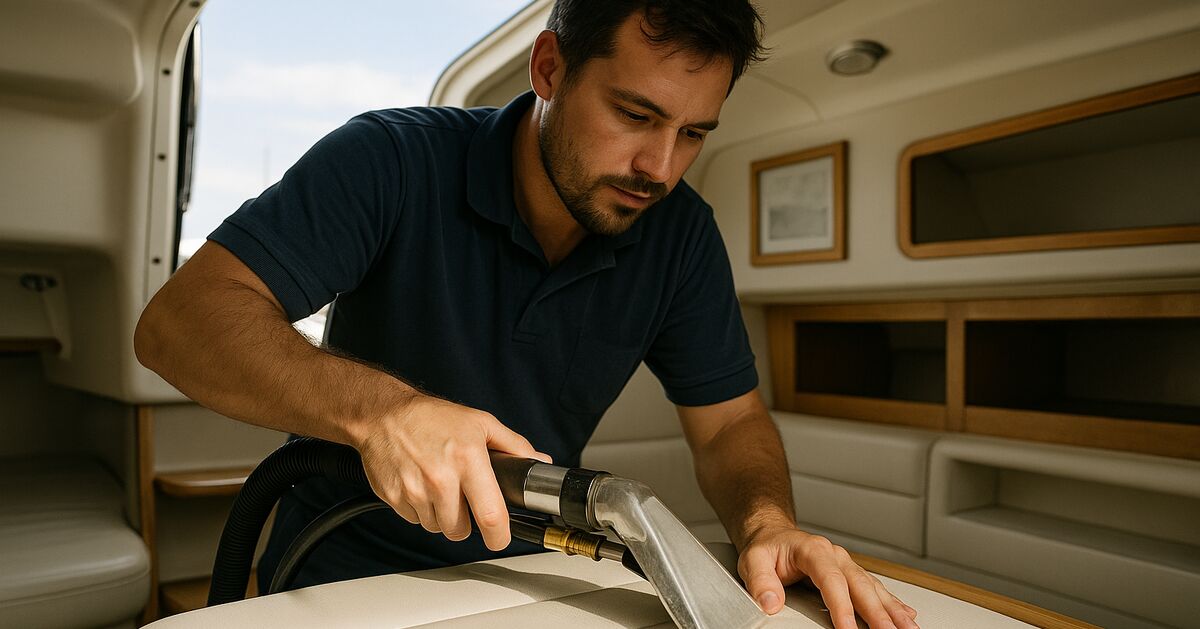
Before any liquid is introduced to fabric or carpet, a proper detail starts with thorough dry vacuuming. This pulls out salt crystals, sand, dried organic debris, and loose mold spores from carpet pile, seat seams, and locker floors. Skipping this step means you're pushing contamination around rather than removing it.
2. Enzyme-based or mold-specific treatment on fabric and foam
The critical step that a wash doesn't include is applying a biologically active cleaner to upholstery and carpet. Enzyme cleaners break down the organic compounds that mold feeds on, addressing the source rather than just masking the smell. Anti-mold treatments go further and address active colonies in fabric fibers. These products typically require dwell time to work, anywhere from several minutes to over an hour depending on the formulation, and they need to penetrate into the material rather than just sitting on top.
For heavily contaminated cushions with foam that's been wet for an extended period, surface treatment may not be enough. The foam sometimes needs to be replaced, or the cushion needs to be sent out for deep extraction cleaning.
3. Thorough wipedown of hard surfaces with appropriate cleaners
Every hard interior surface gets cleaned with a cleaner suited to that material. Vinyl surfaces get a dedicated vinyl cleaner that lifts mold from the texture of the material. Painted or gel surfaces get an appropriate cleaner. Metal surfaces, cup holders, grab handles, and trim pieces all get individual attention. This is the kind of detail work that takes time and doesn't happen during an exterior wash.
4. Bilge cleaning
A proper interior detail includes cleaning the bilge. Oily residue, stagnant water, and organic matter are removed with a bilge cleaner, and the surfaces are wiped down as thoroughly as access allows. A clean bilge can noticeably reduce the odor that migrates up into the cabin. If you've never had your bilge professionally cleaned, the difference in cabin odor afterward is often striking.
5. Locker and compartment cleanout
Every accessible locker and storage compartment is opened, vacuumed, wiped down, and allowed to air out. This includes anchor lockers, storage under seats, and any other enclosed space. These areas are reliably overlooked during routine cleaning.
6. Odor treatment and airflow
After cleaning, the boat benefits from an odor-neutralizing treatment, such as an ozone treatment or a professional-grade odor eliminator applied to the cabin air and surfaces. This is different from an air freshener. A good odor treatment neutralizes the VOCs left behind rather than layering a scent over them. The boat then needs to air out completely before being closed up again.
The Sarasota-area complication: humidity and heat
What makes this especially relevant for boats in our area is the combination of intense UV, high humidity, and warm temperatures year-round. Boats in Sarasota, Siesta Key, Lido Key, and along the Intracoastal toward Nokomis and Venice don't get a cool, dry winter break that might slow mold growth down. The biology keeps running twelve months a year.
A boat that sits closed up at a Bird Key or Casey Key dock between weekend trips is spending five days out of seven in warm, humid, enclosed conditions. That's enough time for mold colonies to reestablish after even a decent cleaning if the root causes aren't addressed.
This is part of why our boat cleaning and detailing services are built around the actual biology of what's happening on Gulf Coast boats, not just what looks clean from the outside.
How often does this need to happen?
For boats used regularly in this climate, a thorough interior detail is worth doing at minimum every season, and for boats used heavily or stored in the water, more frequently. A good maintenance wash program between full details helps control the buildup of organic material that feeds mold. You can read more about how those two approaches compare in our post on one-time detail vs. maintenance wash programs.
If your boat has been sitting closed up for an extended period, for example if you're a seasonal visitor returning to a boat that's been unoccupied, the interior detail becomes a higher priority than anything exterior. The outside might just need a wash. The inside might need a full treatment.
What you can do between professional details
You can't replicate a professional interior detail on your own, but there are habits that slow the problem down considerably.
- Leave hatches cracked open when the boat is docked safely and the weather allows it. Airflow is the single most effective tool against mold growth.
- Never store wet gear, towels, or fishing equipment inside a closed locker.
- Rinse the cockpit floor after every outing, including the areas under the seats and around the base of the console.
- Wipe down vinyl seat surfaces after every use, even just a quick pass with a damp cloth. Removing surface salts and organic material before it works into the seams slows mold at the source.
- Run a small desiccant dehumidifier in the cabin if the boat sits closed up for extended periods. These are inexpensive and can help keep interior humidity low enough to slow mold growth.
- Check the bilge regularly and pump it dry after any rain or heavy spray.
These habits don't eliminate the need for a professional interior detail, but they meaningfully extend the time between treatments and keep the odor from becoming severe between visits.
Don't confuse a clean exterior with a clean boat
A common frustration we hear from boat owners across our Sarasota service area is that their boat looks great from the dock but smells terrible the moment they step aboard. Those two things are not in conflict. The exterior and the interior are separate systems with separate problems, and they need separate solutions.
If your boat has a persistent musty smell, no polish, wax, or exterior detail is going to fix it. The fix is inside, and it takes the right cleaners, the right process, and enough time to do it properly.
For boats with particularly stubborn odor issues, it's also worth reading our related post on getting the mildew and salt out of boat seats and carpet, which covers some of the specific challenges with organic contamination after fishing outings.
If you're ready to stop tolerating a boat that smells like a wet basement, get in touch with us and we'll talk through what an interior detail involves for your specific vessel. We work throughout Sarasota County, from Longboat Key south through Osprey and Nokomis, and we've seen what Gulf Coast humidity does to boat interiors. We know exactly where to look.
You can also browse our frequently asked questions if you want to know more about what to expect before booking a service.
Sources & further reading
- Mold and moisture: where mold grows and what it needs (U.S. Environmental Protection Agency)
- A Brief Guide to Mold, Moisture, and Your Home (U.S. Environmental Protection Agency)
- Volatile Organic Compounds' Impact on Indoor Air Quality (U.S. Environmental Protection Agency)
- Florida Climate Data: humidity and temperature normals for Southwest Florida (NOAA National Centers for Environmental Information)
Claim-by-claim audit (7 checked)
- “Mold and mildew, which are types of fungi, produce volatile organic compounds (VOCs) as they grow and break down organic matter.” (cited → epa.gov)
- “Per the U.S. Environmental Protection Agency's guidance on mold, mold can grow on virtually any surface where moisture and organic material coexist, and it doesn't need much of eit…” (cited → epa.gov)
- “Humidity along the Gulf Coast routinely climbs above 80 percent, especially in summer.” (cited → ncei.noaa.gov)
- “Enzyme cleaners break down the organic compounds that mold feeds on, addressing the source rather than just masking the smell.” (reasoning shown in the article)
- “A clean bilge can noticeably reduce the odor that migrates up into the cabin.” (rewritten to what the article can stand behind)
- “A good odor treatment neutralizes the VOCs left behind rather than layering a scent over them.” (reasoning shown in the article)
- “These are inexpensive and can help keep interior humidity low enough to slow mold growth.” (rewritten to what the article can stand behind)