Why non-skid deck is harder to clean than gelcoat - and how to restore it right
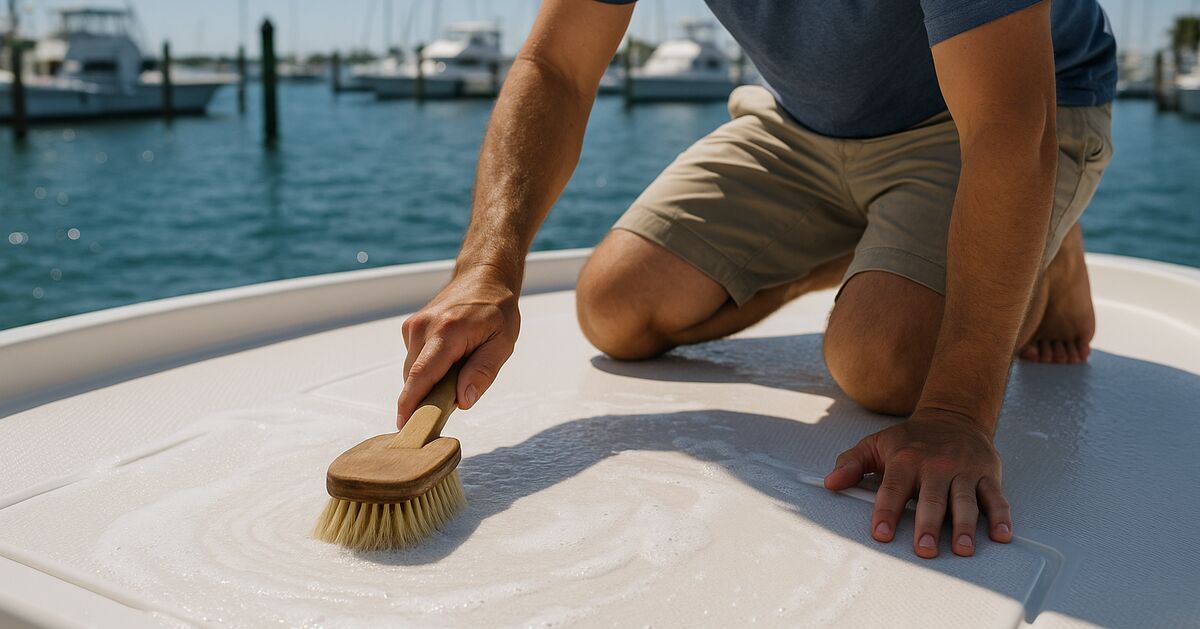
That grayish, ground-in film on your boat's non-skid deck is not just dirt. It's a cocktail of sunscreen, bare-foot skin oils, fish slime, salt crystal residue, mold spores, and oxidized gelcoat - all packed into hundreds of tiny peaks and valleys that were designed to grip your feet but also grip everything else. If you've ever scrubbed a non-skid surface and watched it look almost as bad five minutes later, you already know the problem. The texture that keeps you from slipping overboard is exactly what makes it so stubborn to clean.
This post walks through why non-skid behaves differently from the smooth gelcoat on the rest of your hull, which products to use (and which ones quietly ruin the surface), and the step-by-step technique that actually works - whether you're cleaning a center console in Sarasota, a sportfish on Longboat Key, or a cruiser docked in Venice.
Why non-skid grabs dirt so aggressively
Smooth gelcoat has a relatively flat surface. Soil sits on top of it and water can carry most of it away with a rinse. Non-skid is a different animal. The texture is either molded directly into the fiberglass during the layup process (a pattern stamped into the mold itself) or applied afterward as a sprayed aggregate mixed into paint or gelcoat. Either way, the result is a surface covered in microscopic ridges, bumps, or a crosshatch of raised lines.
Every one of those raised edges is a trap. Dirt slides off the peaks and collects in the valleys. Sunscreen and tanning oils, which are essentially wax-based, fill those recesses and then bake on in Sarasota's heat. Mold and algae anchor into the texture because the rough surface gives them more contact area to cling to. Salt crystals dry inside the pattern and pull moisture out of the surrounding gelcoat over time, which speeds up oxidation.
On a smooth gelcoat surface, a good rinse and a soft wash mitt clear most contamination in one pass. On non-skid, a wash mitt glides right over the tops of the pattern and barely touches the valleys. That's the core mechanical problem, and it's why the right tools matter just as much as the right products.
The mistakes that damage non-skid texture permanently
Before getting into what works, it's worth understanding what quietly destroys non-skid - because some of these are very common.
Pressure washing at high PSI. A pressure washer feels like a fast fix, and a low-pressure rinse to remove loose salt after a day on the water is perfectly fine. But blasting a non-skid surface at high pressure over and over gradually erodes the peaks of the texture pattern and can force water under any adjacent seams or fittings. The surface ends up looking flattened and slightly shiny in areas - and a flattened texture is a slippery one.
Chlorine bleach used too strong or too often. Bleach kills mold and mildew fast, which is why people reach for it. In a diluted form it has a role, but concentrated bleach attacks the gelcoat's resin matrix over time, leaving it chalky and fragile. On a patterned surface where liquid pools in the valleys, the bleach sits in contact with the gelcoat far longer than it would on a smooth surface.
Wax applied to non-skid. This one surprises people. Wax on smooth gelcoat is essential for UV protection and a clean appearance. Wax on non-skid fills the texture pattern, reduces grip, and creates a surface that's actually more dangerous to stand on. If you've ever felt a non-skid area that seemed strangely slick, someone probably waxed it, either accidentally during a hull wax job or intentionally thinking it would "protect" the deck. Choosing the right wax or polish for your boat's surfaces goes into detail on this for hull surfaces, but the rule for non-skid is simple: keep wax off it entirely.
Abrasive pads used dry or with the wrong cleaner. A stiff scrub brush used without enough lubrication can scratch the peaks of the texture into rough, jagged edges that trap even more dirt going forward. The surface ends up looking duller and feeling rougher in the wrong way.
The right products for non-skid deck
You don't need a complicated product list. You need a few things that actually match the chemistry of what you're cleaning.
A dedicated marine non-skid cleaner or a mild boat soap with surfactant. There are products formulated specifically for non-skid, like Star Brite Non-Skid Deck Cleaner or Meguiar's M6332 Marine All Purpose Cleaner, that combine a surfactant to lift oils with mild abrasive particles fine enough not to scratch but effective at getting into the texture. A good marine soap used at a stronger dilution than you'd use for a rinse wash can also work for light maintenance cleaning.
An oxygen-based cleaner for mold and mildew. Products based on sodium percarbonate (sometimes sold as "boat wash with oxygen" or under brand names like OxiClean in marine formulations) release oxygen when mixed with water and break down the organic matter mold feeds on. They're gentler on gelcoat than bleach and work particularly well when allowed to dwell for a few minutes.
Diluted bleach only as a last resort for black mold. If you're dealing with deeply embedded black mildew and an oxygen cleaner hasn't fully cleared it, a solution of one part household bleach to ten parts water can be applied briefly, scrubbed, and then rinsed very thoroughly. Do not let it sit. Rinse twice.
A non-skid deck restorer or UV protectant (not wax). Once the surface is clean, products like 303 Aerospace Protectant applied sparingly can restore the slight sheen that UV-damaged non-skid loses over time while protecting the gelcoat from further UV breakdown - without filling in the texture the way wax does. Apply it lightly, buff with a soft cloth, and avoid buildup in the valleys.
The technique: tools that actually reach the texture
The mechanical side of this job is just as important as the chemistry.
A stiff-bristle nylon brush, not a soft wash mitt. The brush bristles flex down into the pattern valleys and physically dislodge what the cleaner loosens. You want a dedicated deck brush with a medium-stiff nylon bristle - soft enough not to scratch, stiff enough to reach. A short-handled hand brush gives you more control than a long pole brush when you're working a detailed pattern.
Work in small sections. Apply your cleaner to two or three square feet at a time, let it sit for the dwell time the product recommends (usually 2 to 5 minutes), and scrub before it dries. In Sarasota's sun, cleaners can evaporate and the loosened soil can re-deposit if you apply too large an area at once. This is especially true in the summer months when the deck surface temperature can be well above the air temperature.
Scrub in multiple directions. A crosshatch scrubbing motion - first along the pattern, then across it - works soil out of the valleys from two angles. If the texture runs in lines, scrubbing only parallel to those lines leaves the cross-valleys untouched.
Rinse thoroughly with moderate pressure. After scrubbing, rinse with a hose at moderate pressure and a wide-fan nozzle. You want enough flow to flush the loosened material out of the valleys, not enough to blast the surface. Rinse until the water runs completely clear and there's no foam remaining.
Dry before applying any protectant. Let the deck dry fully - ideally in the sun for 20 to 30 minutes - before applying any UV protectant. Trapping moisture under a protectant layer encourages the very mold you just removed.
How to handle heavily oxidized non-skid
On a boat that hasn't been properly maintained for a season or two, or one that lives in Sarasota's sun without any UV protection, the non-skid may be oxidized beyond what cleaning alone can address. Oxidized non-skid looks gray or chalky even after cleaning, and it feels rough and powdery when you drag a finger across it.
For light to moderate oxidation, a dedicated gelcoat oxidation remover (not a polish designed for smooth surfaces) can be worked into the non-skid with a stiff brush. The mild abrasive in the product removes the oxidized outer layer and exposes the healthier gelcoat below. This is slow, physical work on a textured surface, and it's one of the areas where professional help genuinely saves hours of time and prevents mistakes. Our full boat cleaning and detailing services include non-skid restoration as part of thorough deck work.
For severe oxidation where the texture itself has become structurally compromised, a professional assessment is the right starting point. There are limits to what cleaning and restoration products can achieve.
Non-skid on different types of boats
The cleaning challenge varies depending on your boat type and how it's used.
Center consoles and bay boats used for fishing collect the worst combination of contaminants: fish blood, bait oils, sunscreen, and saltwater all mix on the deck surface. These boats benefit most from a thorough rinse immediately after every trip, before any of that material has a chance to bake on. For a deeper look at dealing with fish-related contamination, removing fish blood, bait, and odor from your boat covers the specific steps.
Cruisers and express boats with larger deck areas often have non-skid that goes neglected around the edges and in cockpit corners because those areas don't get foot traffic and don't get noticed. Mold tends to start exactly there. Check the corners and low spots first.
Pontoon boats have a different deck surface altogether, but if you have a pontoon with a rubberized or carpeted non-skid, the cleaning approach shifts significantly. The aluminum tube and deck restoration post covers what's unique about cleaning a pontoon boat's structure.
A realistic maintenance schedule for Southwest Florida
In Sarasota's climate, the combination of UV intensity, heat, humidity, and salt means non-skid degrades faster than it would in a northern freshwater lake. A realistic schedule for most boats:
- After every use: Rinse the deck with fresh water, paying attention to corners and drains.
- Monthly: Full scrub with a marine non-skid cleaner and stiff brush.
- Every 3 to 4 months: Deeper clean with an oxygen-based product for mold control, followed by a light UV protectant.
- Annually: Assess oxidation levels. If the surface is starting to gray or chalk, address it before it requires more aggressive restoration.
Boats kept on lifts on Longboat Key, Bird Key, or Siesta Key still need this cycle. Being out of the water does not protect the deck from UV, heat, or humidity-driven mold.
When to call in professional help
Some non-skid situations are simply too far gone for a single afternoon of DIY work, or the deck area is large enough that doing it properly would take a full weekend. Professional cleaning also removes the risk of choosing the wrong product concentration or scrubbing technique and damaging the texture in a way that's difficult to reverse.
If you're in Sarasota, Osprey, Nokomis, Casey Key, or anywhere else along this stretch of coast and you're not sure where your non-skid stands, our team can take a look and give you an honest assessment. We cover the whole area, and you can see all of our service locations to find the one closest to where your boat lives.
A well-maintained non-skid deck isn't just cleaner looking. It's doing its job - keeping you and your crew on their feet on a wet deck. That's worth the extra effort it takes to clean it properly.