Why your boat's metal fittings are corroding so fast in Sarasota's waters
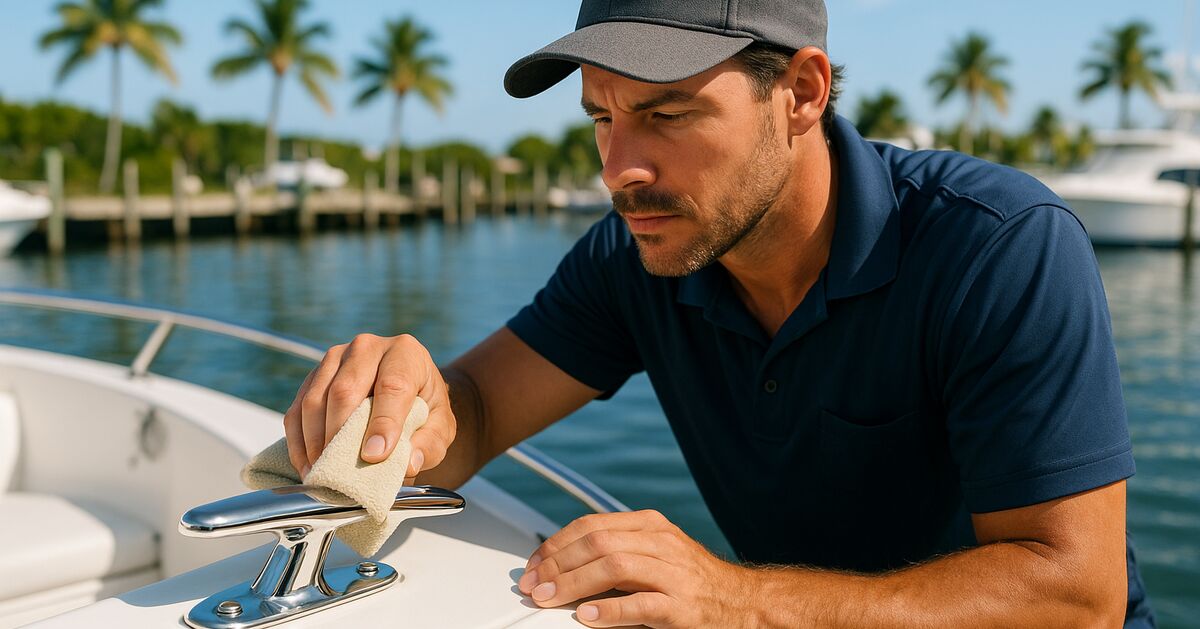
Salt air and 90-degree heat are a slow-motion wrecking crew, and nowhere do they punch harder than on the metal fittings of a boat sitting in Sarasota Bay or anchored off Siesta Key.
If you have noticed rust staining spreading out from your cleats, a chalky white crust building up around your bow rail stanchions, or pitting starting to appear on hardware that looked fine just a season ago, you are not imagining things. Corrosion really does move faster here than in most parts of the country, and there are specific, well-understood reasons for that. More importantly, there are specific things a professional detailer can do to interrupt the process before it costs you hundreds or thousands of dollars in hardware replacement.
Why Sarasota is unusually hard on metal
Most boat owners know that salt water corrodes metal. What surprises a lot of people is how much the form that salt takes matters.
In Sarasota, Venice, Nokomis, and up the coast to Longboat Key, you are dealing with three separate corrosion threats working at the same time.
Airborne salt. The Gulf of Mexico generates fine salt aerosol that drifts inland and settles on every surface of your boat, whether you are out on the water or sitting on a lift in your backyard canal. This salt does not simply wash away with a rain shower. It absorbs moisture from the humid air, stays wet between rainfalls, and forms a thin electrolytic film on metal surfaces. That film is exactly what accelerates oxidation.
High humidity and heat. Sarasota's summer humidity regularly sits above 80 percent, and the water temperature in the bay and inshore passes stays warm nearly year-round. Heat accelerates every chemical reaction, including corrosion. A fitting that might corrode slowly in, say, the Chesapeake, degrades significantly faster here because the electrochemical reactions driving oxidation run at a higher rate when temperatures climb.
Galvanic corrosion in mixed-metal environments. Most boats use several different metals close together: stainless steel cleats, aluminum rails, bronze through-hulls, zinc anodes. When those dissimilar metals are connected through conductive water or even a damp surface, they form a simple battery. The less noble metal gives up electrons to the more noble one and corrodes in the process. In Sarasota's warm, salty, highly conductive water, that current flows freely and eats sacrificial metals faster than most owners expect.
The metals most commonly affected
Stainless steel is often misunderstood. It is not rust-proof; it is rust-resistant, and that resistance depends on a thin passive oxide layer on its surface. Wipe that layer away with an abrasive, trap salt deposits against it, or introduce oxygen-deprived conditions (like a bolt sitting inside a wet fitting), and you get crevice corrosion or the familiar rust staining that bleeds down the hull like a rusty tear.
Aluminum oxidizes quickly and forms a chalky white or gray crust. On its own, aluminum's oxide layer is actually somewhat protective, but when aluminum is in contact with stainless or bronze hardware in a salty environment, galvanic corrosion can pit and weaken it surprisingly fast.
Bronze and brass develop a green-gray patina (verdigris) that many owners mistake for normal aging. Sometimes it is. Sometimes it signals dezincification, a process where zinc leaches out of the brass alloy and leaves behind a weak, spongy copper matrix that looks solid but can crack or fail under load.
Zinc anodes are supposed to corrode, because they are sacrificial, but anodes that are consumed faster than expected are a signal that the galvanic situation on your boat has gotten out of hand and deserves a closer look.
Common mistakes that make corrosion worse
A surprising number of boat owners unintentionally accelerate the problem. A few of the most common errors:
- Rinsing only the deck and forgetting hardware. A quick freshwater rinse after a trip is good. But if you are only hitting the cockpit sole and not flushing around cleats, stanchion bases, and rail fittings, you are leaving concentrated salt sitting in every crevice.
- Using the wrong cleaning products. Harsh acids, bleach-heavy all-purpose cleaners, and abrasive pads all strip the passive layer from stainless steel and remove whatever protective coating remains on aluminum. Once that protection is gone, the base metal is exposed.
- Ignoring crevice corrosion under hardware. Water wicks under base plates and deck fittings and stays there. Without periodic removal and inspection, that trapped moisture becomes a corrosion factory you cannot see until structural damage has already begun.
- Skipping wax and protective coatings on metal. Most boat owners know gelcoat needs wax. Many do not realize that bare metal benefits from the same protective barrier. Without it, airborne salt and humidity make direct contact with the metal surface around the clock.
- Letting rust staining sit. The brown staining that bleeds from a corroding fitting is more than cosmetic. It is iron oxide migrating into your gelcoat or fiberglass. The longer it sits, the more it penetrates and the harder it becomes to remove without aggressive compounds. Our detailed guide on how to get rid of waterline stains on a boat hull in Sarasota covers this specific problem at length, but the short answer is: time is always your enemy with staining.
What a professional detailer actually does about corrosion
This is where the value of professional service becomes concrete rather than vague. A trained detailer is not just polishing things to look pretty. They are interrupting a chemical process, and the steps they take are systematic.
Thorough freshwater flushing with attention to hardware. Every crevice around a cleat, stanchion base, rod holder, and rail fitting gets flushed, not just the flat surfaces. This removes the electrolyte that keeps corrosion running.
Metal-specific cleaning compounds. Stainless steel polish is not the same product as aluminum brightener or bronze cleaner. A professional uses the right chemistry for each metal, which means effective cleaning without stripping the passive layer or causing unintended damage to adjacent materials.
Mechanical polishing of pitted or stained stainless. Light pitting and rust staining can often be reversed with a proper polish and rotary tool, restoring the passive surface and stopping active corrosion in its tracks. This is not something you want to do with a random orbital and the wrong compound, because improper technique can worsen the surface condition.
Protective coatings on metal surfaces. After cleaning and polishing, a quality detail includes applying a protectant suited to each metal type. For stainless, this often means a carnauba or polymer-based metal sealant. Some detailers also apply corrosion-inhibiting products to hidden areas like stanchion bases and under cleats, where trapped moisture does the most damage.
Inspection and honest reporting. A good detailer is often the first person to notice that a cleat base is showing early signs of crevice corrosion, that an aluminum rail section is starting to pit through, or that a through-hull fitting has developed surface cracking. Catching these things early is worth real money in avoided repairs.
Consistent maintenance intervals. Corrosion is not a problem you solve once. It is a process you stay ahead of. Our post on how often you should wash and detail your boat in Southwest Florida explains the recommended cadence in detail, but for a boat kept in the water in this climate, a professional wash every two to four weeks and a full detail at least twice a year is a reasonable baseline.
Does it matter where on the coast you keep your boat?
The general answer is yes, but not dramatically. A boat on a canal off Casey Key is exposed to different conditions than one docked at a marina in Osprey or kept on a lift in a backyard off the Intracoastal near Nokomis. Boats kept in the water full-time accumulate salt deposits on their hardware continuously. Boats on lifts dry out between uses, which slows some forms of corrosion but does not eliminate the airborne salt exposure that causes surface oxidation.
Boats kept under a canopy or in dry storage have the advantage of less direct rain and sun exposure, but the humid air still gets to them. If you are wondering whether your lift-kept boat really needs regular professional attention, the answer is almost always yes, and we go into the reasoning behind that in our post on whether a boat on a lift still needs waxing.
What professional hardware care looks like in practice
When we visit a boat for a full detail, the metal work is a meaningful portion of the job. Here is a rough sequence:
- Pre-rinse. Flush all hardware thoroughly with low-pressure fresh water to dissolve and carry away surface salt deposits.
- Surface inspection. Note any areas of active rust staining, pitting, verdigris, or white oxidation on aluminum before products are applied. This helps choose the right approach for each piece.
- Cleaning. Apply the appropriate cleaner per metal type, agitate in crevices with a soft brush, and rinse completely. Never leave acidic metal cleaners sitting on adjacent gelcoat or vinyl.
- Polishing. For stainless in particular, a proper metal polish applied with a cloth or low-speed polisher restores brightness and, more importantly, re-establishes the passive surface layer that resists future corrosion.
- Protection. Apply a sealant, wax, or corrosion inhibitor appropriate to the metal and its location. Hardware that lives below the waterline or gets submerged on launch needs a waterproof product; topside hardware can benefit from polymer sealants.
- Documentation. Any fitting showing structural concern (deep pitting, cracking, loose base plate) gets flagged for the owner. We are not marine mechanics, but we can tell you when something warrants a closer look from someone who is.
If you want to understand the full scope of what our detailing services cover, that page walks through everything from hull to hardware to interior care.
The cost of doing nothing
Corrosion that goes unaddressed does not stay on the surface. Rust staining works its way into gelcoat and becomes extremely difficult to remove without cutting compounds that thin the gel layer. Pitting deepens and can eventually compromise the structural integrity of a fitting. Galvanic corrosion can eat through an aluminum component from the inside while the exterior looks passable. A through-hull fitting that has been ignored for years is a safety issue, not just a cosmetic one.
Replacing a set of stainless cleats and rail fittings on a mid-size boat can run into the hundreds of dollars in hardware alone, before labor. A consistent detailing program costs a fraction of that and keeps the hardware you have in service far longer.
Getting started is simple
If your boat's metal work has already developed visible staining, pitting, or crusty buildup, the best move is to get a professional assessment before things progress further. Our team covers all of Sarasota County, from Siesta Key and Lido Key down through Longboat Key and the barrier islands. You can see the full list of areas we serve on our service locations page, or reach out directly to describe your boat and what you are seeing.
Corrosion does not take a day off in this climate. But with the right maintenance program, it does not have to win.