Can I stay on board while my boat is being detailed?
Your boat is your space, and handing it over to strangers feels a little odd the first time. It makes complete sense to wonder: do I need to leave, or can I hang around while the work gets done?
The short answer is that you can stay on board for some of it, but there are real, practical reasons why being off the boat for the bulk of a full detail makes the job go better, faster, and safer for everyone. Let us walk through exactly what happens during a detail, where your presence helps versus where it slows things down, and what the smart move is depending on which service you've booked.
What actually happens during a boat detail
Before you can answer the "can I stay?" question, it helps to understand the sequence of work. A thorough detail on a typical center-console or cruiser in Sarasota County moves through several overlapping stages.
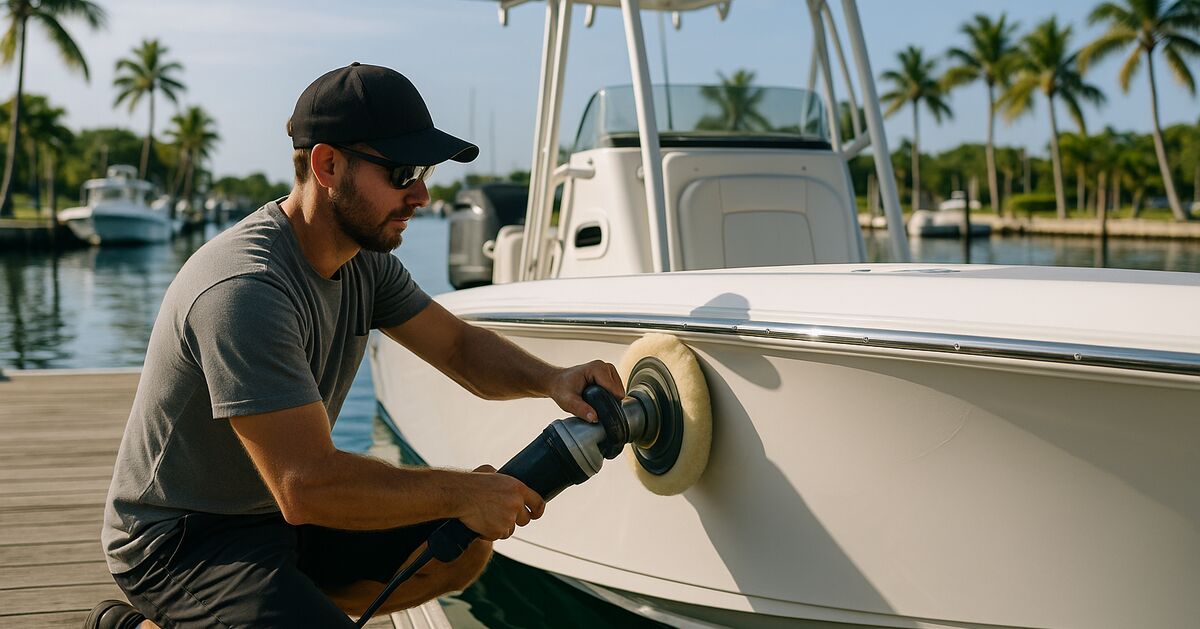
The crew starts with a full freshwater rinse to knock off loose salt, sand, and debris. After that comes a wash-down with marine-specific soap, followed by close work on water lines, cleats, rod holders, and any other hardware that traps grime. If oxidation correction is on the ticket, that means machine polishing with a rotary or dual-action polisher, which generates heat, vibration, and compound mist across a large surface area.
Interior work - wiping down consoles, cleaning upholstery, treating vinyl, vacuuming carpet, scrubbing coolers - often runs parallel to exterior polishing if there are two technicians on site. The job wraps with wax, sealant, or ceramic coating application, a final inspection, and a rinse-off of any product residue.
That whole sequence, for a boat in the 22-to-30-foot range, typically runs three to six hours. Larger vessels or boats with heavier oxidation or mildew take longer. For reference, our frequently asked questions page covers typical timeframes by service type.
The honest case for stepping off the boat
Here is what most crews won't tell you bluntly but quietly wish you knew: a detail goes measurably better when the boat isn't occupied.
Weight and trim. When a polisher is working the bow and someone is sitting in the captain's chair at the stern, the boat sits differently in the water. On floating docks common throughout Sarasota Bay, Siesta Key, and the marina slips on Longboat Key, that shift in trim makes it harder to reach the waterline evenly and increases the chance of compound residue ending up where it shouldn't.
Compound and product mist. Rotary polishing throws a fine mist of compound, sometimes several feet. If you're sitting in the cockpit reading a book, you'll end up wearing some of it. Eye protection is standard gear for the technicians. It shouldn't become a concern for guests.
Fumes from certain products. Vinyl protectants, teak cleaners, and some hull compounds have fumes that dissipate quickly in open air - but in an enclosed cabin, they concentrate fast. The crew will ventilate as they go, but the safest place for people who aren't actively working is off the vessel until the cabin airing period is done.
Workflow and liability. This is a practical one: technicians move quickly around a wet, soapy boat with cords, hose lines, and polisher cords running across the deck. A moving person - even a polite, out-of-the-way one - introduces a slip hazard for everyone. Most professional cleaning crews carry liability insurance, and they'd prefer not to test it on a wet gel coat deck.
When staying is genuinely fine
None of the above means you have to disappear entirely. There are situations where being around works well:
- Exterior wash-only services. If you've just booked a basic wash and rinse rather than a full detail, the job is shorter, there's no compound mist, and sitting in the cockpit while the crew works the hull from the dock is usually no problem at all.
- Handoff and walk-through. The best time to be fully present is at the very beginning. Walk the boat with the technician, point out anything you're worried about (that mystery stain on the port seat, the waterline scale near the transom, the teak that's been graying out), and be there at the end for a final look-over. That 10 minutes on each end is more valuable than hovering in the middle.
- If you live aboard. Liveaboards in the Sarasota area have unique needs, and a good detailing crew will work around you. Just communicate ahead of time so the team can sequence the work - doing the cabin last, for instance, so you have a comfortable space to retreat to.
What to tell the crew before they start
Good communication at the start of any service saves time and prevents misunderstandings. Here are the things worth mentioning before the first hose goes on:
- Any sensitive finishes. If you've had the hull wrapped, if there's a fresh paint job on the hardtop, or if you have custom graphics anywhere, say so. Not every product that's safe on standard gelcoat is right for a vinyl wrap.
- Electronics and open hatches. Let the crew know if any hatches have compromised seals or if there's sensitive electronics in a compartment that tends to get wet. A good team will ask, but you know your boat.
- Preferred products or sensitivities. Some owners want only non-silicone wax, or have a preference for a particular vinyl conditioner because it works with their upholstery color. Say it up front rather than after the product is already on.
- Where you'll be. If you're stepping off, leave a phone number and tell the crew how to reach you if they find something unexpected - a deep scratch under the waterline grime, a bimini seam that's pulling, a hatch that won't dog down properly.
A note on Sarasota County's specific conditions
The environment here is genuinely hard on boats. Salt air, intense UV from May through September, afternoon thunderstorms that leave mineral deposits, and warm water that accelerates algae and barnacle growth on hulls all combine to make maintenance a real discipline rather than an occasional gesture.
If your boat lives in the water at a slip - at Sarasota, Bird Key Yacht Club, the marinas off Longboat Key, or anywhere between Nokomis and Venice on the ICW - hull fouling happens faster than most owners expect. In-water hull cleaning and what bottom growth actually does to your speed and fuel economy is worth understanding if you haven't already.
For boats on a lift or dry storage, the gelcoat takes the brunt of the punishment instead. Oxidation starts earlier than you'd think, especially on vessels that sit uncovered in direct sun. We've written a full breakdown of what causes oxidized and chalky gelcoat and how the correction process works if you want the details.
The point is: the Gulf Coast climate means the service intervals that work in, say, New England simply don't apply here. Our boat cleaning and detailing services are built around that reality.
What a full detail looks like from the outside (so you know it's going right)
If you do step off for the main part of the work and come back midway, here's what a proper job in progress looks like:
The hull should have distinct sections at different stages - one panel freshly polished and gleaming, adjacent panels still showing compound haze, the waterline area getting close attention with a smaller pad or by hand. That uneven look mid-job is normal and actually a sign of methodical work. You want the crew moving in deliberate sections, not rushing a buffer across the whole boat in one pass.
The interior, if it's being done in parallel, should show products sitting on surfaces doing their job rather than being wiped on and immediately wiped off. Vinyl conditioner needs a minute of dwell time. Mildew treatment on seat seams needs longer. If a technician is moving too fast through the interior, the chemistry doesn't have time to work.
For a deeper look at how mildew and salt embedded in upholstery and carpet actually gets removed, our post on cleaning boat seats and carpet covers the process step by step.
The question behind the question
Most people asking "can I stay on board?" are really asking something slightly different: "Can I trust these people with my boat?"
That's completely fair. A boat is expensive, personal, and often represents years of investment. The answer is to do what you'd do with any service professional: ask questions before booking, understand what's included in the service, and be present at the start and end of the job.
Our team works throughout Sarasota County - from Siesta Key and Lido Key to Casey Key, Osprey, and Nokomis - and the same standard applies at every dock: we tell you what we're going to do, we do it, and we show you the result before we pack up.
If you have a specific concern about your boat's condition or a service you're not sure about, reach out before you book. A quick conversation about what your boat actually needs, given where it lives and how it's used, is always worthwhile and costs nothing.
A quick checklist before your detail appointment
To make the whole thing smooth, here's what to do in the day or two before a crew arrives:
- Remove personal gear, tackle boxes, fishing rods, and anything loose from the cockpit and cabin. A clutter-free boat is faster to work on.
- Empty and dry out any coolers.
- Note any specific problem areas you want the crew to focus on.
- Confirm where the crew will have water access and whether there's dockside power available.
- Plan to be present for the walk-through at the start and the final inspection at the end.
- If you're booking for the first time and want to understand what different service tiers include, browse our full list of services first so you can have an informed conversation.
The bottom line: you don't have to disappear, but giving the crew space to do methodical, high-quality work is usually the best thing you can do for your boat. A great detail isn't just about effort - it's about the conditions in which that work happens.