Choosing the right boat wax or polish for fiberglass vs. painted hulls in Sarasota
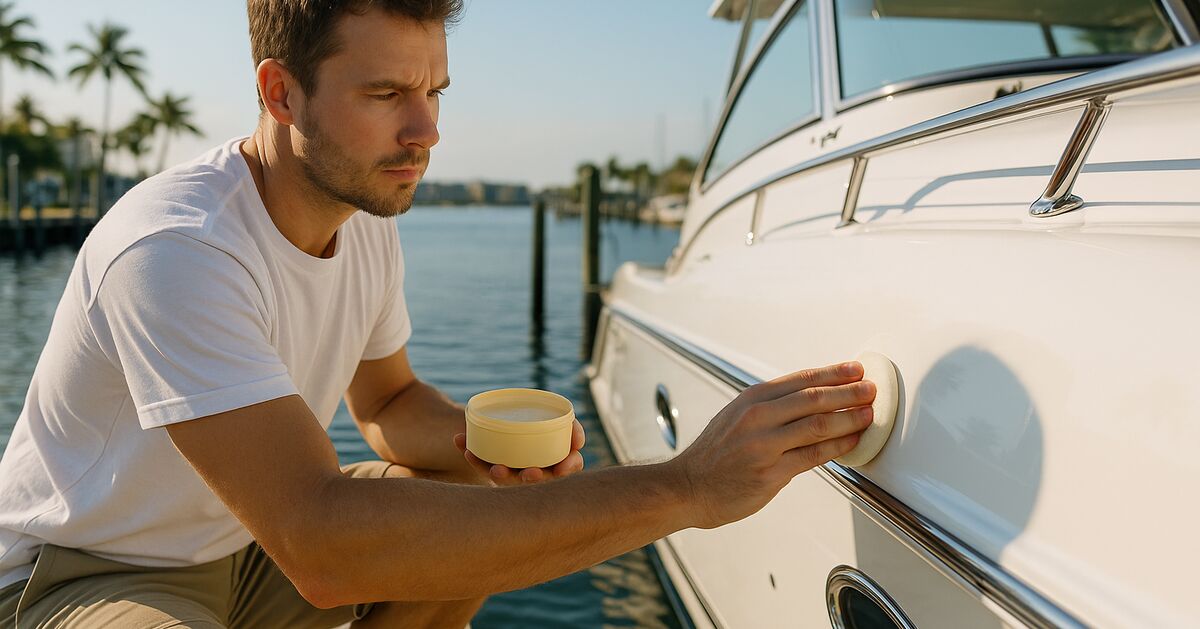
Walk through any marina on Longboat Key or pull up to the fuel dock at Sarasota's marina district on a bright July morning, and you'll see the full spectrum of hull finishes: gleaming white gelcoat, mirror-like Awlgrip topcoats, faded chalky sides that have clearly been ignored for a season or two. The products that made those good-looking hulls shine are not all the same, and reaching for the wrong one can cost you far more than a wasted Saturday afternoon.
Sarasota's Gulf Coast environment is genuinely demanding. Salt spray settles on every surface even when you're not running. UV index values here rival anything in the Caribbean for much of the year. Water temperatures stay warm enough to accelerate oxidation, and the daily cycle of heat, humidity, and afternoon thunderstorms means a hull finish goes through real stress year-round. Picking the right wax or polish is not about brand loyalty or what was on sale at the marine store. It's about understanding what your hull is actually made of and what the local conditions will throw at it.
Fiberglass gelcoat vs. painted hull: why the difference matters
Gelcoat is not paint. It is a thick, pigmented resin layer applied directly over the fiberglass laminate during the boat's original construction. It has no separate primer beneath it, and it is relatively porous compared to modern two-part paints. When UV radiation and salt exposure break it down over time, the surface oxidizes, turning chalky and dull. (If you've already seen that stage on your boat, our post on oxidized, chalky gelcoat: what causes it and how it gets fixed walks through the restoration process in detail.)
Painted hulls, by contrast, have a factory or professional spray finish over the fiberglass substrate. Common systems include single-part linear polyurethane (like Interlux Toplac or similar brands) and two-part catalyzed polyurethanes (Awlgrip, Alexseal, and comparable finishes). Two-part paints cure to an extremely hard, chemically cross-linked film. That hardness is what makes them gorgeous, but it also makes them easy to permanently scratch if you use the wrong abrasive on them.
The practical takeaway: the product that works beautifully on your neighbor's gelcoat hull can permanently dull or microscratch your two-part painted hull, and vice versa. Knowing which surface you have is the first step before you open any container.
How to figure out what your hull surface actually is
On most production boats built before the mid-2000s and many built since, the hull is raw gelcoat. If the boat came from the factory with a bright, solid color and you've never had it repainted, you're almost certainly dealing with gelcoat.
Signs you have a painted finish:
- The hull has an unusually deep, almost wet-looking gloss (common with two-part polyurethane)
- There is visible texture from spray application if you look at a low angle in raking light
- The boat was professionally refinished at some point and you have documentation
- Metallic flake colors or custom color-matched finishes are nearly always painted
When in doubt, you can do a simple fingernail test in a hidden area: gelcoat is relatively soft and will show a faint mark from a firm thumbnail drag. A hard two-part polyurethane finish will resist this noticeably. Your boat's original documentation or a call to the manufacturer can also confirm the factory finish type.
Polishes, waxes, and sealants: what each one actually does
These three terms get used loosely, but they describe genuinely different products with different jobs.
Polish contains abrasives, ranging from very fine to moderately coarse. Its job is to remove a thin layer of oxidized or contaminated surface material, leveling out minor scratches and restoring clarity. Polish does not protect on its own. Think of it as the preparation step.
Wax lays a sacrificial protective layer over the clean surface. Traditional carnauba wax provides a warm, natural-looking gloss and is gentle on virtually all finishes, but it breaks down relatively quickly in UV-intense environments like Sarasota. Expect carnauba to last two to four months on a boat that lives in the sun.
Polymer sealants (sometimes called synthetic waxes) bond more tenaciously to the surface through chemical adhesion rather than just sitting on top. They typically last longer than carnauba, often six months or more, but the gloss character is slightly different. Many boaters and detailers layer a polymer sealant as a base and top it with carnauba for the best of both worlds.
Ceramic coatings occupy a different tier entirely and are worth a separate conversation. If you're curious whether that level of protection makes sense for your Gulf Coast boat, it's a question worth exploring with a professional who knows the local conditions.
The right approach for fiberglass gelcoat
Gelcoat is forgiving enough to tolerate a range of abrasive levels, which gives you options when the surface has seen some neglect. Here is a logical sequence:
Step 1: Assess the oxidation. Run your palm across a dry section of hull. If it comes away with white or chalky residue, you have surface oxidation and need to start with a polish or compound before waxing. Light oxidation responds to a fine polish; heavy chalking needs a medium-cut compound. If the surface is already reasonably clean and smooth, you may be able to go straight to wax.
Step 2: Choose an appropriate compound or polish. For gelcoat, products designed for marine fiberglass work best because they are formulated for the specific chemistry and porosity of gelcoat. 3M, Meguiar's Marine, Star Brite, and BoatLIFE all make well-regarded compound and polish lines. Avoid automotive compound formulas on heavily oxidized gelcoat as they may not have the cut needed for the thicker oxidation layer common on marine gelcoat.
Step 3: Apply a quality wax or sealant. Carnauba products like Collinite 885 or Meguiar's Marine Wax work well and are easy to correct if you make an error. Polymer sealants like Star Brite Premium Marine Polish with PTEF provide longer durability. In Sarasota's climate, a sealant base topped with a carnauba finish coat is a practical combination that balances protection and appearance.
Step 4: Think about frequency. A gelcoat hull that sits uncovered on a lift at a Siesta Key home, exposed to full afternoon sun, will need more frequent attention than one kept in a covered rack. Our deeper guide on how often you should wash and detail your boat in Southwest Florida covers this question thoroughly.
The right approach for painted hulls
Two-part polyurethane finishes require more careful product selection. The payoff is exceptional gloss and durability. The risk is that an overly aggressive abrasive will cut through the thin clear coat or create fine scratches that scatter light and kill the gloss permanently.
Rule one: avoid anything labeled "heavy-cut compound" or "rubbing compound" on a two-part finish. These are appropriate for gelcoat restoration and automotive clear coat, not for the thinner, harder film of a professional marine topcoat.
Use products specifically labeled for two-part or LPU (linear polyurethane) paints. Awlgrip makes its own polish and wax line (Awlcare, Awlbrite) specifically formulated for its topcoats. Alexseal has a corresponding care system. These are not marketing upsells; the chemistry is genuinely different, and using the matching product line reduces the risk of hazing.
Single-part painted finishes (softer, more like thick enamel) sit between gelcoat and two-part in terms of hardness. A fine polish designed for gelcoat is generally safe on single-part paint, but always test in an inconspicuous area first.
Waxing a painted hull: Carnauba is safe on virtually all cured paint finishes and is the gentle choice if you are uncertain. Apply thin coats, buff before it fully hazes, and use a clean, soft applicator. Microfiber applicator pads generate less friction heat than foam for hard painted surfaces.
Never use a rotary buffer at high speed on a two-part paint without professional experience. The combination of heat and abrasion from an aggressive rotary pass can cut through the finish before you realize what's happening. A dual-action (DA) polisher is far more forgiving for DIY work.
Saltwater-specific considerations that affect every hull in Sarasota
Salt contamination changes how products bond and how long they last. Before applying any wax or polish, the hull must be genuinely clean, not just rinsed. Salt crystals left on the surface act as micro-abrasives during the polishing process and can also prevent sealants from bonding properly.
A proper wash-down with a quality boat soap (pH-neutral, not dish soap, which strips existing wax aggressively) removes the salt film. Pay attention to the waterline area, where salt and biological staining concentrate. Waterline staining is its own challenge, and if you're dealing with persistent marks in that band, the dedicated guide on how to get rid of waterline stains on a boat hull in Sarasota covers the specific steps.
UV accelerates wax degradation faster than most product labels suggest, because those labels are written for average conditions. Sarasota, Venice, and the barrier islands receive intense solar radiation from roughly March through October, and the angle of the sun during those months hits a hull's topsides and deck almost perpendicularly during midday. Budget for more frequent maintenance cycles than the product instructions recommend.
Common mistakes that shorten the life of any wax job
- Applying wax in direct midday sun: the product dries too fast to bond and buff out evenly. Work in the shade, early morning, or after the sun drops.
- Using too much product: a thin, even coat bonds better than a thick one. More product just means more buffing effort.
- Skipping the polish step on a dull or lightly oxidized surface: wax cannot restore clarity through oxidation. It seals in the dullness.
- Washing with dish soap before waxing: yes, it cleans the hull, but it strips everything including any remaining protection, and it can leave a residue that interferes with bonding.
- Ignoring the deck and cockpit surfaces: horizontal surfaces take even more UV than the hull sides and benefit from protection just as much.
When to call a professional
Some situations are genuinely beyond the reach of DIY maintenance, not because the task is impossible, but because the risk of an expensive mistake is high.
Heavy oxidation on a large hull (anything over 30 feet) is labor-intensive work that benefits from professional equipment and experience. Two-part paint correction on a boat with a competition-level paint job is a case where the cost of a professional detail is well below the cost of repainting a section. And if you're not certain what finish your hull has, a professional can assess it before any product touches the surface.
Our full range of boat cleaning and detailing services includes hull polishing, waxing, and oxidation correction for both gelcoat and painted hulls across Sarasota Bay, the intracoastal, and the Gulf-side marinas on Lido Key, Bird Key, and Casey Key. We work across the area covered on our locations page, from Osprey and Nokomis in the south up through Longboat Key in the north.
If you have questions about what your specific hull needs before booking, our FAQ page covers many of the common product and process questions, or you're welcome to get in touch directly for a straightforward conversation about what you're dealing with.
The bottom line is simple: fiberglass gelcoat and painted hulls live in the same saltwater and sun, but they age differently and need different care. Matching the product to the surface and the local conditions is what separates a wax job that lasts through a full Sarasota season from one that washes away by the Fourth of July.