How to get rid of waterline stains on a boat hull in Sarasota
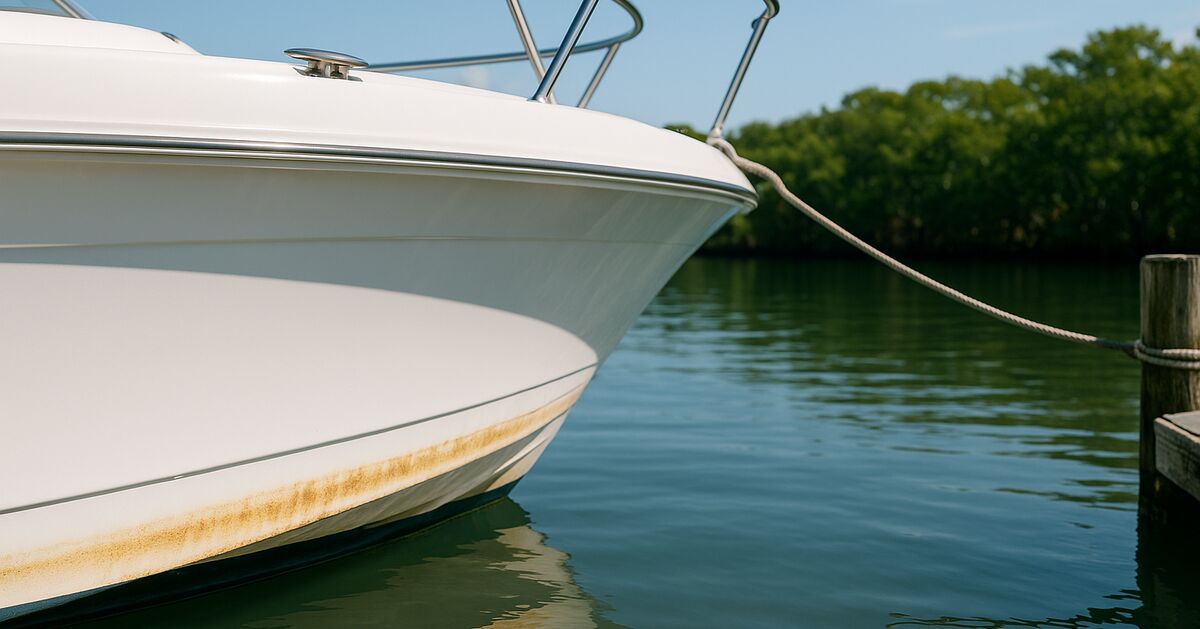
That ugly ring sitting right at your boat's waterline is one of the most common complaints we hear from boat owners all along the coast, from Longboat Key down through Nokomis and Venice. It looks like neglect, but it isn't. It's actually chemistry, and once you understand what's causing it, you'll know exactly what it takes to remove it and keep it from coming back so fast.
What actually causes waterline stains in Sarasota's waters
The waterline is the narrow band where your hull spends its time bouncing between above the surface and below it. That transition zone takes a beating from multiple directions at once.
In Sarasota Bay, Little Sarasota Bay, and the inshore waters around Siesta Key, Lido Key, and Bird Key, the water is not pure ocean saltwater. It's a mix of saltwater pushed in from the Gulf of Mexico and freshwater draining from the watershed inland. That brackish mix carries a cocktail of things that cling to your hull.
Tannins. Mangroves line almost every shoreline in this region, and they leach tannins into the water year-round. Tannins stain fiberglass the same way tea stains a mug, leaving a brownish-yellow film that becomes harder to remove the longer it sits.
Iron and mineral deposits. The water and even some marina water supplies contain iron and other dissolved minerals. When water evaporates repeatedly at the waterline, those minerals get left behind as rust-colored streaks or spots. Owners often think this is rust from hardware, but in many cases the iron is coming right out of the water itself.
Diesel and oil residue. Busy marinas and anchorages around Sarasota, Osprey, and Casey Key see a lot of boat traffic. Fuel and oil floating on the surface get pushed against hulls and settle right at the waterline, leaving a dark, greasy ring.
Algae and biofilm. Even a boat that comes out of the water regularly can develop a thin layer of algae or biofilm at the waterline, especially during the warmer months when water temperatures in our area stay high. This often shows up as a greenish-black stripe.
Salt creep and oxidation. Pure salt crystals left behind by evaporating spray can trap other contaminants and accelerate gelcoat oxidation, making the stain appear chalky or dull rather than just discolored. If you want a deeper look at that process, our post on oxidized, chalky gelcoat: what causes it and how it gets fixed walks through the science in detail.
Why the stain keeps coming back so quickly here
Many boat owners clean their waterline once and then feel frustrated when it returns within a few weeks. The Gulf Coast climate almost guarantees this will happen. We have warm water, abundant sunlight, high humidity, and heavy boating activity. Tannin-rich bay water, intense UV, and organic growth all work together to redeposit staining material faster than it does in cooler or less bioactive environments.
The type of stain also matters for how fast it returns. A tannin stain on bare, unprotected gelcoat will reappear very quickly because the porous surface gives it something to grip. Once a proper protective layer is in place, the same tannin has a harder time bonding and wipes off much more easily at the next cleaning.
The right approach for each type of stain
There is no single waterline product that handles every stain, and using the wrong one wastes time and can damage your gelcoat. Here is how to match the treatment to the problem.
For tannin and organic stains (the brown or yellow ring): Oxalic acid based cleaners are the go-to here. Products formulated for fiberglass waterline cleaning that list oxalic acid as the active ingredient will break down tannin bonds without being excessively harsh on gelcoat. Apply with a soft brush or sponge, let it dwell for the time listed on the label, and rinse thoroughly. Do not let it dry on the surface.
For mineral and iron stains (rust-colored spots or streaks): These need an acid that specifically targets mineral deposits. Phosphoric acid based hull cleaners work well. They are stronger than oxalic acid products, so rinse completely and neutralize with a baking soda and water solution if the label recommends it. Never use undiluted muriatic acid on gelcoat. It will etch and permanently dull the surface.
For oil and fuel residue (dark, greasy ring): A degreaser designed for marine use applied before any acid cleaner is the right sequence. Getting the oil off first lets the acid cleaner reach the actual stain underneath. Dish soap is not a good substitute here because it leaves a residue and is not formulated for the concentration of contamination you see at a marina waterline.
For algae and biofilm (greenish or blackish stripe): A diluted bleach solution or a marine-specific mildew remover will kill and lift algae. Use it carefully, rinse well, and follow with a proper hull cleaner to address any residual staining underneath. Keep bleach away from any metal fittings nearby.
The tools that actually make a difference
Good chemistry does most of the work, but the right applicator helps you avoid unnecessary effort and surface damage.
- A medium-bristle brush on a short handle lets you work the product in without scrubbing too aggressively.
- Melamine foam pads (the white eraser-style pads) are surprisingly effective on light tannin staining and don't scratch gelcoat.
- A polishing pad on a random-orbit polisher is needed after chemical cleaning if the stain has been there long enough to bond into the gelcoat surface itself. Chemical cleaners alone won't fully restore the color in that case.
- Nitrile gloves and eye protection are non-negotiable when working with acid-based hull cleaners. This isn't overly cautious. These products can burn skin quickly.
What to do after the stain is gone
Removing the stain is only half the job. Leaving the gelcoat bare guarantees the stain comes back just as fast, or faster, because the freshly cleaned surface is more porous and more receptive to contamination.
After cleaning and rinsing completely, the waterline area needs to be protected. The options range from a traditional carnauba paste wax to a synthetic polymer sealant to a ceramic coating. Wax is the easiest entry point. It's forgiving to apply, buffs off cleanly, and gives you a good slick surface that sheds tannins more easily. The tradeoff is that wax in our Gulf Coast heat and UV environment typically lasts a few months before it needs to be reapplied.
Synthetic sealants last longer, and a properly applied ceramic coating can protect the waterline for considerably longer than either. If you want to understand whether a wax-only approach is enough for your situation, our boat washing and detailing frequency guide for Southwest Florida covers the maintenance schedules that make sense for different use patterns.
Can you handle this yourself, and when should you call someone?
Mild waterline staining on a boat that gets cleaned regularly is something many owners can manage themselves with the right product and 30 to 45 minutes of effort. The challenge comes when:
- The stain has been building for a season or more and is now bonded into the gelcoat.
- The area involved is large, such as a longer hull where doing it by hand becomes exhausting.
- The gelcoat underneath is already showing signs of oxidation, meaning the cleaning needs to be paired with compounding and polishing to restore the appearance properly.
- The boat is in the water at a slip and you can only reach the waterline from a dock or dinghy, which makes consistent, even application very difficult.
In those situations, trying to power through it yourself often results in an uneven result, wasted product, or accidental damage to trim and rubber seals if a strong acid runs where it shouldn't. Our team handles waterline stain removal as part of our full boat cleaning and detailing services and can assess on the spot whether chemical cleaning alone is enough or whether light compounding is also needed.
What to expect from a professional waterline cleaning
When a professional handles waterline staining, the process typically goes: rinse, degrease, apply appropriate acid cleaner with dwell time, agitate with a brush, rinse thoroughly, assess the result, repeat or move to mechanical polishing if needed, then protect the surface with wax or sealant.
The difference between a professional result and a DIY result usually comes down to product selection, dwell time management, and the follow-up protection step. Many owners clean the stain, feel satisfied, and skip the protection. Then they're back at it in a month.
Pricing for waterline cleaning specifically varies based on hull size, severity of staining, and whether compounding is needed. For a general sense of how detailing services are priced in our area, see our breakdown on how much boat detailing costs in Sarasota County.
Local specifics worth knowing
If your boat sits in a slip in one of the marinas around Sarasota or spends time anchored near the mangroves off Casey Key or Nokomis, expect tannin staining to be your primary adversary. These waters are particularly rich in organic matter.
If you keep your boat at a dry storage facility and splash regularly, your waterline staining is more likely to be mineral and salt-related because you're getting repeated cycles of immersion and drying without the constant tannin exposure. The treatment approach is the same, but the product priority flips: lead with a mineral remover rather than an organic stain remover.
Boats kept on lifts still get waterline staining, particularly the part of the hull that sits at the waterline during loading and unloading. If you assumed a lift excuses you from this maintenance, it's worth reading about whether boats on lifts still need regular waxing and protection.
We serve boat owners throughout the Sarasota area, including Longboat Key, Siesta Key, Lido Key, Bird Key, Osprey, Nokomis, Venice, and the Sarasota mainland. If you're not sure what's causing your specific waterline staining or you want a professional to take a look, the easiest step is to get in touch for a free assessment. We can usually identify the stain type just from a photo and tell you what to expect before we ever show up at your dock.
The bottom line
Waterline stains in Sarasota's brackish and saltwater environment are a facts-of-life maintenance issue, not a sign that something has gone badly wrong. The key is matching the right cleaner to the right stain type, doing the cleaning before the stain has a chance to bond deeply into the gelcoat, and always following up with protection so the next stain takes longer to form. Stay on top of it every couple of months and it stays manageable. Ignore it for a season and it becomes a compounding or polishing job instead of a simple cleaning.