Does my boat really need waxing if I keep it on a lift?
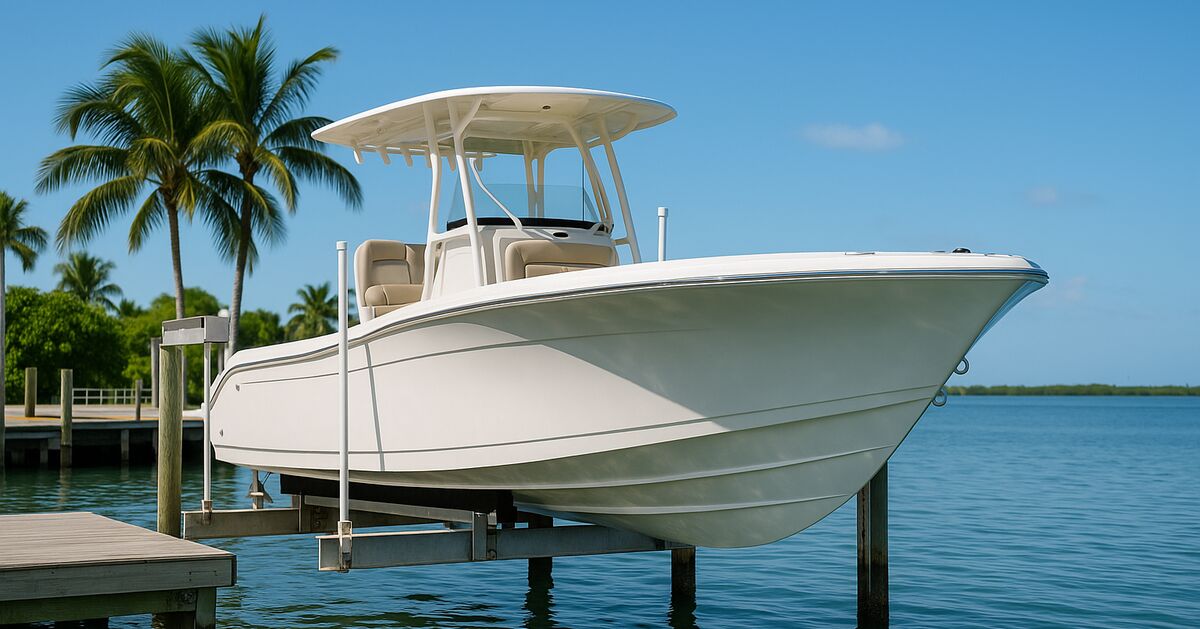
Keeping a boat on a lift feels like the responsible thing to do, and it absolutely is - but a surprising number of lift owners also believe it lets them skip waxing entirely. The logic sounds reasonable: the hull never sits in the water, the bottom stays dry, so what's the point? The honest answer is that a lift solves one problem while leaving several others wide open, and on the Gulf Coast, those other problems are relentless.
What a lift actually protects you from
A boat lift does a genuinely excellent job at a few specific things. It keeps the hull out of salt water between trips, which dramatically slows the growth of barnacles, algae, and other bottom foulers. If you've ever had a boat sitting on a mooring in Sarasota Bay or Blackburn Bay and pulled it out for the season, you know exactly how fast marine growth can take hold - sometimes in a matter of weeks. A lift essentially removes that threat for the hull below the waterline.
A lift also reduces the risk of waterline staining, the stubborn brown ring that forms where a hull sits at the surface. That line can be brutally difficult to remove without compounding, and preventing it is far easier than fixing it.
So yes, a lift earns its keep. But here's the problem: while the hull sits high and dry, everything above the waterline is fully exposed to the environment around it - and in Sarasota County, that environment is genuinely harsh.
The real enemies: sun, heat, and salt air
Southwest Florida runs on sunshine, which is wonderful for boating and brutal for gelcoat. UV radiation is the single biggest cause of oxidation on a fiberglass hull. It breaks down the resin in the surface layer, causing that chalky, dull, flat appearance that makes a boat look years older than it is. If you'd like a deeper look at exactly how that process works, our post on oxidized, chalky gelcoat: what causes it and how it gets fixed walks through the chemistry in plain language.
A boat on a lift in Sarasota, Siesta Key, Longboat Key, or anywhere else along the county's coast is sitting in direct Florida sun, often for days at a time between outings. The gel coat has no shade, no protection, and no barrier unless you've applied one.
Salt air is the second issue. Even when your boat isn't in the water, the air around it is loaded with fine salt particles, especially if you're docked near the Intracoastal, the Gulf, or any of the passes. That salt settles on every surface - fiberglass, stainless, aluminum, vinyl, and glass. Over time it etches and corrodes, and on a hot hull that has been baking in the afternoon sun, it can bond to the surface faster than you'd expect.
Heat is the third factor. Surfaces on a Florida boat can reach temperatures that would surprise you on a clear summer afternoon. That kind of sustained heat accelerates the breakdown of any surface coating, which means even good wax doesn't last quite as long here as it would in a cooler climate.
What wax actually does for a boat on a lift
Wax serves as a sacrificial barrier between the gel coat and all three of those forces. When UV hits a properly waxed surface, it hits the wax first. When salt air settles, it settles on a smooth, sealed surface rather than the porous gel coat itself. When heat cycles happen day after day, the wax absorbs some of that stress so the gel coat underneath doesn't have to.
Without wax, the gel coat takes all of that directly. Over a season or two, the result is visible: a chalky, oxidized surface that has lost its gloss and its depth. At that point you're not waxing anymore - you're polishing and compounding to remove the damaged layer, which takes more time, more product, and more labor. Prevention is considerably cheaper than restoration.
A properly applied marine wax on a lift-stored boat in Sarasota County will typically last somewhere between two and four months before it needs to be refreshed. That timeline shortens in summer when UV intensity and heat are at their peak, and can stretch a bit in the milder months of late fall and early winter. If you're wondering how that fits into a broader maintenance schedule, our guide on how often you should wash and detail your boat in Southwest Florida lays out a practical cadence for this climate.
But what about the hull below the waterline?
This is where lift owners do catch a genuine break. If your boat lives on a lift and only goes in the water for trips, you don't need antifouling bottom paint refreshed on the same schedule as a boat that's always wet-slipped. The hull bottom stays clean much longer.
That said, "longer" doesn't mean "forever." If you leave the boat in the water for an extended stretch - a vacation cruise, a week tied up at a marina in Venice or Nokomis - growth can start accumulating on the hull faster than you'd think. And even lift-stored boats accumulate grime on the lower hull from splashing water, run-off, and the occasional partial submersion during retrieval. An occasional hull cleaning is still good practice.
For boats in wet slips, the stakes are higher and more immediate. Our breakdown of in-water hull cleaning and how bottom growth costs you speed and fuel is worth reading if you split time between a lift and a slip, or if you're thinking about changing your storage situation.
Common mistakes lift owners make
Skipping wax because the boat "looks fine." Gelcoat can look acceptable to the naked eye while already losing its UV protection. By the time the chalking is obvious, significant oxidation has already occurred. A gloss meter or a simple hand test (run your palm across a dry surface - if it comes away with a white powdery residue, it's oxidizing) tells the real story.
Washing with the wrong soap. Some owners grab whatever dish soap or household cleaner is nearby. These strip wax aggressively, which means even a freshly waxed boat can be left unprotected after a single wash with the wrong product. Marine-specific wash soaps are formulated to clean without stripping.
Ignoring the canvas and vinyl. The seats, the Bimini top, and any upholstered surfaces are baking in that same Florida sun. Vinyl conditioner and UV protectant should be part of the regular routine, not an afterthought. Salt air and mildew work on those surfaces too, particularly in the seat seams and around any stitching. If mildew is already a concern, our article on getting the mildew and salt out of boat seats and carpet covers the right approach.
Letting water spots sit. On a boat that's being retrieved from the water regularly, water spots from salt water can etch into the gelcoat and glass if they're left to dry repeatedly in the sun. A quick fresh water rinse after each outing, even just a five-minute hose-down, makes a real difference.
Waiting for the annual detail to do everything. One thorough detailing per year is better than nothing, but in this climate it's not really sufficient for a boat that goes out regularly. Think of it more like maintenance on any other piece of equipment: small, regular attention prevents the large, expensive fixes.
What a professional detail on a lift-stored boat looks like
When a professional comes to service a lift-stored boat, the process typically covers the full exterior: a thorough hand wash to remove salt, oxidation residue, bird droppings, and water spots; a clay bar treatment if the surface has embedded contamination; machine polishing if there's any oxidation present; and a wax or sealant application to restore the barrier. Stainless fittings and rails get polished and protected. Glass gets cleaned and treated. Vinyl gets conditioned.
The interior gets attention too: carpet, upholstery, the helm area, cup holders, storage compartments. Details that owners often overlook because they're not visible from the dock.
The full scope of what's included in a professional detail is worth reviewing if you haven't before - our boat cleaning and detailing services page outlines exactly what we do and why each step matters.
Is waxing different depending on where you're docked?
In broad terms, the UV and heat exposure is similar across the county, but location does influence a few things. Boats docked on the open Gulf side of barrier islands like Siesta Key, Lido Key, or Longboat Key can see heavier salt air exposure than those tucked into more sheltered bay-side canals. If you're on the Gulf-facing side of one of the keys, refreshing your wax protection a little more frequently is a reasonable precaution.
Boats in the marina communities around Osprey, Nokomis, and Venice tend to sit in somewhat more sheltered water, but UV exposure is essentially the same everywhere under a Sarasota County sky.
We work with boats across the county and know the local conditions well. You can see all the areas we cover on our service locations page.
How to get started
If you're not sure what condition your boat's gelcoat is actually in, or you haven't had it professionally detailed in more than six months, a quick inspection is the right first step. We're happy to take a look and give you an honest assessment with no obligation.
If you have questions before reaching out, our FAQ page answers many of the things people ask most often. And when you're ready to schedule, the easiest way is through our contact page.
A lift is a smart investment. A little wax a few times a year makes sure your boat actually looks like one.